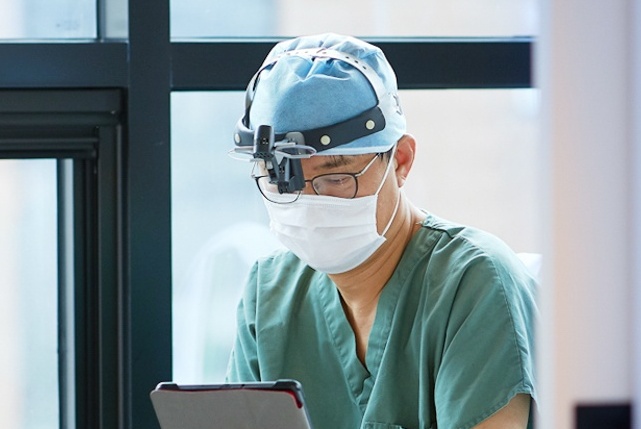
Hello. I am Ahn Byung-jun, director of Ahn Byung-jun Plastic Surgery.
I occasionally meet people who feel confused after initially inquiring about double eyelid surgery and being advised to undergo ptosis correction as well.
You may have thought that creating the eyelid crease would be enough, so being told that ptosis correction is also necessary can naturally make you worry that the scope of surgery is becoming more extensive.
You may also feel concerned that the procedure is being expanded beyond what is necessary simply because your eyes appear droopy.
However, in actual consultations, there are quite many cases in which the desired appearance can be achieved with double eyelid surgery and upper canthoplasty alone, without ptosis correction.
Why double eyelid surgery alone may not be enough
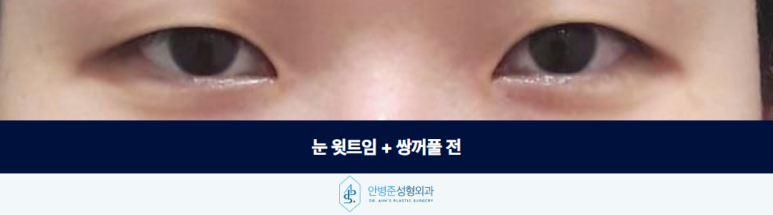
No matter how clearly the crease is defined, the starting point of the crease may appear narrow if the skin around the inner corner of the eye is thick and covers the area.
In particular, if the inner corner is structured so that an epicanthal fold surrounds the inner eye area, the double eyelid crease may appear to stop partway along the eye.
If a new crease is created on eyes like these, the outer portion may look more open, but the inner corner can still feel congested.
For this reason, combining the procedure with upper canthoplasty to refine the skin around the inner corner can allow the crease to flow naturally from beginning to end.
Of course, this requires expertise in carefully adjusting the skin and crease structure.

Not everyone whose eyes appear droopy needs ptosis correction
When the inner corner is covered and the upper eyelid area is thick, the eyes can easily give an overall droopy or sleepy impression.
In some cases, ptosis correction is recommended based only on this outward appearance, with the condition diagnosed as reduced levator muscle function—in other words, ptosis.
However, in practice, it is more common for the levator muscle function to be normal and for the eyes to appear droopy because of excess skin and fat. This is known as pseudoptosis.
If you have pseudoptosis, it may be possible to create a less droopy-looking eye shape with double eyelid surgery and upper canthoplasty alone, without performing ptosis correction that involves the muscle.
On the other hand, performing ptosis correction when it is not necessary can only lengthen the recovery period and may lead to overcorrection, making the eyes look unnaturally large.
Criteria for determining whether ptosis correction is truly necessary
Eyes that appear droopy and genuinely weak levator muscle function are two different issues.
These can be distinguished by checking the degree of eyelid drooping while the forehead is held still and examining how much strength the levator muscle actually produces.
If this evaluation shows normal levator muscle function, double eyelid surgery and upper canthoplasty alone are sufficient in most cases, without ptosis correction.
Conversely, if there is a clear habit of excessively using the eyebrows and the levator muscle is genuinely weak, ptosis correction may be considered as well.
In other words, the need for ptosis correction should not be determined solely by visible drooping. Separately checking muscle function is the standard for deciding whether the procedure is necessary.
When double eyelid surgery and upper canthoplasty are performed together
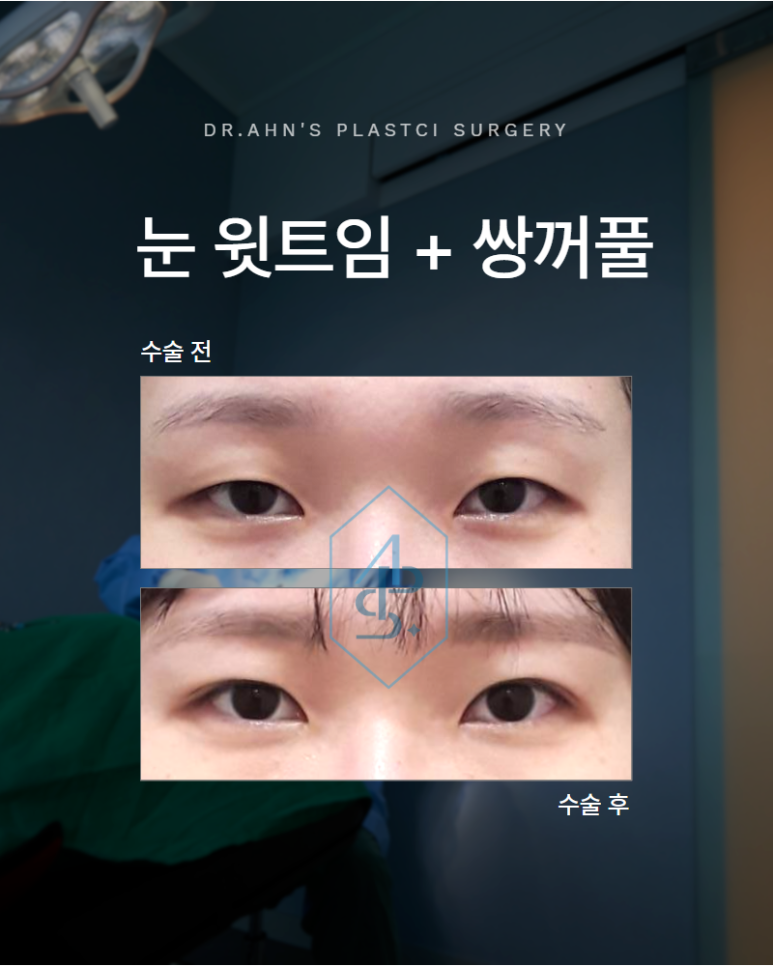
This was a case confirmed to involve pseudoptosis, so the procedure was performed without ptosis correction.
It is important to align the designs of the double eyelid crease and upper canthoplasty based on the reference line.
Because the muscles are not manipulated, the recovery burden is relatively light, and the swelling often subsides relatively comfortably.
Immediately after surgery, swelling remains around both the inner corner and the crease area, so the overall appearance may seem somewhat more pronounced.
After one to two weeks, the initial swelling begins to settle, and the crease and incision line at the inner corner gradually become visibly connected in a natural way.
After about one month, the overall eye shape generally stabilizes, while the scar at the inner corner gradually fades over time.
Not every case in which the eyes appear droopy requires ptosis correction.
If you have pseudoptosis with normal levator muscle function, the eyes can look much more open with double eyelid surgery and upper canthoplasty alone.
By first evaluating muscle function separately, it may be possible to avoid expanding the surgery to include procedures that are not actually necessary.







Previous image
Next image