Hello. I am Dr. Ahn Byung-jun, director of An Byung-jun Plastic Surgery.
Some people visit for a consultation because their eyes do not look open and refreshed.
They often describe a lingering sense of heaviness or congestion.
When we look into the cause, it is often related not only to the eyelid crease but also to the structure around the inner corner of the eye.
That is why upper canthoplasty is often discussed alongside double-eyelid surgery.

Even with a crease, covered inner corners can make the eyes look heavy
Even when the crease is clearly defined, thick skin around the inner corner can make its starting point look narrow.
This is why the outer part may look open and refreshed while the inner part retains an impression of being somewhat pressed down.
In many cases, simply revising the crease does not resolve this heaviness.
That is why upper canthoplasty may also be considered.

Changes that upper canthoplasty adds to the crease
Upper canthoplasty is a procedure that removes excess skin in the upper inner-corner area where the double-eyelid crease begins.
Opening this area allows the crease to continue naturally and without interruption from the inner corner to the outer corner.
The overall appearance of the eyes can also become more open and defined.
Rather than changing the width or shape of the existing crease, the concept is to create space so that the crease can begin properly.
When planning a first double-eyelid surgery, the structure of the inner corner is assessed first to determine whether both procedures should be performed together from the outset.
If there is already sufficient space at the inner corner, double-eyelid surgery alone may be enough. However, if the area is covered by thick skin, designing upper canthoplasty together with the surgery from the beginning may produce a more natural result.
Conversely, in cases where a crease already exists but only heaviness around the inner corner remains, upper canthoplasty can be added while leaving the existing crease unchanged.
Because a new crease does not need to be created in this case, the recovery burden is generally relatively low.
Points to consider when performing the procedures together
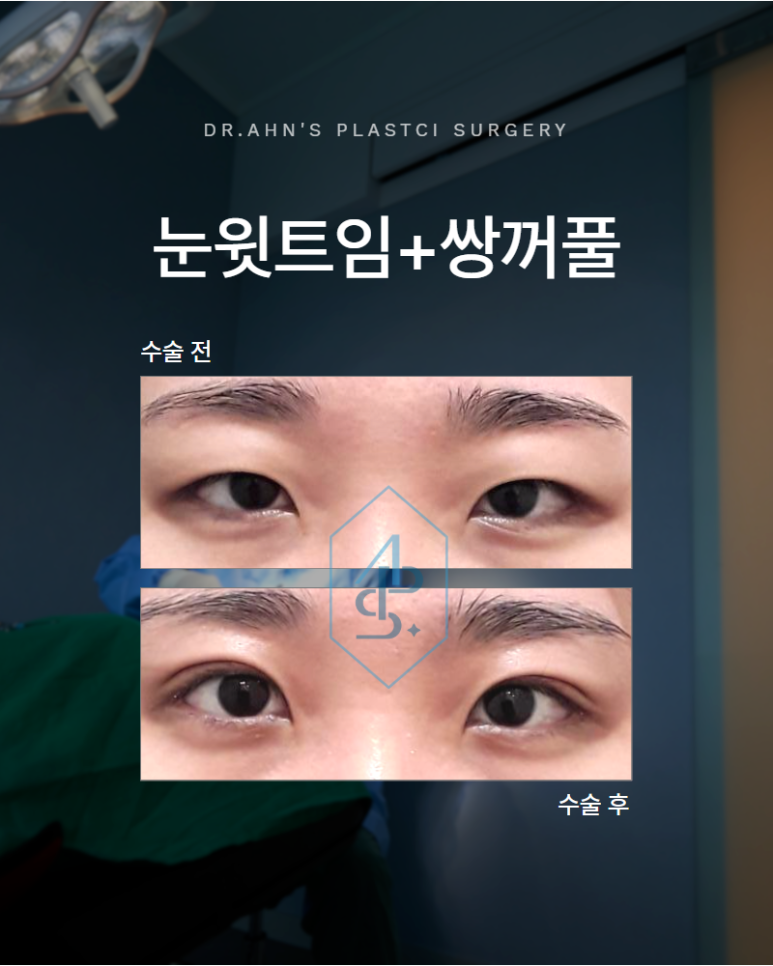
As in the following case, when double-eyelid surgery and upper canthoplasty are performed on the same day, the crease and the incision line at the inner corner must be aligned along a single reference line.
The inner corner should be addressed first, followed by positioning the starting point of the crease, so that the two lines connect naturally.
If this order is not properly coordinated, an awkward boundary may remain between the crease and the incision line.
For this reason, it is important to plan both procedures together as part of an overall design from the initial planning stage.
Changes observed during recovery
Immediately after surgery, swelling may remain around both the inner corner and the crease, making the eyes appear somewhat more pronounced.
After about one to two weeks, the initial swelling subsides, and the crease and inner-corner incision line gradually begin to look more natural.
Around one month after surgery, the overall appearance of the eyes generally stabilizes, while the scar at the inner corner gradually fades over time.
If your eyes do not look open and refreshed, I recommend having the structure of the inner corners carefully examined as well.
Whether upper canthoplasty is needed or double-eyelid surgery alone is sufficient depends on the amount of excess skin covering the inner corner.
Consider creating a natural-looking eye shape through a plan designed by an experienced board-certified plastic surgeon.





Previous image
Next image