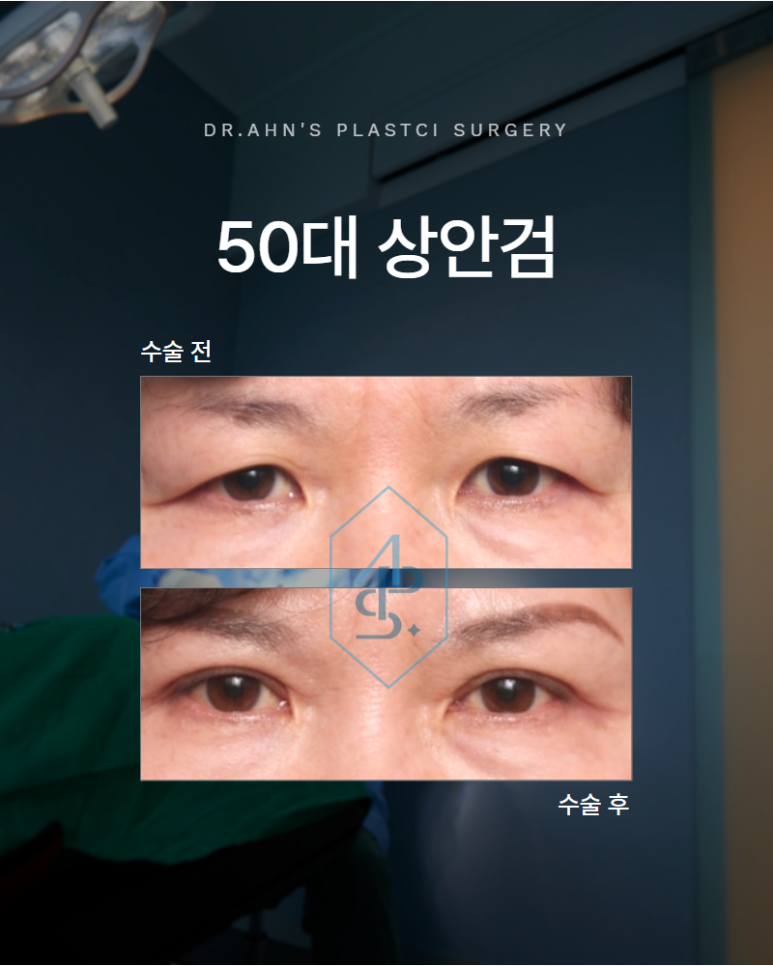
Hello. I am Dr. An Byung-jun, director of An Byung-jun Plastic Surgery.
Some people who visit the consultation room have made the appointment themselves, while quite a few come in after their children made the appointment for them.
Some tell us that they looked into upper blepharoplasty in their 50s as a birthday gift or as a gesture of appreciation for all their hard work over the years.
In actual consultations, there are many cases in which upper blepharoplasty can help both functionally and in terms of appearance.
So today, I will summarize some information that may be helpful for those considering upper blepharoplasty after their 50s.

Why Do Droopy Eyelids Become Particularly Noticeable in Your 50s?
When you are young, drooping eyelids often do not cause much discomfort, even when they begin to develop.
However, once you reach your 50s, skin elasticity visibly decreases, and the degree of drooping tends to worsen as well.
As part of your field of vision becomes obstructed, simply opening your eyes can feel uncomfortable. If you continually strain your forehead and eyebrows to compensate, your facial expressions may gradually become more rigid.
Each time you look in the mirror, you may appear tired and more stern, while your concerns about your appearance naturally grow as well.
For this reason, many people in their 50s seek upper blepharoplasty not simply because they want to look younger, but because opening their eyes itself has become uncomfortable.

What Is the Difference Between Upper and Lower Blepharoplasty?
Blepharoplasty is divided into upper and lower blepharoplasty according to the location of the eyelid being treated.
Upper blepharoplasty removes excess, drooping skin from the upper eyelids, while lower blepharoplasty addresses the fat and skin beneath the eyes.
Upper blepharoplasty in your 50s is mainly performed when lax skin on the upper eyelids obstructs the field of vision or makes the eyes look heavy and closed in.
For opening the eyes to feel more comfortable, it is necessary to assess and address not only the lax skin but also the drooping muscles and excess fat in an overall manner.
During this process, creating an overly pronounced crease can make the result look unnatural.
Therefore, it is important to form a soft, natural crease suited to the reduced elasticity of the skin.
Recovery Is Different from That of Younger Skin
After your 50s, the skin regenerates at a different rate compared with that of people in their 20s and 30s.
Even with the same upper blepharoplasty procedure, recovery may take longer, and the time it takes for swelling and bruising to subside can vary considerably from person to person.
That is why I explain this in advance, starting at the consultation stage before surgery.
You should allow ample time for recovery when making your plans. This can help reduce the discomfort associated with having to return to your daily routine too quickly.
The Recovery Process Is as Follows
Immediately after surgery, swelling and bruising may make your appearance feel somewhat unfamiliar.
After about one to two weeks, the initial swelling gradually begins to subside.
Around the one-month mark, many people notice that their eyes have stabilized and that their field of vision feels more open.
Afterward, the scars also gradually fade, blending into the eyelid creases, and your appearance settles into a natural look.
Upper blepharoplasty in your 50s can improve not only cosmetic concerns but also functional discomfort when opening the eyes.
However, because skin regeneration is different from that of younger people, it is important to allow sufficient time for recovery when making your plans.
Please consult with a board-certified plastic surgeon to determine the approach that is right for you.






Previous image
Next image