You’ve probably heard of Botox at least once, right?
It is used in various ways,
from improving forehead wrinkles and square jaw lines
to managing the trapezius muscle,
and it is a procedure many people are seeking.
However, there are still many questions such as,
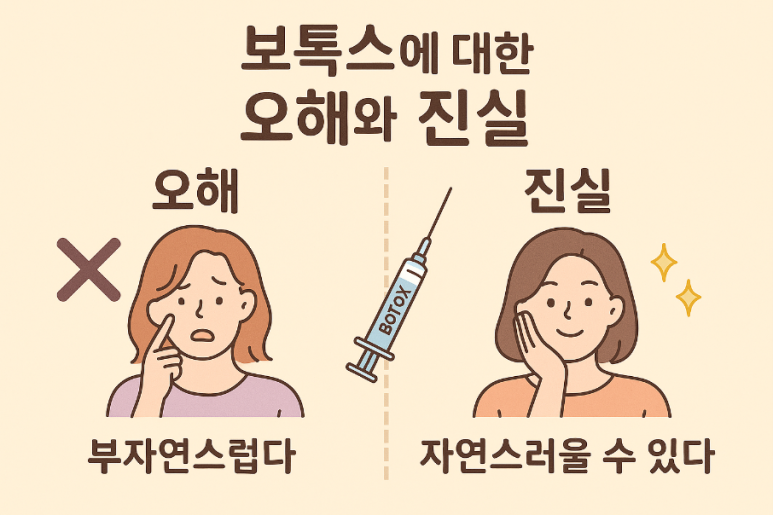
“Will my face look stiff?”
“Can you get addicted to Botox?”
Today, we’ll clear up these misunderstandings
and also summarize the points you should know
before and after the procedure.
Q. Does Botox make your facial expressions stiff?
A. A stiff-looking expression can happen
when the dose is too high,
or when the injection site is not appropriate.
If the procedure is tailored to each person’s facial muscles
and administered in the correct amount,
you can maintain natural expressions
quite well.
Q. Is Botox addictive?
A. Medically speaking, Botox is not something you become
“addicted” to.
However, because the effect gradually wears off
and returns to the previous state,
people may feel like they want to keep maintaining it.
It is often chosen as part of ongoing care.
Q. Can Botox be done anywhere?
A. Absolutely not.
Whether genuine products and the correct dosage are used,
and the skill of the medical staff,
have a major impact on the results.
Using non-genuine toxins or low-cost procedures
can actually increase the risk of side effects,
so caution is needed.
✅ Botox Procedure Before-and-After Checklist
💬 Pre-procedure checklist
- Be sure to tell the medical staff
whether you have recently taken antibiotics or muscle relaxants
→ Medications you are taking
can unexpectedly amplify Botox’s effects,
so for a safe procedure,
you must inform them in advance.
- If you are pregnant or breastfeeding,
postponing the procedure is recommended
→ Because safety for the fetus
has not been sufficiently proven,
it is wise to block any possible risk
in advance.
- Avoid heavy drinking, smoking,
and strenuous exercise before and after the procedure
→ When you drink alcohol, blood vessels dilate,
and blood flow increases.
As a result,
the treated area is more likely to bruise
or swell more severely.
It can also trigger immune or inflammatory reactions,
which may interfere with recovery.
→ Smoking constricts blood vessels
and reduces the supply of oxygen and nutrients.
It delays recovery in the treated area
and increases the possibility of bruising,
inflammation, and infection.
→ If strenuous exercise raises your body temperature
and increases blood flow immediately after the procedure,
there is a risk that botulinum toxin may spread
to adjacent areas.
- Avoid saunas and jjimjilbangs
for at least two days
→ High-temperature environments increase blood flow,
which can cause Botox to spread to other areas
and worsen side effects such as bruising or swelling.
During the first 1–2 days, when the treated area is stabilizing,
minimizing stimulation is the most important thing.
💬 Post-procedure precautions
- On the day of the procedure,
don’t lie down or lie face down
- To prevent the medication from spreading
- Do not massage or rub hard
- The effects begin to appear gradually
after 3–7 days,
and after 2 weeks,
the effects settle in stably.
Botox is not always an "artificial"
or "obvious" procedure.
If you understand it properly
and receive the procedure properly,
you can achieve natural,
high-satisfaction results.
If you are considering the procedure,
please be sure to check whether the clinic uses genuine products
and whether there is sufficient consultation.
A small investment in yourself
can come back as great confidence.