If you are not satisfied after eye surgery
or are experiencing functional discomfort,
you may consider revision blepharoplasty.
�a0
However, revision surgery is more complex
and requires a delicate approach,
so choosing the right timing, understanding the
recovery process, and having thorough
consultations with a trusted medical team are essential.
�a0
Because revision surgery is performed after tissue has already been damaged once,
it is more difficult than the first surgery.
�a0
Therefore, beyond simply changing the line,
more complex procedures may be needed,
such as releasing adhesions and
supplementing insufficient tissue.

When to Consider Revision Surgery
Proper timing
It is generally recommended to determine whether revision surgery is possible
after at least 6 to 12 months
after the first surgery.
However, depending on the patient's condition, it may be delayed further.
�a0
Why is enough time needed?
🔻 Stabilization of swelling and scarring
Immediately after surgery, swelling and scars remain,
making it difficult to accurately judge the final result.
As time passes, the swelling goes down
and the scar tissue becomes softer,
which allows the areas that need revision
to be identified and planned more accurately.
�a0
🔻 Recovery of tissue
It takes a considerable amount of time for skin and tissue
damaged by surgery to fully recover.
�a0
If surgery is performed again before the tissue has properly healed,
the risk of side effects increases,
and the surgical outcome may also
not be good.
�a0
🔻 Flexibility depending on the patient's condition
The recommended period is only
a general average,
and depending on an individual's recovery speed or condition,
a decision to undergo revision surgery may need to be made later.
�a0
In particular, if there has been inflammation or other complications,
it is safer to allow a longer
recovery period.

Common Reasons to Consider Revision Surgery
👉 Aesthetic reasons
Asymmetry in the double eyelid line,
line position (too high or too low),
an overly thick or unnatural line,
a sunken appearance caused by over-removal, etc.
�a0
👉 Functional problems
Difficulty closing the eyes,
worsening ptosis (drooping eyelids),
worsening tearing/dry eye, etc.
�a0
👉 Complications / aftereffects
Excessive scarring, adhesions,
ectropion caused by over-removal, etc.
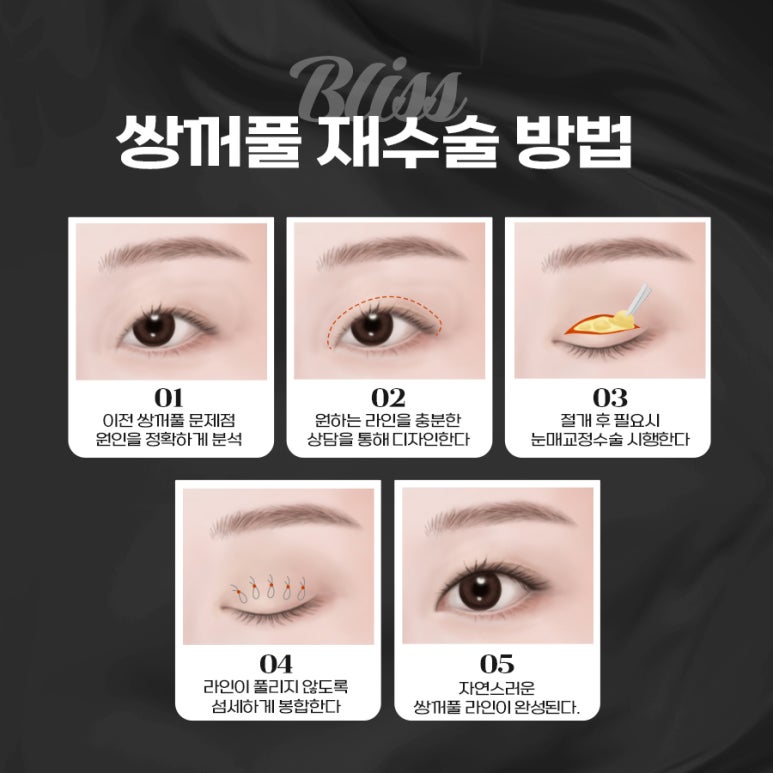
Surgical Methods by Revision Type
The eye condition must be diagnosed and the problem accurately identified,
then the surgical method should be selected according to the cause.
The cause is addressed, and a personalized design is carried out by considering
the patient's individual preferences and desired outcomes.
�a0
Incisional method � Incisional method
Along the existing incision line,
scar tissue is removed and the line is
recreated.
�a0
Non-incisional � Incisional or non-incisional
If the line has loosened, it can be fixed
with an incision,
or if it has become slightly faded, it can
be refixed with the non-incisional method.
�a0
✨ Combined ptosis correction
If there is a drooping eye shape or a functional problem,
ptosis correction is often performed together.

Preparation Before Revision Surgery
Before planning revision surgery,
thorough preparation is necessary.
�a0
🔷 Sufficient consultation
Clearly organize the parts you were dissatisfied with after the first surgery
and communicate them to the medical team.
�a0
🔷 Preoperative tests
Check for ptosis, dry eyes, skin laxity,
and scar condition to determine
the feasibility and method of revision surgery.
�a0
🔷 Progress photos
Bringing before-and-after photos from the previous surgery
can be very helpful for the medical team
when comparing and analyzing.
Revision eyelid surgery is a high-difficulty procedure that must consider
not only aesthetic improvement,
but also functional issues and tissue recovery.
�a0
If you prepare carefully with enough time and information,
you can expect a more satisfying result.