
Many people want to make a positive impression for various reasons such as interviews, meetings, dating,
and social life.
Among plastic surgeries,
eyelid surgery is widely performed,
and many people hope to change their image through it.
Even after double eyelid surgery,
there are cases where the eyes still do not look clear and refreshed.
This can be the case when ptosis is present.
If people around you often say you look tired,
or if you feel that your eyes
look dull,
it is important not to stop at simply creating a double eyelid,
but to correct ptosis as well so that the strength used to open the eyes is improved and functional enhancement is achieved together.
In today’s post, we will look at what to consider when correcting ptosis
and the surgical methods involved.
What is ptosis?
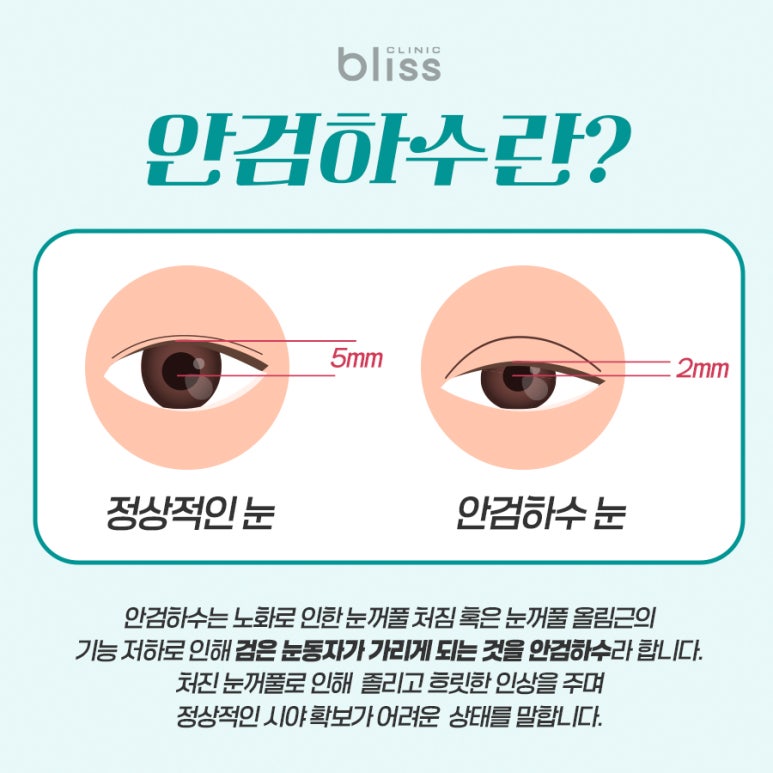
Ptosis is a symptom in which the eyelid droops due to insufficient strength to open the eyes,
resulting in an eyelid that hangs lower and eyes that appear sleepy or tired.
When the eyelid covers the pupil,
it can cause not only an appearance change but also difficulty securing the field of vision.
Because it becomes difficult to lift the eyelid, people may use their forehead muscles to open their eyes,
which deepens forehead lines.
In addition, a habit of lifting the chin upward to secure the field of vision when looking straight ahead can develop,
which may create a bad impression.
If this condition is left untreated,
the shape of the eyes may become asymmetrical or appear distorted,
and secondary problems such as fatigue, headaches, vision decline, and drooping eyes may occur,
so it is important to accurately understand your own condition.
Ptosis correction process
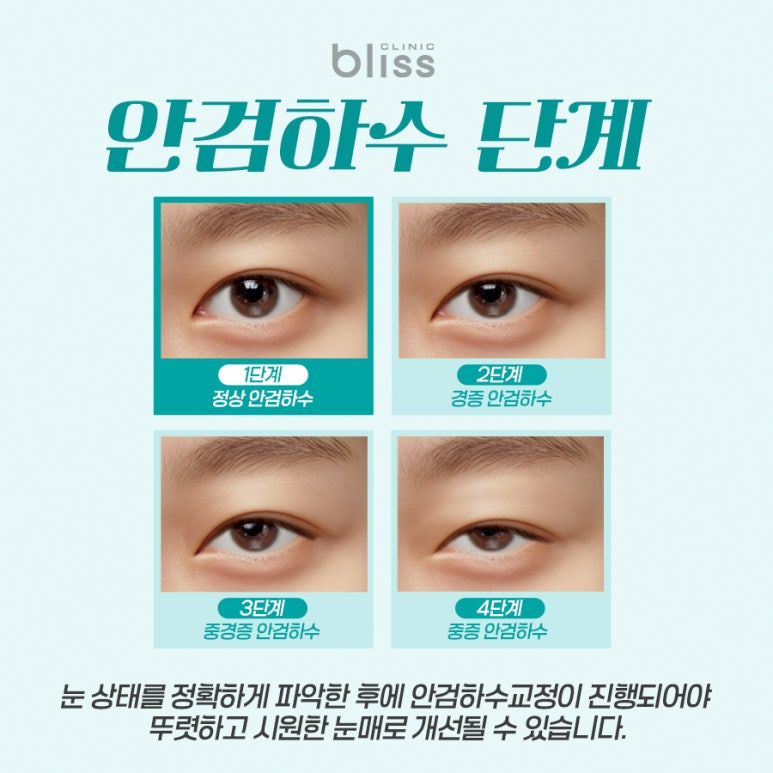
⑴ Precise measurement of the correction amount
⑵ Planning for eye shape correction
⑶ Double eyelid design
Ptosis is not a condition that can be judged simply by whether there is a double eyelid or by cosmetic standards.
Therefore, before surgery, the range of correction should be determined by carefully evaluating eyelid movement, muscle strength, skin thickness, and left-right symmetry.
The key is not to design the eyes to open as widely as possible,
but to set a design that harmonizes with the face shape
and complete an attractive eye appearance.
Ptosis correction methods
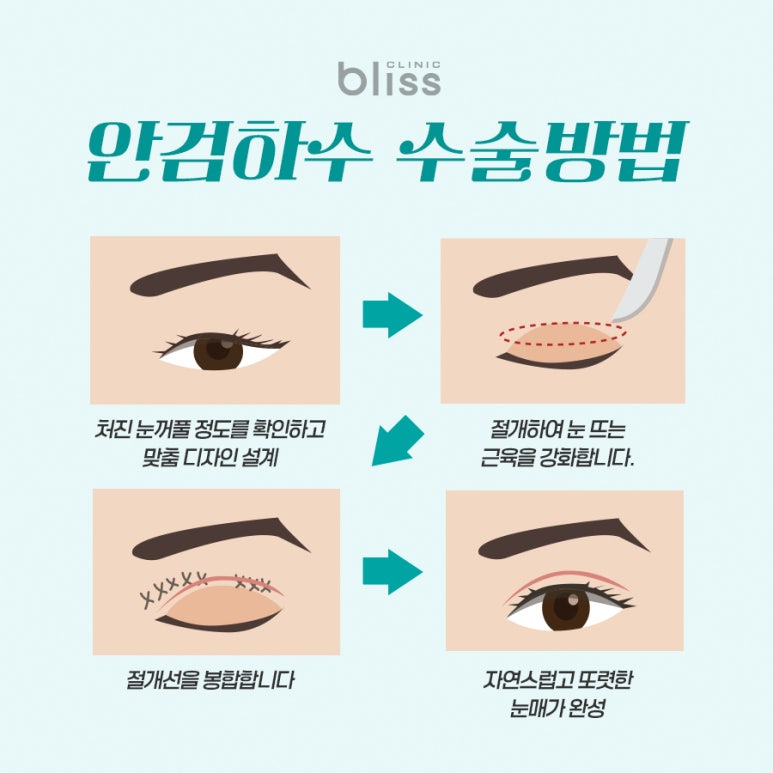
Ptosis correction eyelid surgery is broadly divided into the incision method and the non-incision method.
The non-incision method does not cut the skin; instead, holes are made in the upper eyelid,
and sutures are passed inside to tie the levator palpebrae superioris muscle and Mueller’s muscle with knots,
thereby strengthening the power to open the eyes.
Its advantages are that it does not leave scars,
causes less swelling and bruising, and has a shorter recovery period.
The incision method cuts the skin and directly manipulates the levator palpebrae superioris muscle
or shortens the length of Mueller’s muscle,
providing strong fixation and making it effective even for severe ptosis.
However, because it involves an incision, it has the drawbacks of scarring and a longer recovery period.
To achieve successful ptosis correction,
rather than insisting on one method,
it is preferable to choose by comprehensively considering the individual eye structure and desired results.

For successful results
For those interested in eye surgery,
ptosis correction is known as a procedure that can make the eyes look larger and clearer,
but this can be considered incorrect information.
In addition, excessive ptosis correction may prevent the eyes from closing completely or worsen dryness,
so careful planning is necessary.
Therefore, since it should only be performed on patients with functional problems,
it is important to accurately assess the condition of the eyes through consultation.

Director Oh Doo-young of Bliss Clinic carefully analyzes the condition of the eyelid muscles,
skin thickness, and eye proportion
to carry out customized ptosis correction,
so that the eyes can be improved into a natural and clear impression,
and highly satisfying results can be expected.