Dieting is often said to be a lifelong task,
and many people
are interested in weight management.
However, when late-night work piles up and company dinners continue,
it can be difficult to keep up with exercise and diet control consistently,
which can make medical help feel essential.
Recently, more people have been trying to control their weight
with the help of "obesity medications."
Among obesity medications available in Korea,
Wegovy and Mounjaro are
widely mentioned.
I would like to talk about what features and mechanisms lead to changes,
and whether they are risky.
How does weight loss happen?
Obesity medications help with weight loss
by regulating several systems in our body.
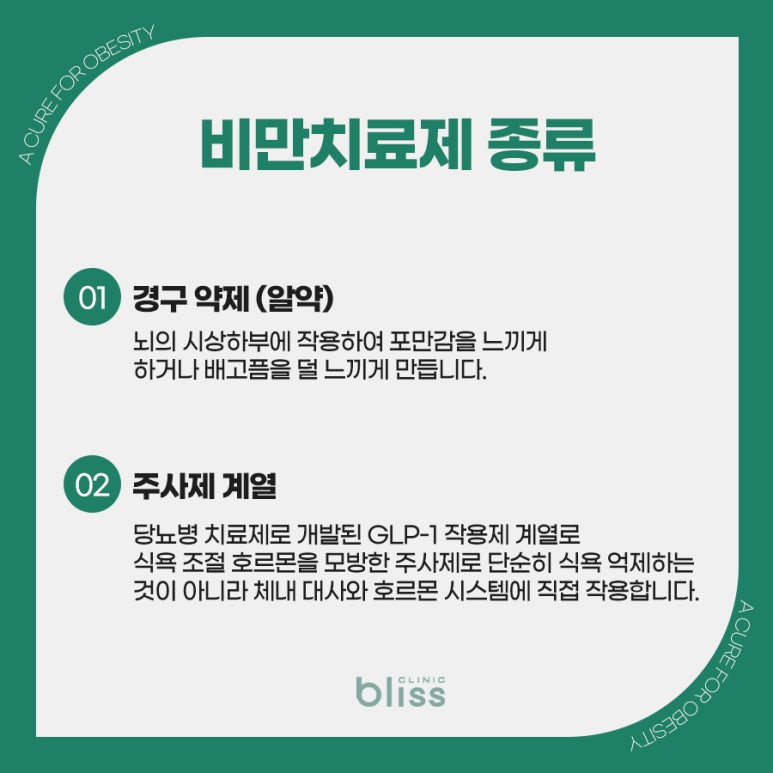
They can be broadly divided into two types.
The first is oral medication (pills),
which acts on the hypothalamus in the brain
to make you feel full
or reduce hunger,
thereby lowering food intake
or blocking the body from
absorbing fat.
The second is the recently attention-grabbing
injectable obesity medication class.
Wegovy and Mounjaro belong here.
They are GLP-1 agonists originally developed
as diabetes treatments.
GLP-1 is an injectable medication that mimics a hormone that regulates appetite.
It acts on the brain to suppress appetite and increase fullness,
while also improving pancreatic function
to help control blood sugar.
It is evaluated as having a strong weight management effect,
not simply by suppressing appetite,
but by directly acting on the body’s metabolism and hormone systems.
Differences among obesity medications
The obesity medications that are receiving the most attention in Korea are
specifically Wegovy and Mounjaro.
Both are GLP-1-based medications and have excellent effects on weight loss and blood sugar control,
but there are differences.
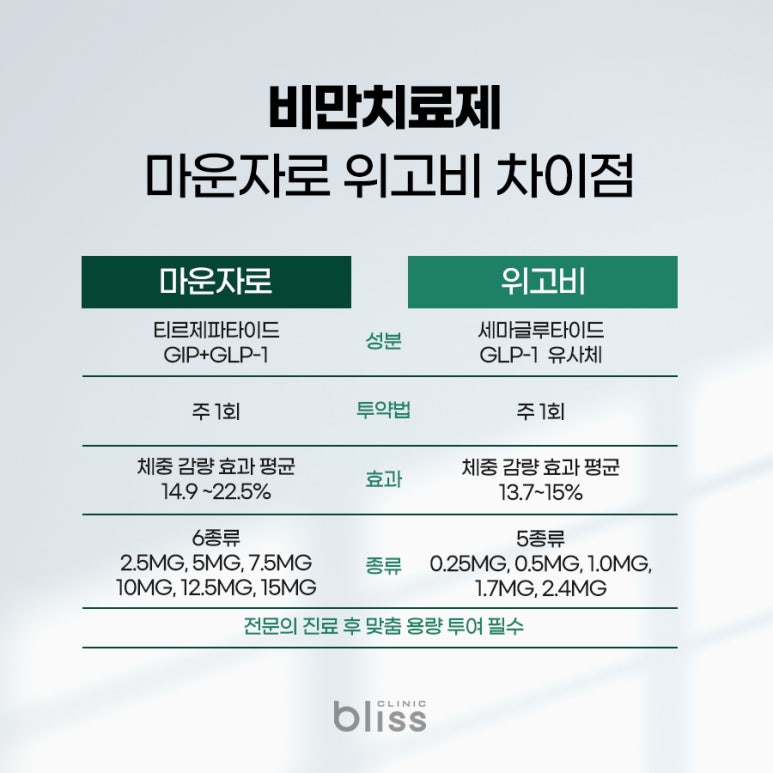
Wegovy contains semaglutide,
a GLP-1 analog that is similar to a naturally secreted satiety hormone in our body.
Because of this, even if you try to eat as usual,
the amount you eat naturally decreases,
so it is relatively suitable for people who struggle with overeating.
Since it only needs to be injected once a week,
it can feel convenient for busy modern lifestyles.
However, because it works in the body for a full week after one injection,
you need to pay more attention to dose adjustment when first starting.
Initial side effects may include heartburn, bloating,
nausea, and abdominal pain,
but most are mild
and can gradually improve as the body adapts.
In clinical studies, it has been reported
that 68 weeks of use led to a weight loss of about 10–15%.

Mounjaro is the most recently released
obesity medication.
Its main ingredient is tirzepatide,
and the biggest difference from Wegovy is that
it acts not only on GLP-1
but also on another hormone called GIP.
GIP promotes insulin secretion and helps break down fat,
so beyond simple appetite suppression,
it may also provide fat-loss benefits.
Research results suggest that after 72 weeks,
using 15 mg can lead to a weight loss of 15–20.9% of one’s body weight,
and some 평가 it as having a greater weight-loss effect than Wegovy.
Because appetite suppression and body fat reduction can occur at the same time,
it may be helpful for people with metabolic diseases such as diabetes and fatty liver.
It may also show positive changes in visceral fat reduction,
so people struggling with abdominal obesity
and those at risk for metabolic syndrome
may also expect good results.
The advantages and disadvantages differ
depending on the type of obesity medication.
To use Mounjaro or Wegovy effectively,
it is necessary to have a thorough consultation with a medical professional
about which choice is appropriate based on the patient’s constitution,
target weight-loss amount,
and financial situation.

Is it safe?
It is only natural to worry about whether it is okay to lose weight with medication.
The GLP-1 injectable medications currently in use
do not forcefully block appetite in their mechanism of action.
Rather, they help the body’s natural functions so that it sends signals that you are not hungry and that you are full.
Both types of obesity medications, Mounjaro and Wegovy,
have been approved by the U.S. FDA as obesity treatments
and have completed approval by Korea’s Ministry of Food and Drug Safety.

Precautions for obesity medications
Obesity medications are not simply for cosmetic purposes,
so not everyone is a candidate for drug treatment.
In general, they may be prescribed when the body mass index (BMI)
is 30 kg/m2 or higher,
or when BMI is 27 kg/m2 or higher with metabolic diseases
such as hypertension, diabetes, or hyperlipidemia.
Obesity medications such as Wegovy and Mounjaro can be expected
to improve metabolic diseases beyond just weight loss.
In the beginning, common symptoms include
decreased appetite, nausea, fatigue,
constipation, or diarrhea,
but most people adapt within 2–3 weeks.
Therefore, it is better to start with a low dose and gradually increase it,
so management by a specialist is needed.
When starting an obesity medication for the first time,
the level of risk can vary depending on your constitution,
underlying conditions, and the medications you are taking,
so individualized care is important.

As the variety of obesity medications has increased,
a more delicate approach is needed.
Above all, what matters is choosing the option that fits
your weight-loss goals and health status.
So, rather than asking which medication leads to more weight loss,
it is more important to choose the medication that is right for you.
At our clinic, we do not simply prescribe medication.
We monitor changes in patients through blood tests and body composition tests
while carrying out treatment,
which helps maximize the medication’s effectiveness
and ensure safety.
Through the Mounjaro, Wegovy DT7 program,
we provide personalized treatment.
If you have questions about obesity treatment options,
please feel free to contact us at any time.