
The eyes are the area of the face
where people’s gaze stays the longest.
However,
due to various factors,
they are also the place where aging
appears the fastest.
As time passes,
collagen production decreases as aging progresses,
and as skin elasticity declines and sagging occurs,
under-eye fat becomes more prominent,
and hollowing and dark circles under the eyes
can make you look tired, dark,
and lacking in energy,
which is why many people seek help from
under-eye fat repositioning surgery.
Today, we would like to summarize
the pain, bruising,
and recovery process and duration
of under-eye fat repositioning performed at Bliss.

Why does the under-eye area protrude?
The structure that supports
the under-eye fat,
called the orbital septum,
becomes weakened and causes it to bulge outward.
It can happen naturally as you age and weaken,
or it can also be caused by environmental factors
such as irregular lifestyle habits and accumulated fatigue,
as well as genetic factors,
such as having an inborn facial skeleton with
well-developed under-eye fat or a sunken bone structure.
In other words, the causes of under-eye puffiness
are diverse and occur for complex reasons,
so it can happen at any time
to people of all ages and genders.
✔️ When the protruding under-eye area sags and the groove below it is deep
✔️ When the under-eye area is hollow, leaving less volume under the eyes and making you look older
✔️ When dark circles are not covered even with makeup
✔️ When under-eye elasticity has decreased due to aging
✔️ When you want to create smooth and bright under-eyes without obvious signs of surgery

Effects and duration of under-eye fat repositioning
If under-eye fat repositioning is performed properly,
you do not need to worry about how long the results will last.
However, because skin thickness and the amount of fat
vary from person to person, the degree of improvement you feel
can differ somewhat.
Under-eye fat repositioning does not remove the protruding under-eye fat.
Instead, it dissects the hollow area around the tear trough,
creates space equal to the lost volume,
and moves the orbital fat to the desired location and depth
to secure it in place accurately.
For this process, septal reinforcement should be performed together
to prevent the fat from being pushed out again.
At Bliss, we create a natural and three-dimensional
under-eye line.
Of course, aging cannot be completely stopped,
so you can think of it as the point at which things are
organized once through surgery,
after which aging will slowly begin again.
👉 Bulging under-eye fat becomes smooth.
👉 Improvement in under-eye shadows and dark circles
👉 Hollow areas are filled and sagging areas become firmer
👉 Natural results without obvious signs of surgery

Under-eye fat repositioning pain
Because under-eye fat repositioning is performed under local or sedation anesthesia,
there is almost no pain during the surgery.
After the anesthesia wears off,
you may feel pressure around the eyes,
as if they are being pressed down with a heavy weight,
along with a dull, stiff,
and rough sensation.
Since the procedure involves an incision on the inner side of the conjunctiva,
it is not a sharp, cutting pain like being sliced with a knife,
so it is manageable.
The discomfort from under-eye fat repositioning gradually lessens
over 2 to 3 days.
📌 Manage swelling with cold compresses in the early stage
📌 Sleep with your pillow slightly elevated so your head
is above your heart
📌 Avoid actions that irritate the eyes, such as rubbing them
or forcing them open to insert contact lenses

Why the results differ
Even after undergoing under-eye fat repositioning,
some people experience significant bruising
while others do not.
You may think,
"I guess I bruise easily by nature,"
but differences can also arise depending on the surgical team's skill.
The under-eye area has thin skin and is a region where muscles,
fat layers, and tiny blood vessels are intricately intertwined,
so even a 1 mm difference can determine whether swelling and bruising occur.
The more delicately the area is handled,
the less likely under-eye fat repositioning pain
or discomfort is to last for a long time,
so the experience of the medical team is especially important.
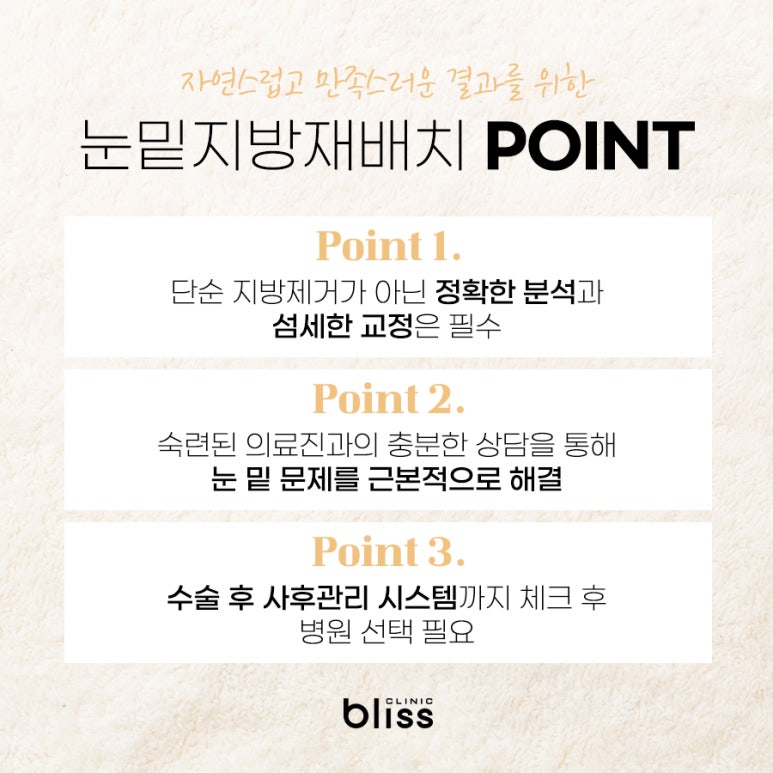
Because the degree of fat repositioning largely determines the outcome,
if the consultation proceeds with customized correction
without exaggeration about what can change,
you can achieve a satisfying result.
Before surgery, it is important to carefully examine your own condition,
including the amount of under-eye fat, degree of protrusion,
and skin thickness, and to find a plastic surgery specialist
with anatomical knowledge who can establish an accurate plan.
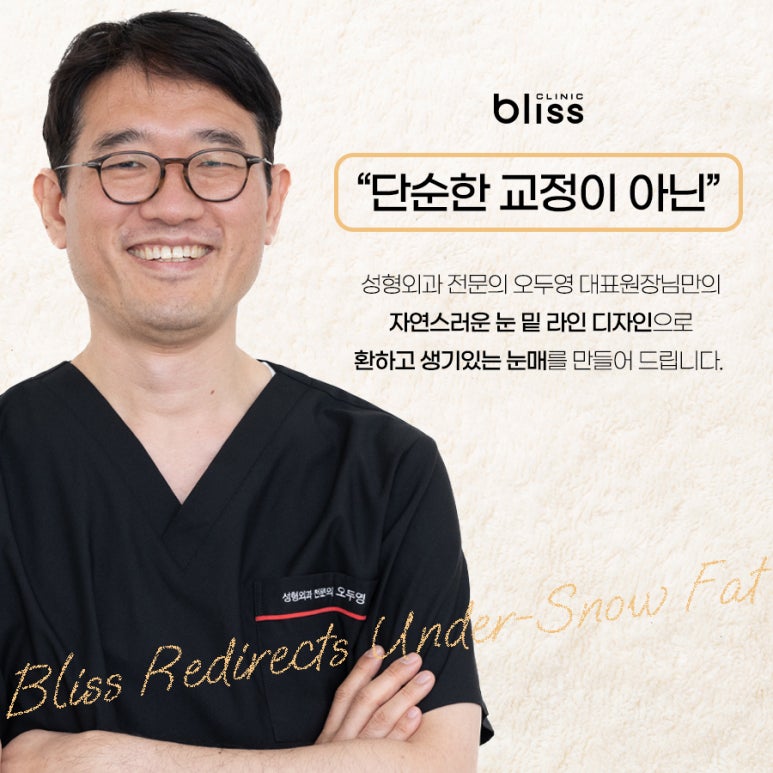
A plastic surgery specialist with 30 years of experience
With Director Oh Doo-young’s long-standing experience and expertise
gained over many years of performing various surgeries,
you can experience safe and well-suited changes
based on each person’s eye condition, cause,
and improvement goals.