Breast Lift for Sagging Breasts: The Method Should Vary Depending on Body Shape and Degree of Sagging.

Even when you feel somewhat satisfied with your body-line management,
another concern is bound to arise.
This is because the issue is not simply your weight or size;
changes in each area continue to catch your attention.
In particular, a woman’s body undergoes major changes
through pregnancy and childbirth, and among them,
changes in the breast line are one area that many people
feel particularly sensitive about.
Although the joy of holding a child after childbirth grows,
many people also experience stress because the shape of their breasts
looks different from before after breastfeeding ends.
As breasts that enlarged during pregnancy and breastfeeding
shrink again, their elasticity may decrease, creating the sensation
of lost volume, while skin sagging may become more pronounced.
Many people say that their confidence has declined
when they see their changed silhouette in the mirror.
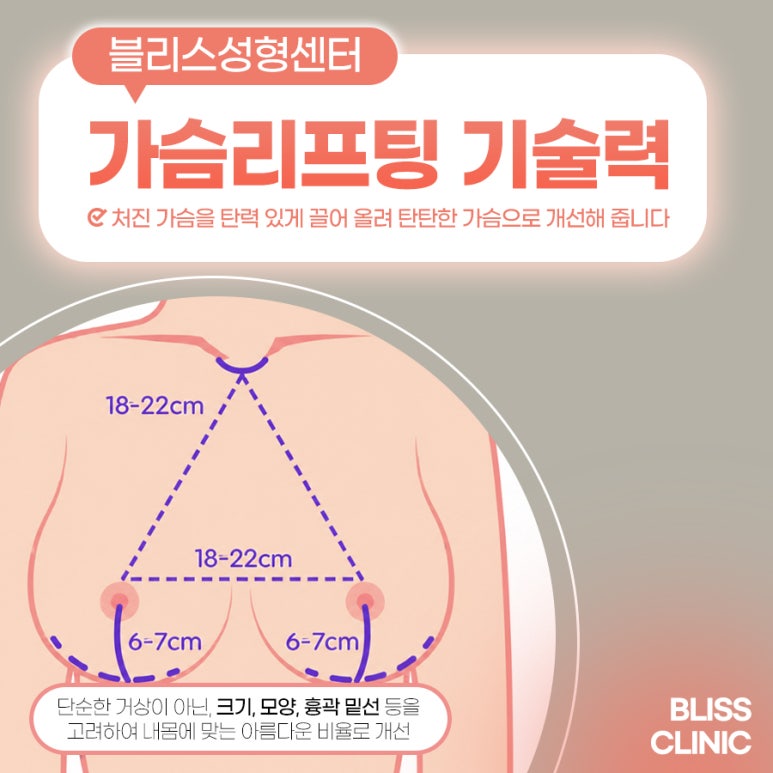
Sagging breasts do not automatically require a breast lift.
Not everyone with sagging breasts needs the same type of surgery.
This is because the issue cannot be viewed simply as a loss of volume.
After pregnancy and breastfeeding, the internal breast tissue
repeatedly expands and contracts, and during this process,
the supporting structures that hold up the breasts may gradually weaken.
In particular, when the Cooper’s ligaments that support the breast tissue
become stretched, the position of the breasts themselves may shift downward,
making the overall line appear different.
These changes cannot be explained solely by reduced skin elasticity.
As increased weight during pregnancy, volume changes caused by breastfeeding,
and the effects of gravity repeatedly continue over a long period,
the tissue’s support may decrease.
The problem is that once the supporting tissue has been stretched,
it is difficult for it to return to its previous state on its own.
For this reason, after childbirth, the loss of upper-breast volume
and the sensation of reduced elasticity may become more noticeable.
Therefore, improving sagging breasts should not be approached
simply as “surgery to lift them.”
The appropriate method may vary depending on how much breast volume
currently remains, how much excess skin is present,
and the location and degree of sagging.
In some cases, natural improvement may be possible
with a breast lift for sagging breasts alone,
while implants may also be considered when the loss of volume is significant.
The important point is not to automatically choose breast lift surgery,
but to plan an approach suited to the individual’s body shape and condition.
Assessing the current degree of sagging comes first.
If you are considering a breast lift for sagging breasts,
the first thing needed is an accurate evaluation of your current breast condition.
This is because it is difficult to determine the surgical approach
based solely on the impression that the breasts appear saggy.
The appropriate method may vary depending on how much volume
is maintained inside the breasts, whether upper-breast volume
has decreased after breastfeeding, or whether sagging has worsened
because of the breasts’ overall size and weight.
Therefore, it is important to carefully assess the degree of sagging,
skin elasticity, and the condition of the mammary gland tissue.
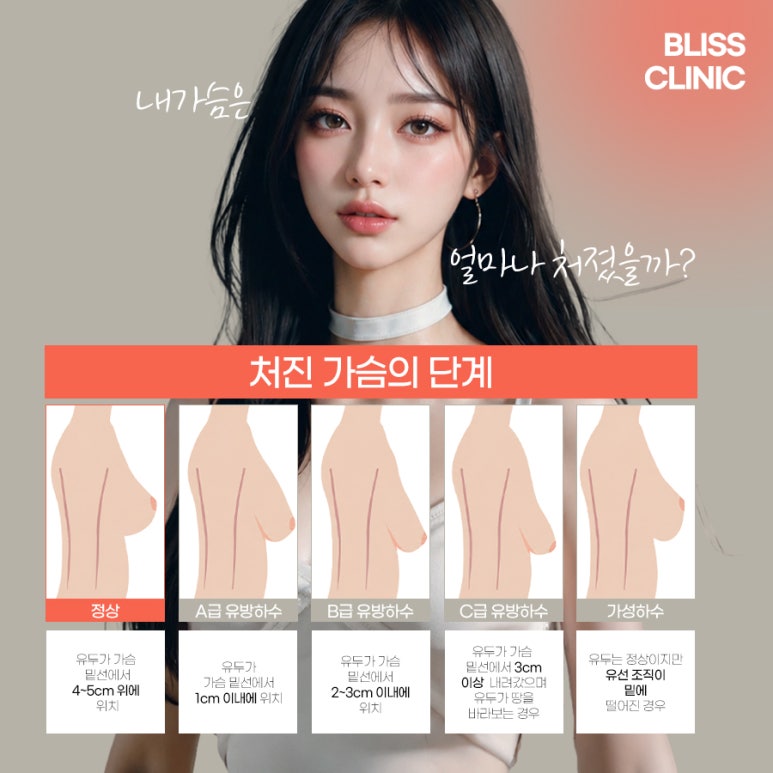
One particularly important criterion in surgical planning
is the position of the nipples.
Generally, an ideal breast line refers to a condition in which the nipples
are positioned above the inframammary fold.
Conversely, if the nipples are at approximately the same height as the fold
or have descended below it, it may be difficult to create a natural shape
by simply adding volume. In such cases, breast lift surgery,
which repositions sagging tissue upward, may also be considered.
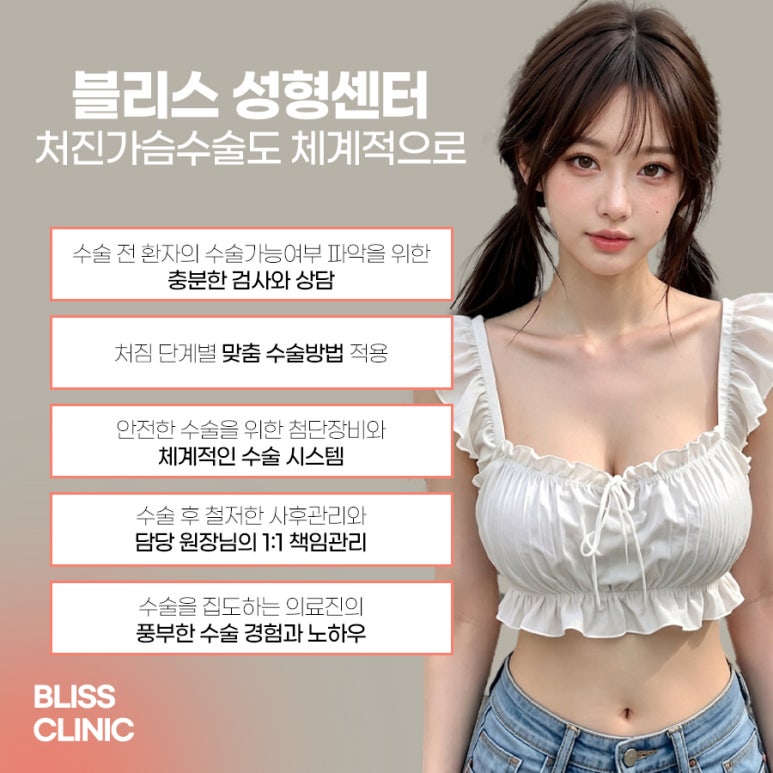
When carrying out a breast lift for sagging breasts, Bliss Plastic Surgery Center
does not look only at size. We establish the treatment direction
by comprehensively analyzing each individual’s degree of sagging,
skin laxity, and amount of remaining tissue.
It is also important to consider left-right balance
and overall body proportions to plan a more natural and stable breast line.
Rather than judging based solely on numbers, examining the actual silhouette
and overall balance together may lead to a more satisfactory result.

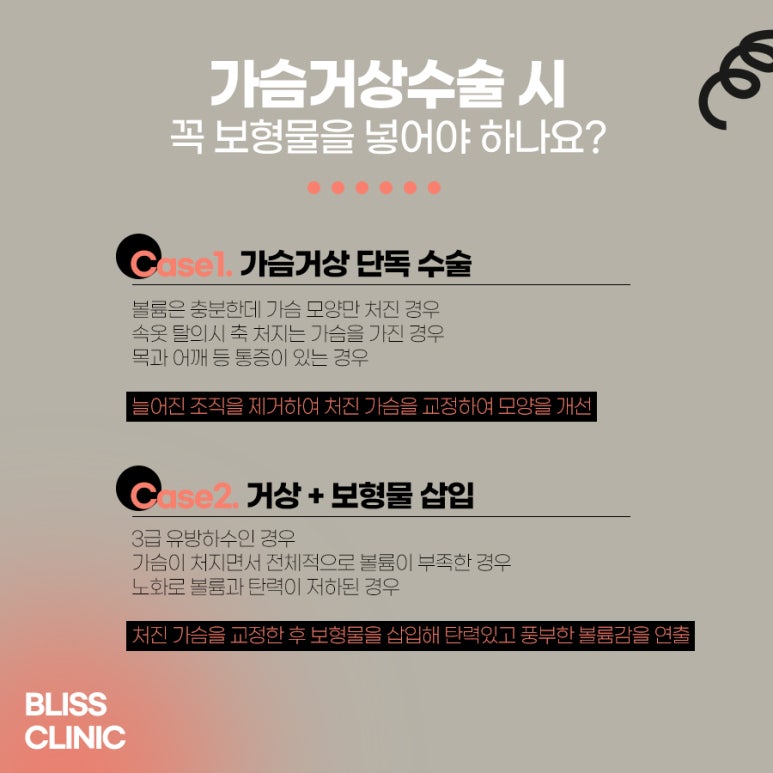
When sagging can be corrected with implants alone
When the degree of sagging is not severe, such as grade 1–2 breast ptosis
or pseudoptosis, improvement in the breast line may be possible
with implant placement alone.
In particular, when the breasts appear less elastic because volume decreased
after childbirth and breastfeeding, this approach fills the space that has become deficient
while naturally restoring the breast shape.
This can be understood as similar to the principle of restoring the shape
of a wrinkled balloon by filling it with air again after it has deflated.
When internal volume is reinforced with implants, the hollow-looking upper breasts
may be filled out, and the overall silhouette may appear firmer and more defined.
Therefore, when skin sagging is not severe and there has not been a major change
in the position of the tissue, satisfactory results may be possible with augmentation alone.
However, because implants maintain their shape relatively higher on the breast,
breast tissue that has already lost elasticity may remain positioned lower.
In such cases, it is also necessary to consider the possibility of an upper-lower separation,
where the upper area becomes fuller while the lower tissue appears to sag separately,
or the development of a double fold.
Therefore, when planning a breast lift for sagging breasts,
it is important to take an approach that naturally complements the current tissue condition
rather than simply inserting a larger implant.
At Bliss Plastic Surgery Center, rather than focusing on excessive augmentation,
we analyze skin elasticity, tissue position, and anatomical structure together
to plan a more stable and balanced breast line.
When the issue can be addressed with lifting alone
When sagging has progressed severely to grade 3 or higher breast ptosis,
it may be difficult to expect satisfactory improvement from implant placement alone.
If the nipples have already descended considerably and there is a large amount
of excess skin, it is difficult to correct the overall line simply by adding volume.
In such cases, breast lift surgery that corrects the sagging tissue and skin together
is often necessary.
If the goal is to improve the sagging shape itself rather than increase breast size,
surgery centered on lifting may be appropriate.
Conversely, if sagging is accompanied by a loss of volume,
combining a breast lift with implant placement may be considered
to address both the line and volume at the same time.
Ultimately, the important point is to take an approach suited to the current breast condition
rather than simply pursuing augmentation.
The key to a breast lift for sagging breasts is removing excess skin
and repositioning the mammary gland tissue that has shifted downward
into an appropriate position.
Rather than simply pulling the skin upward and suturing it,
this process brings the sagging tissue together again to create
a three-dimensional breast shape.
The positions of the nipples and areolas are also adjusted
to achieve overall proportion and balance.
The direction of the lift, taking natural volume transitions into account,
is also considered important.
The procedure is planned to support the tissue securely
so that the shape does not collapse over time,
with an emphasis on creating a balanced silhouette
not only from the front but also from the side and oblique angles.
Will the breasts sag again after surgery?
One of the questions people considering a breast lift for sagging breasts
are most curious about is:
“Can the breasts sag again after surgery?”
To begin with, breast tissue naturally changes over time,
so it is difficult to say that its shape will be maintained permanently.
However, if surgery is performed accurately using a method suited to the current condition,
it may help slow the progression of sagging and maintain a more stable breast line
for a longer period.
Breast lift surgery is not simply a procedure to remove excess skin.
It also involves moving the mammary gland tissue that has descended downward
back into an appropriate position and providing stable support for the internal structures.
For this reason, it is important to develop a surgical plan
that sufficiently considers each individual’s skin elasticity, tissue volume,
and body-shape characteristics.
Ultimately, the way the tissue is repositioned and secured
can affect how well the result is maintained.

The effects of aging and gravity continue even after surgery.
If weight repeatedly changes or skin elasticity decreases quickly,
sagging may appear again over time.
Therefore, how long the results of a breast lift for sagging breasts last
depends not only on the surgery itself,
but also on the patient’s tissue condition, lifestyle habits,
and whether aftercare is followed.
Surgery is closer to a starting point for improving the current sagging.
To maintain stable results for a long time afterward,
it is important to minimize weight fluctuations
and consistently follow the recovery and care instructions provided by the medical team.
When an individualized plan is combined with ongoing care,
more satisfactory results may be expected.

Above all, rather than judging your condition on your own based only on information online,
it is necessary to have a consultation directly with a medical professional
who has sufficient experience and understanding.
This is because accurately analyzing the current breast condition
and establishing an approach suited to the body shape and tissue characteristics
can help reduce unnecessary surgery or excessive correction.
Choosing the method most suitable for you through an individualized plan
and a sufficient consultation process may lead to a more satisfactory result.