You can also check it in the video.
How Is the Timing for Breast Implant Replacement During Revision Surgery Determined?

For a more beautiful body line and greater confidence,
many people choose breast augmentation.
After the initial surgery, patients hope that the satisfying results will last for a long time,
but as time passes, some consider revision surgery because of changes in body shape or dissatisfaction
with the shape and feel of the breasts.
In particular, because the breasts are composed of a combination of fat, mammary gland tissue, muscle, and other structures,
revision surgery tends to be more technically challenging than the initial procedure.
Therefore, accurately diagnosing the current condition
and carefully checking the condition of the existing implants and changes in the surrounding tissue
are especially important.
In this post, we will look at situations in which breast revision surgery may be needed
and precautions to consider depending on the timing of implant replacement.

Reasons Breast Revision Surgery May Be Needed
The most common reason breast revision surgery is needed
is that satisfaction with the shape or feel changes over time.
In particular, the condition of the capsule that forms around the implant
can significantly affect the shape and feel of the breasts.
When an implant is inserted, the body naturally forms
a thin capsule around it.
Normally, a soft capsule settles into place,
allowing the breasts to maintain a natural volume and feel.
However, if capsular contracture occurs, the capsule can become firm
and contract, causing the breasts to feel hard and potentially resulting in changes in shape
or pain. In such cases, breast revision surgery
may be necessary. The existing implant is removed,
the internal tissue is treated as needed, and a new implant
is inserted.
Implant damage, changes in body shape, and sagging or asymmetry
due to aging may also be reasons for revision surgery.
In many cases, the procedure is performed with the aim of replacing the implant
with a newer one to achieve a more natural feel
and greater stability.
Timing of Breast Revision Surgery
One of the most important considerations when thinking about breast revision surgery
is choosing the appropriate timing.
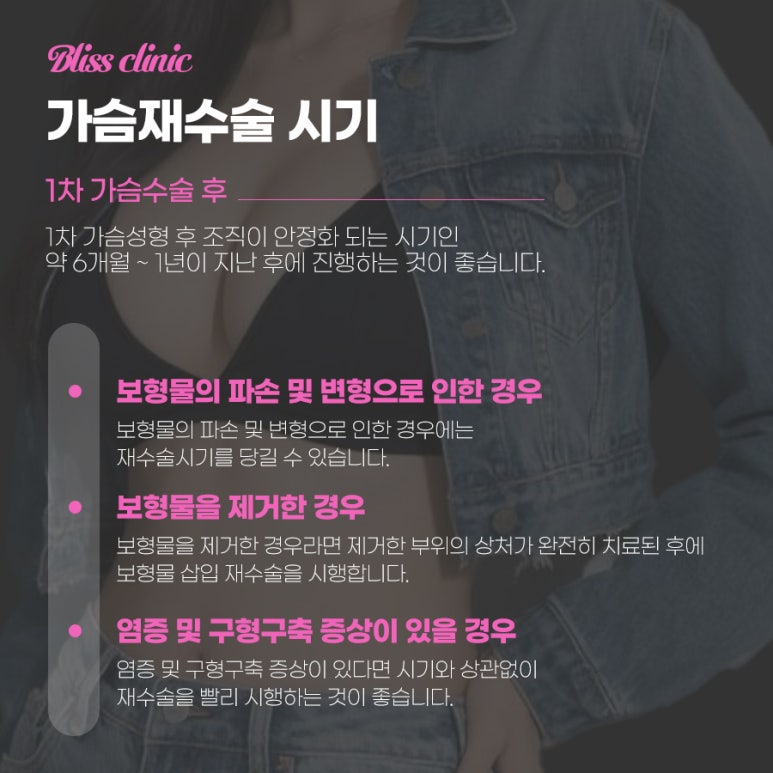
In general, after the initial breast augmentation, sufficient recovery time
is needed for the internal tissue and scars to stabilize.
Usually, a period of at least six months to one year
is recommended.
In particular, within three to five months after surgery, the tissue is still firm
and the healing process is ongoing. Proceeding with revision surgery too soon
may increase the risk of bleeding, swelling, or recurrent capsular contracture.
Therefore, except in cases requiring prompt treatment, such as implant rupture
or severe inflammation, it is safer to decide whether to undergo revision surgery
after at least six months have passed since the initial surgery,
once the condition of the tissue and the extent of recovery have been thoroughly assessed.
Preoperative Examinations Before Breast Revision Surgery
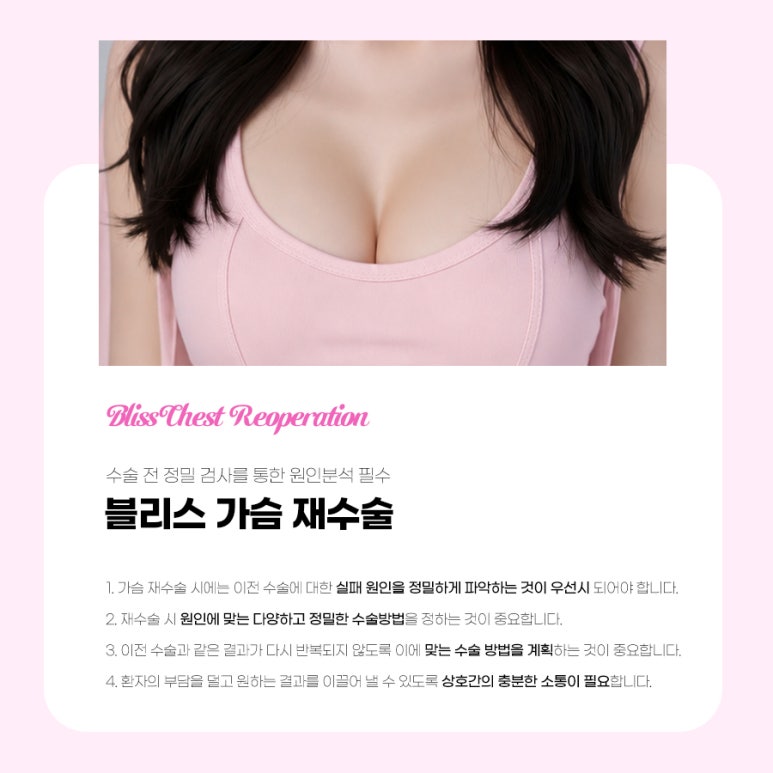
When planning breast revision surgery, it is essential to carefully assess
the current condition of the breasts.
In particular, the condition of the implant and the surrounding capsule
must be accurately evaluated to determine the appropriate surgical approach.
These examinations comprehensively assess whether the implant has ruptured,
the thickness and location of the capsule, the presence of inflammation or other complications,
and the possibility of breast disease.
Depending on the examination results, the need for capsulectomy
and the method of implant replacement may vary.
The examinations performed may also differ for each patient
depending on their condition and symptoms.
Frequently Asked Questions About Breast Revision Surgery
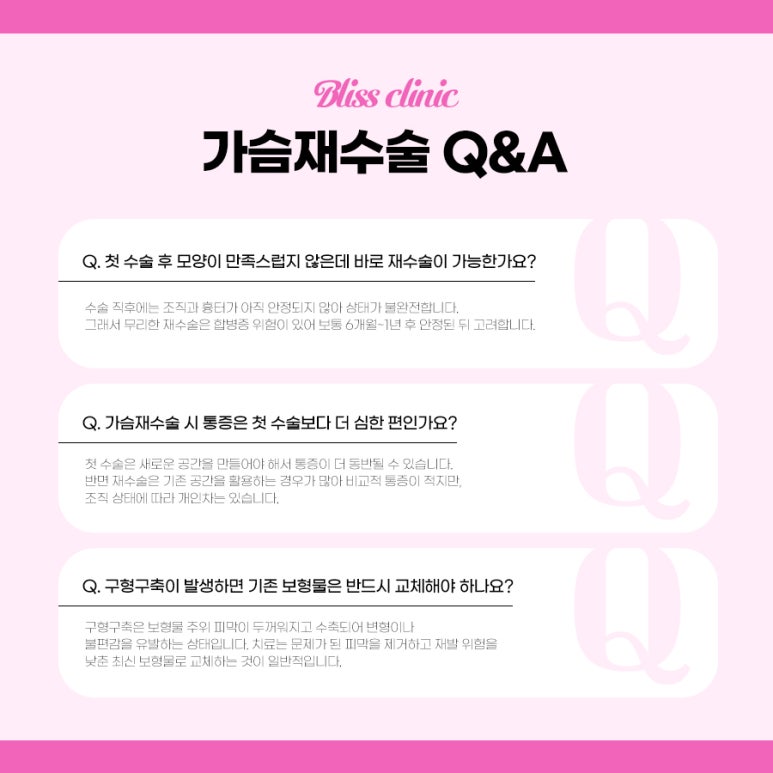
Q. I am not satisfied with the shape after my initial surgery. Can I have revision surgery right away?
A. Immediately after surgery, the internal breast tissue is still firm
and undergoing healing, and the scar tissue has not yet stabilized sufficiently.
If revision surgery is performed too soon during this period,
unexpected complications or dissatisfaction with the results may occur.
Therefore, it is generally recommended to consider revision surgery
after at least six months to one year has passed,
once the tissue has stabilized sufficiently.
Q. Is pain during breast revision surgery generally more severe than during the initial surgery?
A. During the initial surgery, a new pocket must be created
to insert the implant, which may be accompanied by pain.
In revision surgery, however, the pocket that has already formed
is often used. Nevertheless, individual differences may occur
depending on the extent of the surgery and the condition of the tissue.
Q. If capsular contracture occurs, must the existing implant always be replaced?
A. Capsular contracture refers to a condition in which the capsule surrounding the implant
becomes abnormally thickened and contracted.
In this case, rather than simply retaining the implant,
removing the problematic capsule tissue and replacing the implant
with a new one featuring the latest surface technology intended to reduce the occurrence of capsular contracture
may help prevent recurrence.

Breast revision surgery requires a technically higher level of difficulty than the initial surgery
due to factors such as adhesion to the original capsular tissue
and changes in skin elasticity.
Therefore, it is important to proceed after having a thorough consultation
with a medical professional experienced in revision surgery.
In addition, before deciding whether to undergo revision surgery,
the current condition of the breasts should be accurately evaluated first.
The position of the implant and the condition of the surrounding tissue,
as well as the overall health of the breasts, should all be assessed
to establish a safer plan.
With an accurate diagnosis and systematic analysis as the foundation,
more stable and satisfactory revision surgery results
may be anticipated.