If you are considering double-eyelid surgery or have just undergone the procedure,
one of the things you are probably most curious about is the swelling recovery process.
Especially as the time to return to daily life, such as work or school, approaches,
many people worry about how much swelling will remain around their eyes.
You may also feel self-conscious about how others look at you,
or become anxious because the swelling seems to last longer than expected.
However, swelling after double-eyelid surgery is a normal reaction that naturally occurs
while the tissues stimulated during surgery recover.
It is not something that time alone will always resolve,
but rushing your care will not make it improve dramatically either,
so care appropriate to each stage of recovery is important.
In this post, we will take a detailed look at the swelling timeline after double-eyelid surgery,
the recovery process, differences according to the surgical method,
and ways to reduce swelling more effectively.

Why Does Swelling Occur After Double-Eyelid Surgery?
Swelling occurs after double-eyelid surgery because the eyelid tissue
is stimulated during the surgical process.
When an incision is made or the crease is fixed, the body naturally triggers
an inflammatory response to repair the injured area.
During this process, blood vessels dilate and fluid temporarily collects
between the tissues, making the area around the eyes appear swollen.
In particular, the eyelids have very thin skin and a high concentration
of blood vessels and lymphatic tissue, so swelling tends to be more noticeable
than in other areas.
Swelling is often at its worst around the second or third day after surgery,
after which it gradually subsides as blood and lymphatic circulation stabilize.
However, the recovery rate may vary depending on individual constitution,
the surgical method, and lifestyle habits.
In general, significant swelling subsides considerably after about seven days,
while the remaining residual swelling gradually decreases over two to three months.
It may take approximately six months for a natural and stable crease
to become fully established, so allowing sufficient recovery time is important.

Double-Eyelid Surgery Swelling Recovery Process: Changes by Stage
Swelling after double-eyelid surgery changes in stages over time.
Although the recovery rate varies depending on individual constitution and the surgical method,
it generally follows a similar pattern.
✔️ Immediately After Surgery to Day 3
This is when swelling and bruising are usually at their most severe,
and your eyes may feel heavy and uncomfortable to open.
Cold compresses, plenty of rest,
and keeping your head elevated can be helpful at this stage.
✔️ Day 4 to Week 1
Significant swelling gradually begins to decrease,
and suture removal is often performed during this period.
However, the two sides may look different, making them seem asymmetrical.
✔️ Weeks 2 to 1 Month
As much of the swelling around the eyes subsides,
you can resume daily activities,
and the crease gradually begins to take on a more natural shape.
✔️ Months 1 to 3
As residual swelling gradually decreases, the overall appearance of the eyes
becomes more stable. This is also the stage when differences between the two sides
slowly begin to find balance.
✔️ Months 3 to 6
As the tissues stabilize, scars and residual swelling nearly disappear,
bringing the appearance of the eyes closer to the final result.

Differences in Swelling Depending on the Double-Eyelid Surgery Method
The recovery period for swelling can differ significantly depending on the method
chosen for double-eyelid surgery.
Therefore, it is important to understand the expected recovery rate
for your specific surgical method in advance.
📌 Non-Incisional Method
This method creates adhesion for the crease through tiny openings
without making an incision in the skin, so there is relatively little tissue damage.
Significant swelling usually subsides considerably within one week,
and after about a month, the appearance of the eyes can look relatively natural,
making this a comparatively quick recovery.
📌 Incisional Method
This method involves making an incision, removing unnecessary fat and muscle,
and fixing the crease through suturing, so it causes relatively greater tissue damage.
As a result, significant swelling may last for two to three weeks,
and it usually takes six months or longer for residual swelling to completely subside
and for a stable crease to become established.
However, although the incisional method has a longer recovery period,
it has the advantages of a lower likelihood of the crease loosening
and the ability to create a more defined appearance of the eyes.
Therefore, rather than judging the result based only on the initial swelling,
it is best to allow sufficient recovery time and monitor the progress.
Normal Recovery from Double-Eyelid Surgery Swelling and When to Seek Evaluation
The recovery process after double-eyelid surgery is not resolved simply by letting time pass;
it is important to observe the pattern of changes.
Whether your current condition reflects normal recovery
or requires additional evaluation can be assessed by observing changes in the swelling.
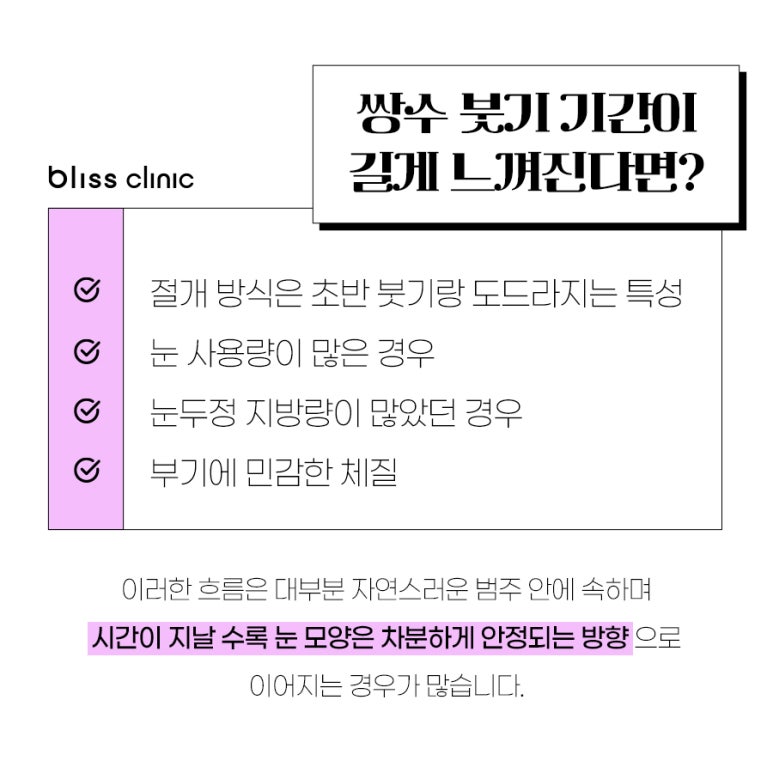
During a normal recovery process, the swelling tends to decrease gradually,
even if slowly. Although the pace may be gradual,
a characteristic sign is that the appearance becomes slightly more natural today than yesterday,
and this week than last week.
If this pattern is present, you can consider it part of the normal recovery stage
and continue monitoring its progress.
On the other hand, if there is little to no change in the swelling after more than two weeks,
or if a substantial difference in swelling between the two eyes continues,
it may not be simply part of the normal recovery process.
In such cases, checking the current condition may be helpful.
Ultimately, the key is to determine
whether there are any changes showing that the condition is improving,
even slightly.

Care Methods and Lifestyle Habits for Reducing Double-Eyelid Surgery Swelling Quickly
There is no special secret for quickly reducing swelling after double-eyelid surgery.
Consistently following basic care methods
has a significant effect on the speed of recovery.
The main considerations are the timing of compresses and lifestyle habits.
Applying cold compresses from immediately after surgery through the first seven days
can help stabilize the blood vessels and reduce bleeding and swelling.
Also, keeping your head slightly higher than your heart while sleeping
can reduce blood pooling toward the face and help relieve swelling.
Light activity that does not overexert you, such as walking, can help circulation
and support recovery. However, it is best to avoid salty foods,
as they can increase the amount of water in the body and prolong swelling.
In addition, drinking enough water and getting adequate sleep can support recovery.
You should also be careful, as keeping your head lowered for a long time while using a smartphone
or rubbing and otherwise irritating the eye area may delay the recovery of swelling.

The appropriate method of double-eyelid surgery varies depending on individual factors,
such as the structure of the eyes, skin thickness, and amount of fat.
Therefore, applying the same method and identical crease to everyone
is not appropriate.
What matters is choosing a clinic that can accurately analyze your current eye condition
and sufficiently explain the desired outcome and what is realistically possible.
In some cases, it may be determined that surgery is not necessary,
and it is advisable to receive guidance in the direction appropriate for that situation.
Also, swelling or asymmetry may appear after surgery,
but these aspects generally improve naturally during the recovery process.
By fully understanding this process and consistently monitoring your progress,
you can complete your recovery more steadily.