Hello,
We are JW Garden Plastic Surgery,
which delivers results.

What is a hump nose?
A hump nose refers to a nose in which the middle of the bridge
protrudes upward, and the tip of the nose droops downward.
A prominent bridge can give a strong
and harsh impression.
This can be corrected with surgical treatment,
but hump nose surgery requires correction of the bone,
so it is considered one of the more difficult types of rhinoplasty.
How is hump nose surgery performed?
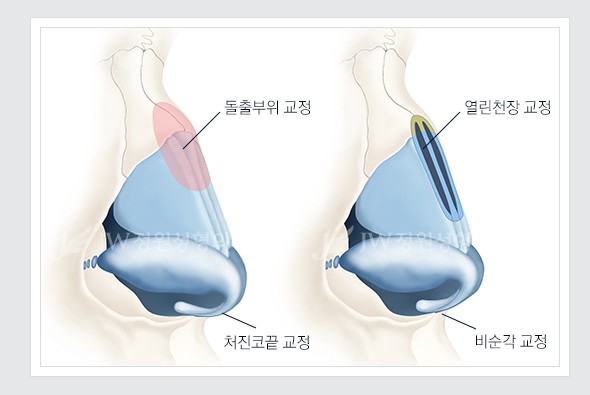
Hump nose surgery is generally performed in two main steps.
As explained earlier, a hump nose is a condition in which
the bridge protrudes upward
and the tip of the nose droops downward.
By correcting the protruding bridge
and the drooping tip,
a natural and smooth nasal line can be created.
Correction of the protruding area
In a hump nose, the protruding bridge
involves both bone and cartilage.
The protruding nasal bone and cartilage are removed to perform the correction.
Because the nasal bone is very thin, after the protruding bone and
cartilage are removed, that area may look as if there is a hole.
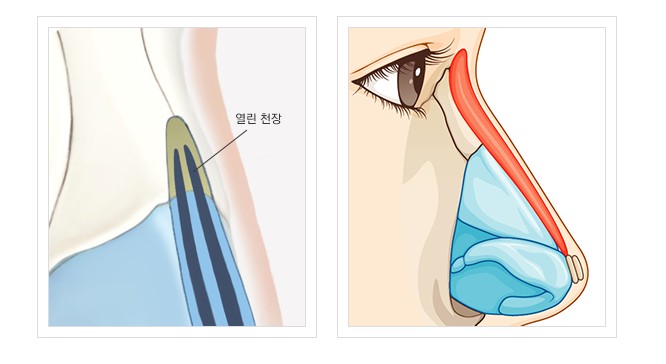
This is called an open roof deformity.
If it is only minor, it may be left alone,
but if the open roof area is wide, it may be noticeable to the touch,
and in appearance it can look spread out and make the side of the nasal bone
feel angular, so correction is recommended.
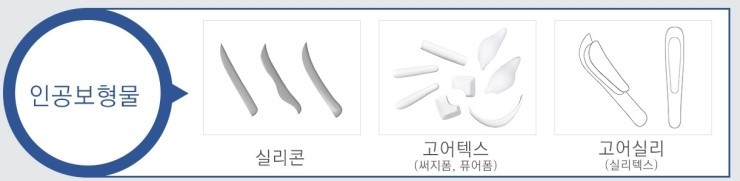
When correcting an open roof deformity with dorsal augmentation,
the affected area is covered with an artificial implant such as silicone or Gore-Tex
to create a smooth surface,
and the bridge of the nose can also be raised more prominently.
If osteotomy of the nasal bone is performed, after the bone is cut,
the sides of the bone can be brought together to smooth out the open roof.
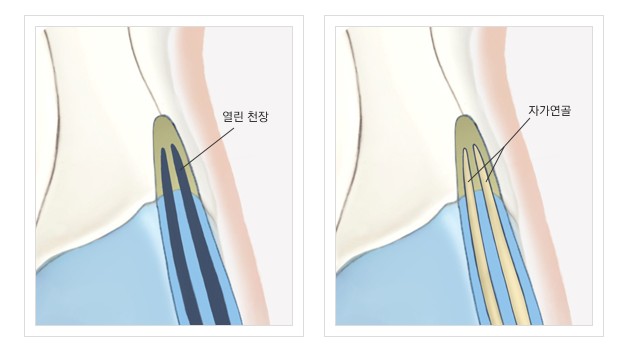
If you do not want dorsal augmentation or nasal bone osteotomy,
another method is to insert a septal cartilage graft into the open roof area
to flatten it.
Correction of the drooping tip
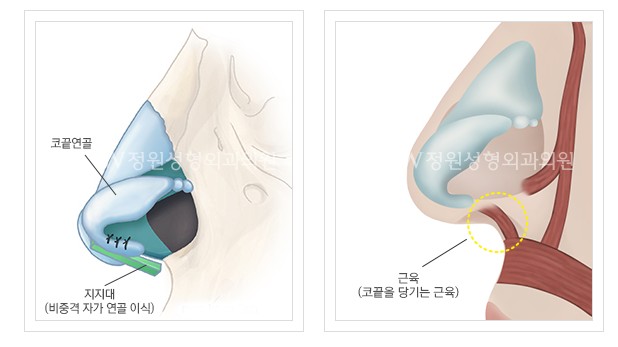
A drooping nasal tip can be corrected by rearranging the shape and position
of the structural cartilage of the tip (alar cartilage).
To prevent the tip from drooping and descending over time after surgery,
a support is inserted into the columella area to support the tip,
and the muscle pulling the tip downward may also be cut.
With this tip correction, the angle where the columella and the philtrum meet,
that is, the nasolabial angle, can also be corrected if it is narrow.
However, depending on the situation, autologous cartilage may be additionally placed
above the nasolabial angle to correct it at the same time.

When is hump nose surgery needed?

When the middle part of the bridge is raised and protruding
When the tip of the nose is bent downward and droops
When the nasal tip is lower than the bridge
When you want to change the appearance caused by a hump nose

Hump nose surgery is an operation that corrects the bone.
If too much nasal bone is removed, a perforation may occur,
and if too little is removed, the surgical effect may be insufficient.
Therefore, from the diagnosis of a hump nose onward,
it is especially important to choose medical staff with extensive experience and skill.
JW Garden Plastic Surgery considers not only the hump itself,
but also the problems that may occur in combination with it,
with years of know-how and proprietary technical expertise,
producing more reliable correction and a beautiful line.

*Plastic surgery may cause side effects such as bleeding and infection, depending on the individual.