Hello :)
Delivering results
JW Jawon Plastic Surgery Clinic.
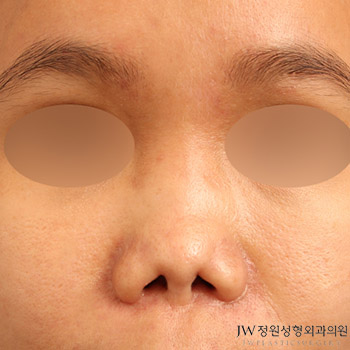
Rhinoplasty is not simply about raising the bridge of the nose
and lifting the tip to create a beautiful nasal line.
It is most important to accurately understand the structure and function of the nose
and to perform surgery with a nose height and shape
that harmonize with the individual’s face.
If this is overlooked and you are swayed by a pretty nose, rhinoplasty surgery costs, or rhinoplasty event promotions,
indiscriminate nose surgery can leave you with even greater stress and emotional wounds than before the surgery.
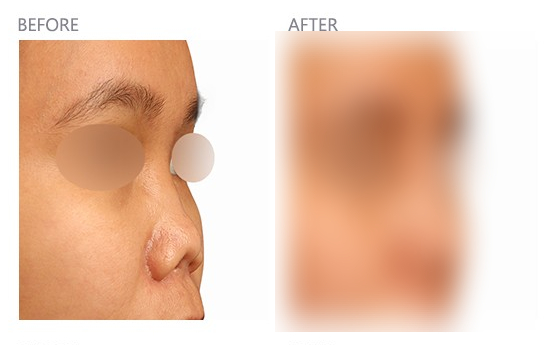
Clicking will take you to the before-and-after photo page.
One reason revision rhinoplasty has recently become just as common as primary surgery is that
after undergoing rhinoplasty without careful consideration, the nose collapses or
various problems such as dissatisfaction with the shape, inflammation, and complications occur.
Today, let’s take a look at revision rhinoplasty.
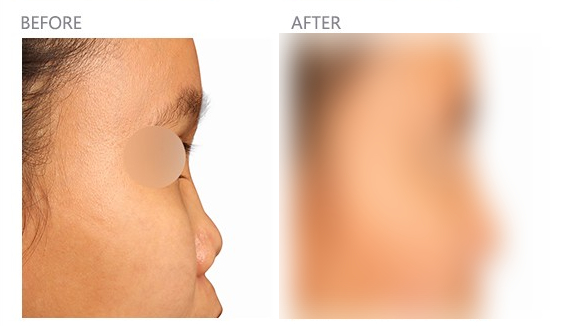
In the case above, contracture symptoms appeared after rhinoplasty,
causing contracture deformity of the nose shape,
and the tip lifted upward and became shorter,
exposing the nostrils. Through revision surgery,
the bridge of the nose was reconstructed and the tip was brought downward
to correct the nostril exposure.
What implants are used for revision/reconstruction rhinoplasty?

As in the case above, contracture deformity of the nose
can occur due to multiple nose surgeries, inflammation,
or an innate silicone rejection reaction.
For this reason, autologous cartilage is used in revision rhinoplasty for contracture deformity.
Among these, autologous rib cartilage allows for a sufficient length because a larger amount can be harvested than with septal cartilage or ear cartilage,
and its firm characteristics make it possible to build a high, elaborate nose securely.
In addition, because autologous rib cartilage is cartilage harvested from the patient’s own body,
there is no rejection reaction and, compared with other tissues,
its absorption rate is also low, which is an advantage for long-term maintenance.
Does autologous rib cartilage bend?
Many plastic surgery clinics find rhinoplasty using rib cartilage difficult and burdensome,
because rib cartilage is difficult to harvest and can experience warping.
To prevent this phenomenon, Director Seo Man-gun of JW Jawon Plastic Surgery Clinic
performs surgery using the multilayer rib cartilage carving method.
The harvested rib cartilage is finely refined
and stacked in two layers at the nasal tip,
with two pieces of cartilage from opposite directions overlapped to prevent warping
and to build up the bridge of the nose more firmly.
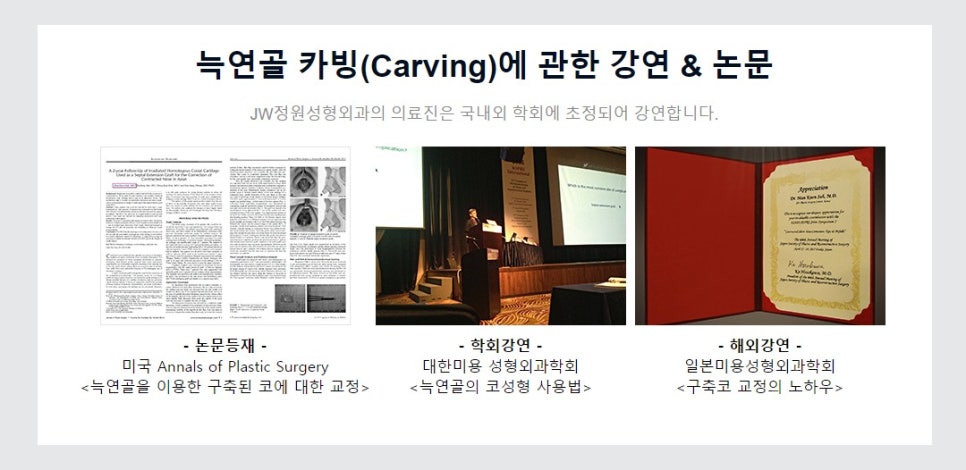
Using this surgical method, Director Seo Man-gun
had a paper published in the SCI-level international journal Aesthetic Plastic Surgery
and was also invited to give lectures at major domestic and international academic conferences.
When is the right time for revision/reconstruction rhinoplasty?
Those considering revision rhinoplasty often wonder about the timing of the procedure.
For any plastic surgery, it is generally best to wait at least 6 months,
and in some cases more than 1 year,
before undergoing revision surgery.
The reason is that the nasal tissue needs time to stabilize
and become softer.
However, if after rhinoplasty there is inflammation, implant displacement,
or the skin on the tip or bridge becomes severely red and thin,
creating a risk that the implant may protrude through the skin,
revision surgery should be performed immediately.
Not a revision surgery, but the final surgery!
JW Jawon Plastic Surgery Clinic’s revision/reconstruction rhinoplasty
anticipates issues that may arise after surgery, such as warping, asymmetry,
and absorption rate, and develops and performs the surgical plan accordingly to achieve satisfying results.
In cases where rib cartilage is used, most patients have already had rhinoplasty before.
Therefore, because the tissue condition is poorer than in a first surgery,
we perform surgery with an aesthetic sense that looks 10 years ahead
and the technical skill to complete it so that no further surgery is needed.
20 years dedicated only to rhinoplasty! Director Seo Man-gun of JW Jawon Plastic Surgery Clinic

Director Seo Man-gun of JW Jawon Plastic Surgery Clinic,
who has performed only rhinoplasty for more than 20 years,
uses extensive clinical experience and unique technical expertise
to accurately identify the problems of the first surgery
and achieve good results with the most suitable materials
and surgical plan for each individual’s nose condition.
A final surgery, not a revision surgery.
Consult with JW Jawon Plastic Surgery Clinic now.


*Plastic surgery may cause side effects such as bleeding and infection depending on the individual.