What people commonly call a "bulbous nose" refers to a nose with a blunt tip and wide nostrils that gives a round, undefined impression. In the past, it was called that because it was believed to bring good fortune, but recently it has come to give a less refined impression and has become a complex for many people, especially East Asians.
When the cartilage at the tip of the nose is excessively developed, when the cartilage is positioned abnormally and spreads outward, or when there is a lot of soft tissue in the nasal tip and alae, improvement can be made through nostril reduction and bulbous nose tip correction.

By considering various cases, the cartilage can be corrected to suit each person's face, and if necessary, the subcutaneous fat layer beneath the alar skin can be removed to create a high, slim nose tip.
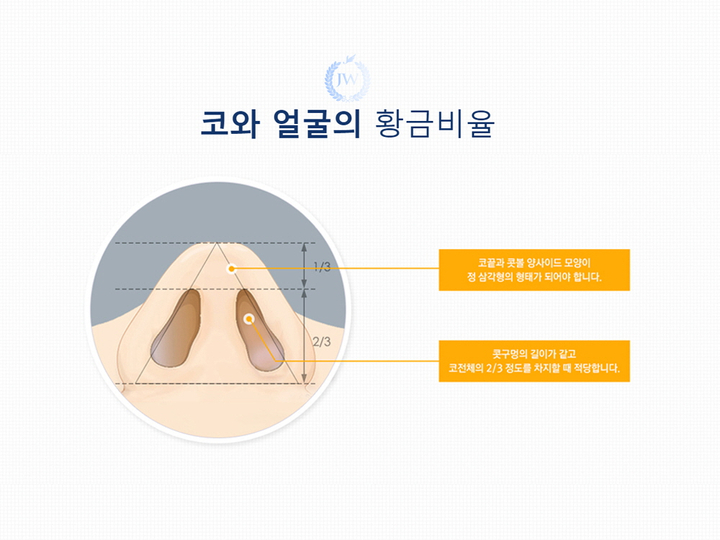
At this point, the key to nostril reduction and bulbous nose tip correction is not simply reducing the size of the nose tip, but creating a nose that is also beautiful in shape.
Along with cartilage correction, even thick skin tissue can be precisely adjusted so that a bulbous nose can be clearly improved.

We recommend nostril reduction and bulbous nose tip correction for the following people!
01 When the nostrils are large and spread wide
02 When the nostrils are large and blunt
03 When the nose tip is round
04 When the skin and fat of the alae are thick
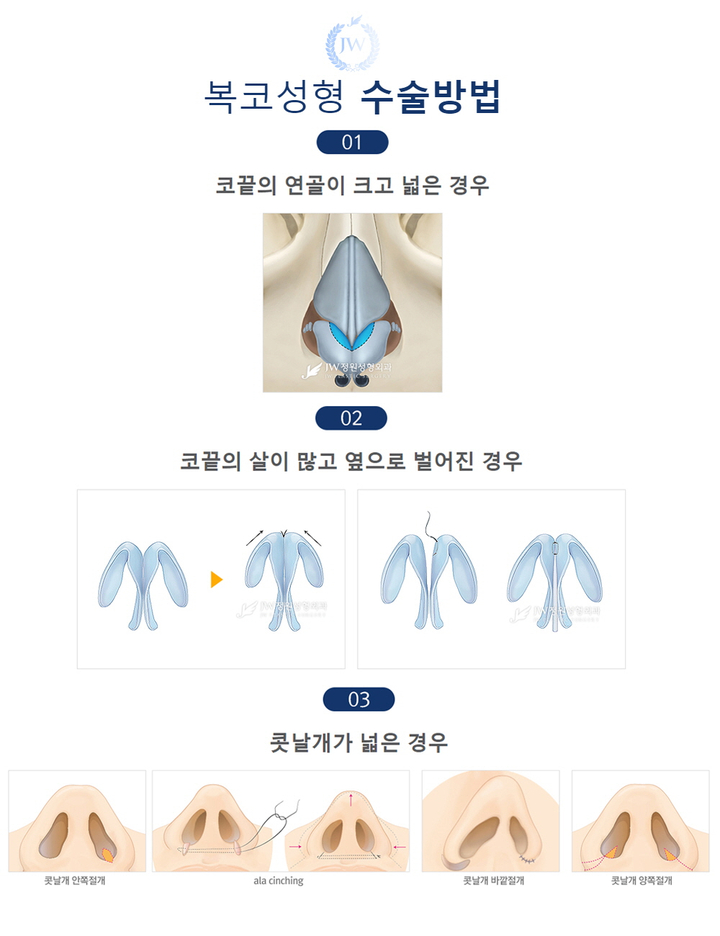
Because nostrils also differ in shape and type, the surgical method also changes accordingly.
01 When the cartilage at the nose tip is large and wide
A method is used in which part of the cartilage at the nose tip is resected and refined.
02 When there is a lot of tissue at the nose tip and it spreads outward
By performing a procedure that brings the nose tip cartilage toward the center, a slimmer and more refined nose tip can be created. At the same time, some of the tissue itself at the nose tip or nostrils is directly removed from inside the nose to reduce bulk and create a thinner-looking nose tip.
03 When the alae are wide
When the alae spread outward and are wide, there is surgery to directly reduce the alae. There are methods such as nostril reduction by incising the floor inside the nostrils, ala cinching (the method of tying with sutures to narrow the alae), incising the outer alae and bringing them inward as if tightening them, and making the width to the desired size by incising both the floor inside the nostrils and the outer alae.
As shown above, the method used to correct the alae differs depending on the type, and if surgery is performed according to the individual's current alar shape, a natural nose shape that suits the person can be completed.

With surgical experience and expertise, nostril reduction and bulbous nose tip correction can be performed to refine the shape of the nose tip or nostrils without inserting any materials into the nose tip. At this time, to expect sufficient surgical results, it is advisable to correct the shape of the nose while considering the overall facial shape and to establish a systematic surgical plan.
Director Seoman-gun of JW Plastic Surgery is the head of the Rhinoplasty Study Group of the Korean Society of Plastic and Reconstructive Surgeons, and has over 20 years of experience in rhinoplasty alone, having performed approximately 15,000 surgeries to date.
In addition, they continue to make efforts for safe surgery by establishing systems such as endoscopy, in-depth 3D-CT examinations, scientific facial analysis and surgical outcome prediction with Morpheus 3D, and the presence of a specialist in anesthesiology and pain medicine.