Hello.
The difference in skill is the difference in results. This is JW Jeongwon Plastic Surgery.^^
The nose is the center of the face and has the greatest influence on a person’s impression. Anyone would dream of a smooth nose and a sophisticated image like the celebrities seen on TV, and may have undergone nose surgery for a more defined and elevated look. Unfortunately, many people have come to consider nose revision surgery after being misled by doctors with little surgical experience and indiscriminate event-style plastic surgery marketing, only to experience contracture after surgery, implant visibility, implant deviation, dissatisfaction with height, and other issues.
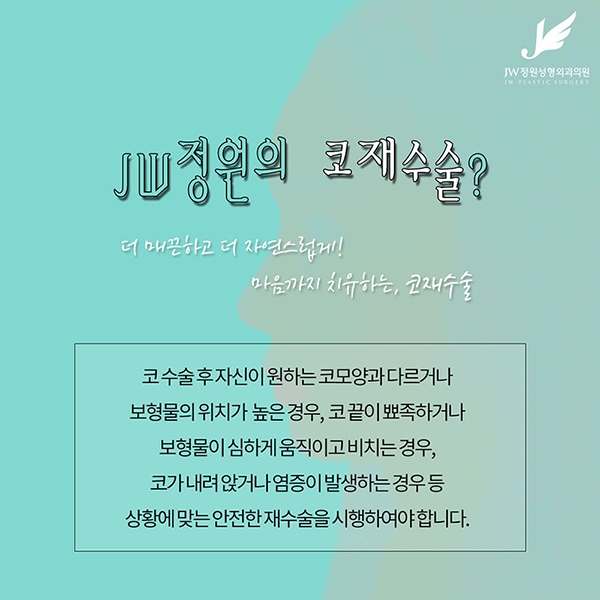
Nose revision surgery is much more difficult and delicate than the first nose surgery, so if the result differs from the desired shape, if the implant sits too high, if the nasal tip is sharp or the implant moves or shows significantly, or if the nose collapses or inflammation occurs, there are many possible cases to consider. It should be performed safely only after an accurate diagnosis by an experienced specialist.
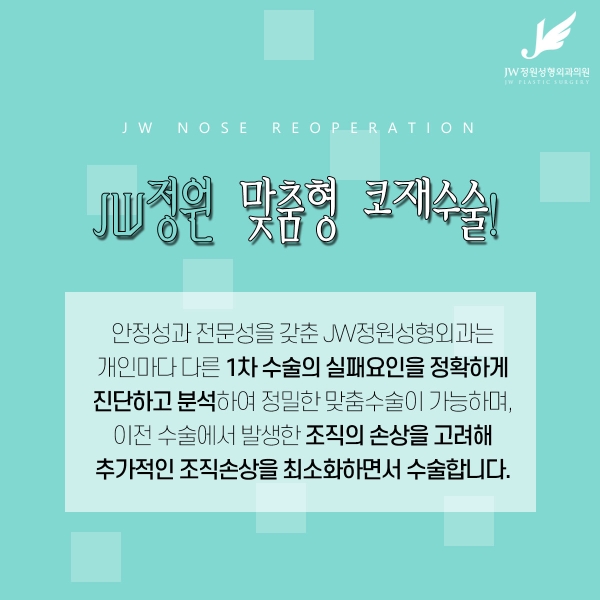
The most ideal timing for nose revision surgery is either immediately, 1 to 2 weeks after surgery, or after 6 months to 1 year has passed. JW Jeongwon Plastic Surgery, which has both safety and expertise, accurately diagnoses and analyzes the factors behind the failure of the first surgery, allowing precise customized surgery. It also takes into account the tissue damage caused by the previous surgery and performs the procedure while minimizing additional tissue damage.
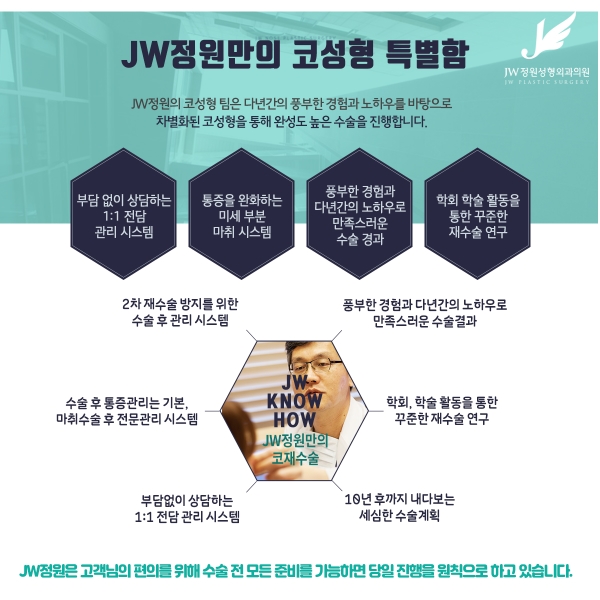
The nose revision team at JW Jeongwon Plastic Surgery carries out highly refined surgery through differentiated nose revision procedures based on years of rich experience and know-how. In addition, for the convenience of patients, all preparations before surgery are, as much as possible, completed on the same day as a rule.
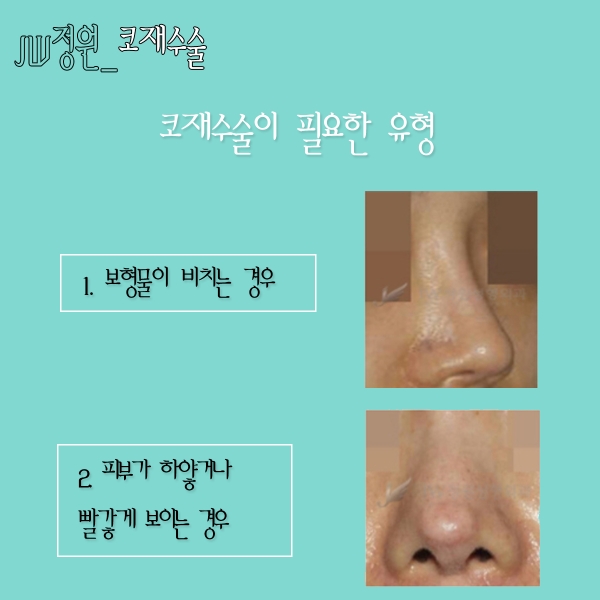
[Types that require nose revision surgery]
① When the implant is visible
: This occurs when the skin of the nose has become thin. The implant should be replaced, and a procedure to reinforce and thicken the thinned skin should be performed at the same time for better results. Methods of reinforcing the skin include using dermis (artificial dermis) or fascia. When the condition is severe, the inserted implant is removed and the nose is augmented using only autologous tissue (dermal fat) or cartilage.
② When the skin appears white or red
: When the skin turns white or red, it means the skin has become thin to the point that there is a problem with blood circulation. If left untreated, the skin may become progressively thinner and may even break through, so it is better to remove the implant or problematic cartilage. After implant removal, the thinned bridge and tip of the nose are corrected using autologous tissue such as artificial dermis.
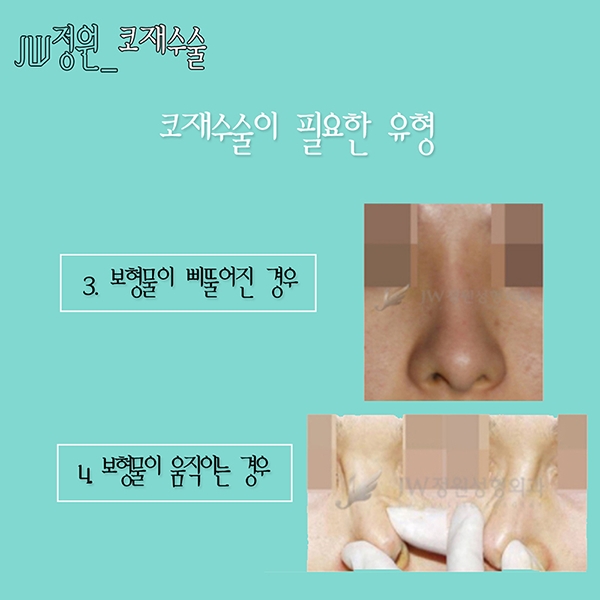
③ When the implant is crooked
: If the inserted implant is crooked, it can be corrected by recreating the pocket straight and placing the implant precisely beneath the periosteum. However, if the nose itself was originally bent, correction surgery for the crooked nose must be performed.
④ When the implant moves
: If, during surgery, the implant was not placed beneath the periosteum of the nasal bone and instead was inserted just under the skin, it will move. It can be corrected by placing it back precisely beneath the periosteum. If the periosteum has already been damaged and there is concern that the implant may move even if placed beneath it, using Gore-Tex or autologous tissue instead of a silicone implant results in much less movement.
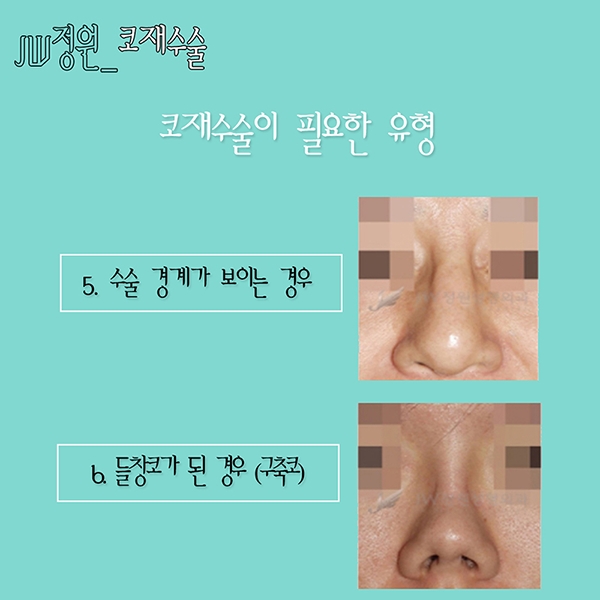
⑤ When the surgical boundary is visible
: If the width of the implant does not match the width of the nasal bone, the inserted implant can be removed and a new one inserted after adjusting the width, allowing correction to a more natural shape.
⑥ When the nose becomes upturned (contracted nose, contracture deformity)
: A contracted nose can occur due to inflammation, multiple surgeries, or constitutional factors. Although it is one of the most difficult types of nose revision surgery, our correction of contracted noses is backed by extensive experience and know-how, and the postoperative satisfaction rate is high enough to have been included in an international academic journal. Very good results can be achieved using septal autologous cartilage, ear cartilage, or rib cartilage.
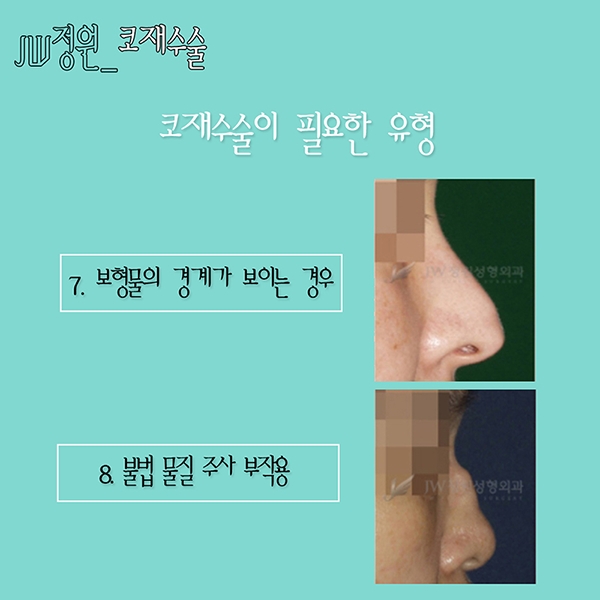
⑦ When the boundary of the implant is visible
: There are cases where the endpoint of the implant at a certain point on the bridge of the nose is visible, and it becomes especially noticeable when smiling. After removing the implant, the length is extended further, but to avoid putting strain on the nasal tip, correction is done by making the end section extremely thin.
⑧ Side effects from injections of illegal substances
: It is impossible to completely remove foreign substances, but the method used is to remove as much as possible and then graft autologous tissue.
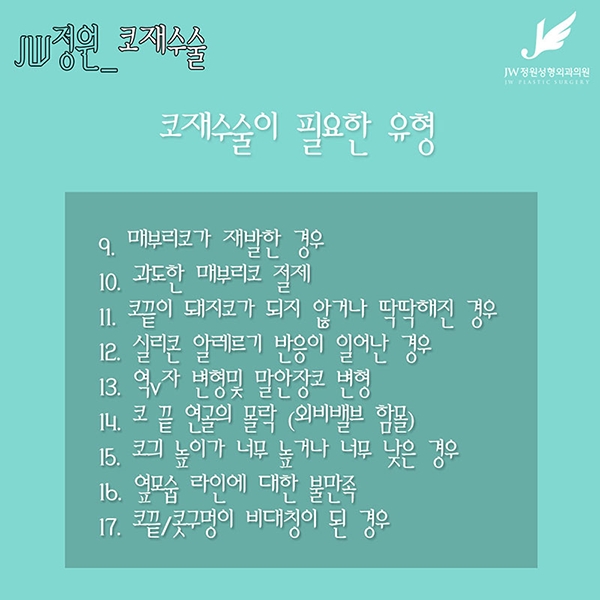
In addition, there are various postoperative complications that may require revision surgery. Depending on the condition of the nose, the procedure can be highly difficult and require extensive surgical experience, so it must be performed by a specialist.
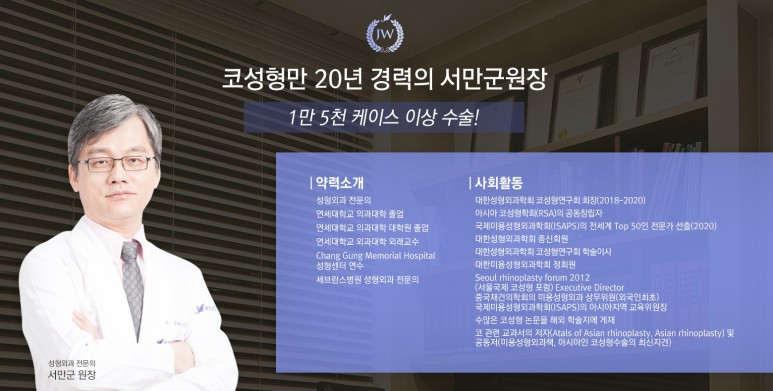
JW Jeongwon Plastic Surgery is not a fast-paced hospital focused on high-volume, low-margin treatment. It is a hospital that delivers greater value through customized care focused on each and every patient, and proves it through results so that you can feel it was a wise choice. The turning point of my life, the final nose revision surgery, is JW Jeongwon’s answer.
[Phone Consultation]
02.541.5114
[Clinic Hours]
Weekdays 10:00 AM ~ 7:00 PM
Saturday 10:00 AM ~ 5:00 PM
(Sundays and public holidays are closed)
If you have more questions about the surgery, please click the image below to inquire. Thank you.
*Plastic surgery may cause side effects such as bleeding or infection depending on the individual.