Many people are interested in
under-eye fat repositioning surgery, which can change a dull
and gloomy-looking impression.
This is a surgical method that can help resolve concerns caused not only by dark circles but also by under-eye fat.
Even improving just the area under the eyes
can change the overall mood and impression,
creating a more lively and bright appearance.

Under-eye fat repositioning surgery is
also called dark circle removal surgery.
It is a procedure that can improve
under-eye areas where fat protrudes bulgily downward
or where the area appears sunken due to a lack of fat.
Many people choose to undergo it because of aging, but these days
many younger people are also having the procedure.
Dark circles caused by protruding under-eye fat are often due to skin sagging or excess fat.
The reason under-eye fat appears is usually that, in one's 30s to 40s,
as the septum surrounding the under-eye area weakens,
leftover fat becomes excessive and begins to bulge outward.
For this reason, the tear trough under the eyes becomes deeper
and the under-eye area looks darker.
For those considering under-eye fat repositioning,
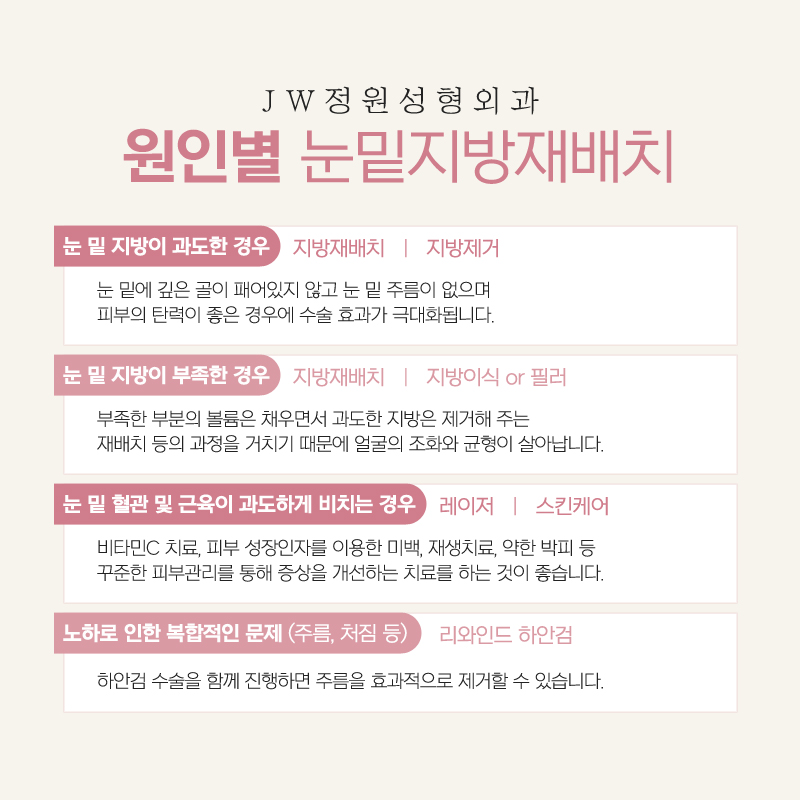
when there is too much under-eye fat,
it is often because they were born with excess fat
or because the supporting structure is weak, creating shadows.
When there is too little under-eye fat, the colors of the muscles and tissue show through the thin skin with almost no subcutaneous fat,
making the area look dark.
If the muscles beneath the under-eye blood vessels are excessively visible, the skin around the eyes is thin and weak,
making it sensitive to ultraviolet rays and external irritation,
and the area appears black due to the melanin pigment contained within cells.
In the past, this was treated with resurfacing using lasers or chemicals,
but the results were not permanent,
so people were not satisfied.
The most common case, age-related sagging,
occurs when the elasticity of the eyes decreases,
causing fat to protrude and forming a deep groove under the eyes.
At JW Garden Plastic Surgery,
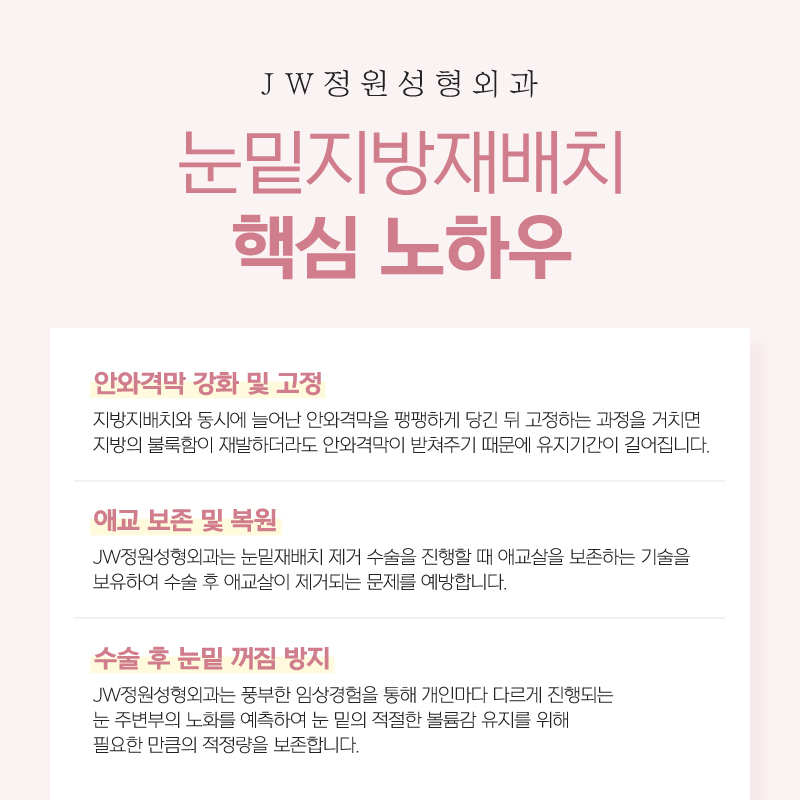
the orbital septum is strengthened and fixed,
and the stretched orbital septum is pulled up tightly and secured.
This helps the results last longer because even if the bulging fat recurs,
the strengthened support helps hold it in place.
When performing under-eye fat repositioning,
if too much is removed or the surgery is not carried out delicately,
the aegyo-sal, which is considered an advantage,
may also be removed, causing the original impression to be lost.
However, when under-eye fat repositioning and removal surgery is performed,
the aegyo-sal is preserved, so the procedure can be done without such side effects.
Even for those who did not originally have aegyo-sal,
it can also be filled in together through filler or dermal grafting,
so it is best not to worry and instead talk it over through a consultation.
Even if you had good results by having under-eye fat repositioning surgery in your 20s or 30s,
before aging becomes clearly noticeable,
time still passes and aging continues.
So even after surgery, and even as time goes by,
if you want to maintain an appropriate amount of volume,
rather than removing fat completely,
only the necessary amount is removed
so that both effects can be achieved.
In the past, when people talked about under-eye fat repositioning surgery,
it was mostly performed by people in their 40s and older, but things are quite different now.
Since acquired symptoms usually begin appearing in one's 20s,
many people these days who are very interested in care and maintenance are also undergoing under-eye fat repositioning.
Because it is a commonly performed surgery,
it should not be thought of as simple.
The results and satisfaction vary depending on the specialist's skill and experience,
deep anatomical knowledge, and the solutions they provide,
since the eyes are a complex and delicate structure.
Therefore, before undergoing under-eye fat repositioning surgery,
it is best to consult with the attending specialist and plan a procedure suited to the cause and shape of your under-eye fat,
so that it can be carried out safely.