Arioligio Effects,
Can It Remove Crow’s Feet?
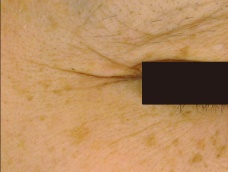
"If I get Arioligio,
will my crow’s feet go away?"
The eye area is the part of the face where
signs of aging appear first.
Because the skin is thin and facial movement is frequent,
wrinkles form easily.
That is why many people consider treatments for the eye area,
but when it comes time to choose one,
hesitation is natural.
People also worry that it might look unnatural.
Among the many eye-area treatments,
Arioligio is a procedure that
smooths wrinkles naturally.
Today, we’ll look at how Arioligio smooths wrinkles,
and how much improvement is actually possible,
through clinical papers.
| Arioligio Effects: Can It Remove Crow’s Feet? |
|---|
| 1. How does it work on crow’s feet?2. What do clinical papers show?3. How can you improve the results? |
- Arioligio Effects
How does it work on crow’s feet?
Arioligio is a method that uses an eye-specific tip
with the Oligio device.
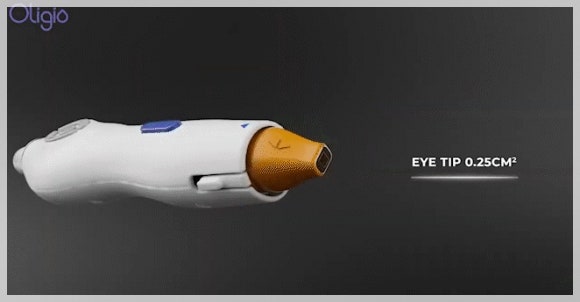
Oligio uses monopolar radiofrequency to
send current into the skin,
and the resistance heat from that process
raises the temperature inside the skin.
Collagen in the skin has a triple-helix structure
connected by hydrogen bonds.
When skin temperature rises, this structure denatures,
causing collagen contraction.
This is the core mechanism behind the lifting effect.
What matters here is the "proper temperature."
If the temperature is too high, it can cause pain, scars,
and burns.
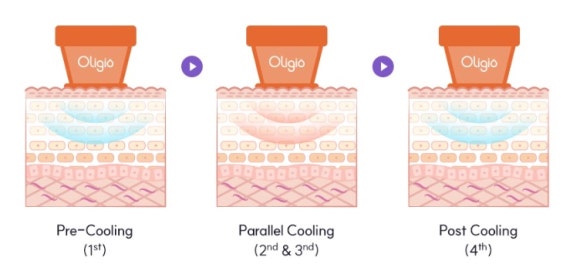
With cooling, Oligio keeps the surface temperature at around 40°C,
while using the principle of an inverse thermal gradient
to heat the deeper tissue more strongly,
allowing the procedure to be performed more safely.
- Arioligio Effects
What do clinical papers show?
So, let’s look at how much of an effect
Arioligio actually has
through a clinical paper.

The above study evaluated the effect of monopolar radiofrequency
on improving crow’s feet wrinkles in 70 Korean participants.
A total of three treatments were performed at two-week intervals.
The effect was measured four weeks after the final treatment.
The results showed that the average crow’s feet wrinkle area
before treatment was 95.08 mm²,
and after treatment it decreased to 80.64 mm².
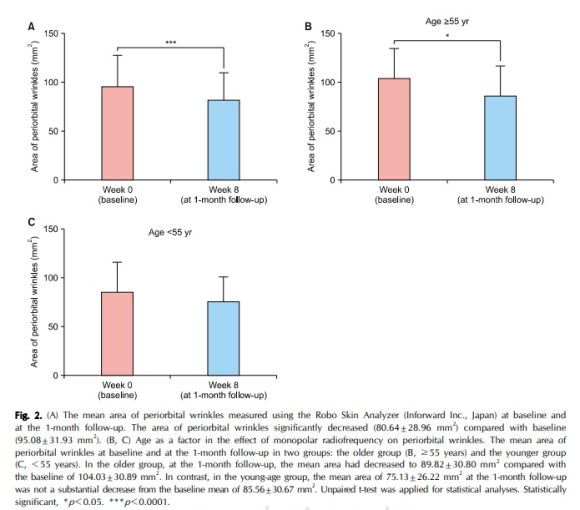
That was an improvement rate of about 15.19%.
The difference was also statistically significant.
An even more interesting finding was
the difference by age.
The researchers divided the participants into two groups:
55 and older, and under 55.
In the 55-and-older group,
the area decreased from 104.03 mm² before treatment
to 89.82 mm² after treatment,
while in the under-55 group,
it decreased from 85.56 mm² to 75.13 mm².
This means that the older the person and the more severe the wrinkles,
the more noticeable the effect of Arioligio can be.
The researchers believed that older people have more stretched
and loosened collagen fibers,
so even with the same level of thermal stimulation,
there is greater room for collagen contraction and regeneration.
In other words, because there is more room for improvement,
the change stands out more.
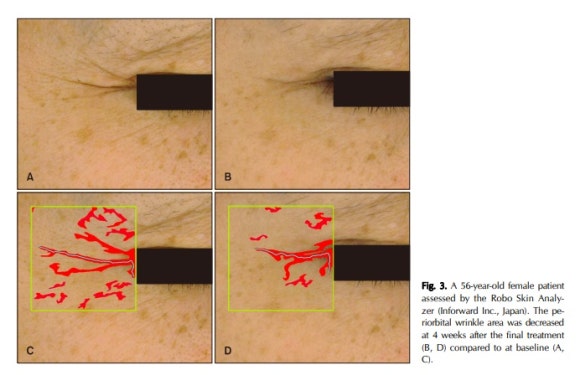
In the before-and-after photos of a 56-year-old woman
who participated in the study,
wrinkles were also clearly reduced.
- Arioligio
How can you improve the results?
The factors that affect Arioligio results
can be broadly divided into three areas.
Age and wrinkle severity, the treatment protocol,
and aftercare.
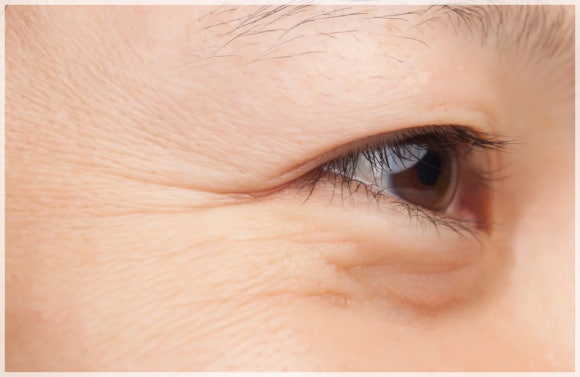
Age and wrinkle severity
As explained above, the effect is more noticeable
when the patient is 55 or older,
or when the wrinkles are severe.
This is because there is greater room for collagen contraction
and regeneration.
On the other hand, if a person is younger and has only mild wrinkles,
the effect may be minimal
or vary greatly from person to person.
Therefore, Arioligio is best suited for middle-aged and older adults
with moderate or greater crow’s feet wrinkles.
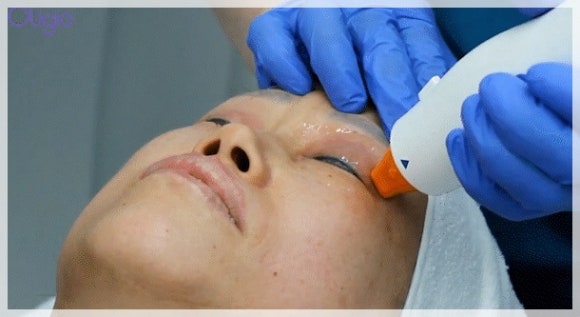
Treatment protocol
The effect of Arioligio depends
on how the procedure is performed.
In the study above, three treatments were performed
at two-week intervals.
The number of sessions matters, but
it is also important to use the proper energy level
based on the skin condition.
If the energy is too weak, there will be no effect;
if it is too strong, side effects may occur.

Aftercare
After Arioligio, collagen regeneration continues
for 2 to 3 months.
The results can vary depending on the skin environment during this period.
For 1 to 2 weeks immediately after the procedure,
it is important not to give the skin excessive stimulation.
In particular, you should avoid strong massage, saunas,
Korean steam rooms, and vigorous exercise.
Sun protection is also essential.
Skin that is in the process of regenerating is vulnerable to external stress,
so exposure to ultraviolet rays may cause pigmentation
or inflammatory reactions.
Therefore, apply sunscreen carefully,
and use a hat or umbrella during times when the sunlight is strong.
Today, we talked about the effects of Arioligio.
We looked in detail at the principle behind how Arioligio can
improve crow’s feet wrinkles,
and how much effect can be expected.
Worries about crow’s feet tend to increase
as people get older.
As shown in the study, if you are 55 or older
or if the wrinkles are moderate to severe,
you can expect more noticeable results,
so please do not assume that deep wrinkles are already too difficult to address.
I hope today’s post was helpful for those concerned
about crow’s feet wrinkles.
Thank you. This has been Jamsil U&I^^
< How to Find a Good Dermatology Clinic in Jamsil? >
< Jamsil U&I Clinic Hours >
Weekdays: am 10:00 ~ pm 08:30
Saturday: am 10:00 ~ pm 05:00
(Consultations without a lunch break)
< Directions >
The Jamsil branch of U&I Clinic is
located in the Lotte World Wellness Center.