"Is it really such a big deal to be missing one tooth?"

Losing even one tooth means losing much more than you might think.
At first, you may not even notice the inconvenience, but one day you look in the mirror and feel that your face somehow looks different. During meals, chewing the foods you usually ate becomes uncomfortable, and gradually even your speech may start to sound unclear.
And only then do you realize how much impact a small tooth can have on our daily lives.
Around that time, you often hear one thing from people around you: "These days, implants are the best. You can use them comfortably just like natural teeth."
But once it becomes your own situation, your thoughts change. Just the word surgery feels burdensome, and you start wondering, "Will the cost be too high?" and "Where is a clinic that is truly good?"
So many worries circle in your head. In moments like that, it is important to step back first and think through things one by one.
From here on, I will explain everything from the basics for those who are new to implants.
- Why should you get an implant?
"Can’t I just leave a missing tooth as it is?" To put it simply: no, you should not.
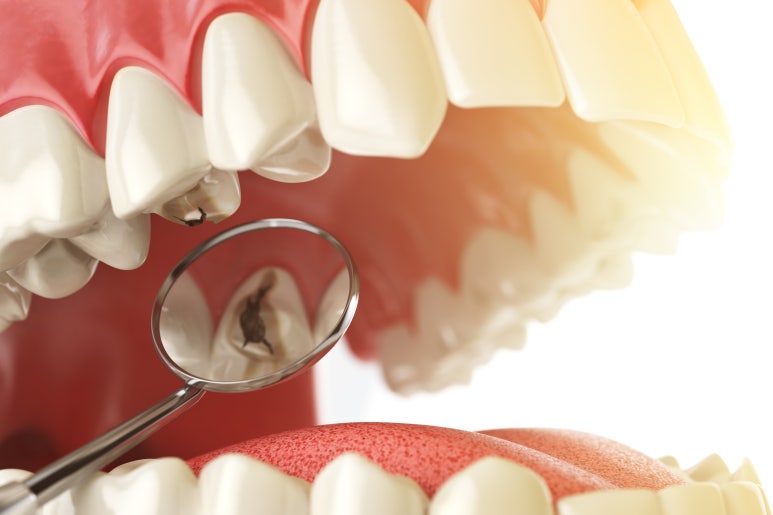
When a tooth is missing, the surrounding teeth try to fill the gap by tilting, and the upper and lower teeth that bite together may shift upward or downward, causing the entire alignment to collapse.
As time passes, chewing ability declines, and it can even lead to changes in facial shape. In particular, if the missing tooth is a front tooth, it can affect appearance and often lead to reduced confidence.
That is why replacement treatment is needed quickly, not just for cosmetic reasons but also for health. An implant is known as one of the best alternatives for restoring function that is closest to a natural tooth.
Key advantages of implants
-
Chewing force close to that of natural teeth
-
Can be performed independently without damaging adjacent teeth
-
Can last long term (10 to 20 years or more)
-
Both aesthetically pleasing and functional
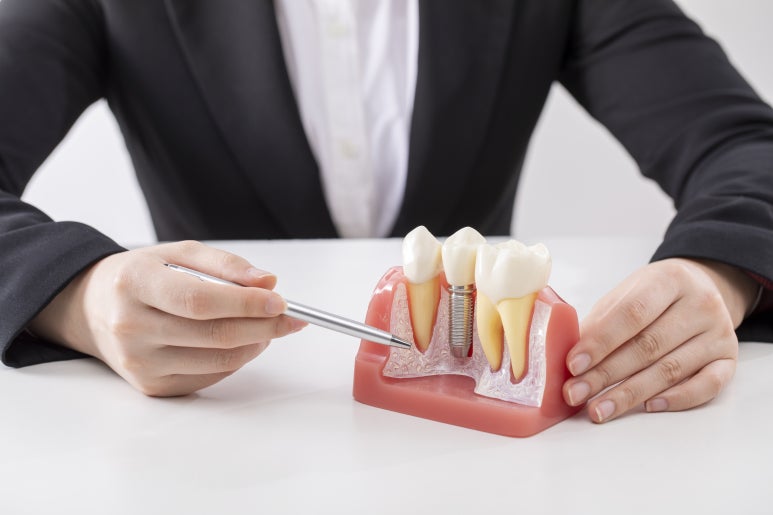
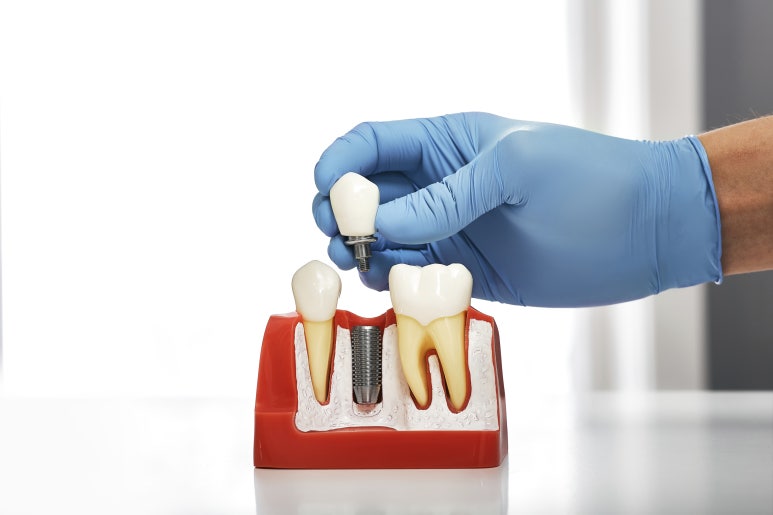
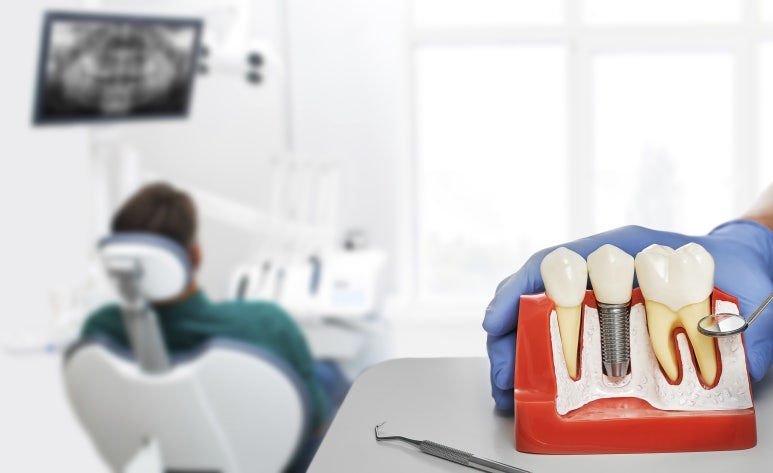
Unlike conventional prosthetic treatments such as dentures or bridges, an implant has a structure in which an artificial root is placed independently and a tooth is then built on top of it. Because of this, it is firmly fixed and can be used without wobbling, and its chewing strength is also very close to that of a natural tooth.
- How is the implant procedure performed?
"It’s not a scary surgery; it’s more systematic than you think"
One of the biggest concerns for people encountering implants for the first time is the word “surgery.” But modern implant procedures are far more precise than in the past, and they have developed in a direction that minimizes pain.
Depending on the patient’s condition, the process is divided into one or two stages, but it generally follows the flow below.
Step 1. Detailed examination and diagnosis
This is the stage where the overall condition inside the mouth is examined before the procedure.
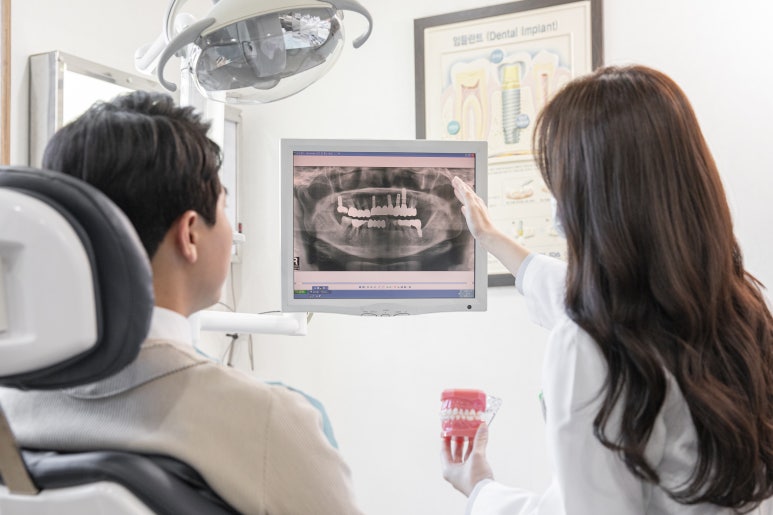
Through CT scans, 3D scanning, and intraoral imaging, the amount of jawbone, the position of nerves, the condition of surrounding teeth, and more are checked.
At this time, systemic conditions such as diabetes and high blood pressure are also checked.
This diagnosis must be thorough for the implant success rate to be high. A good clinic will take enough time from the examination stage to explain everything and establish a plan.
Step 2. First surgery – placement of the artificial root (fixture)
After local anesthesia, the artificial root is placed into the jawbone.
This process takes about 30 minutes to 1 hour, and you can go home the same day.
For about 2 to 4 months after surgery, there is a period of osseointegration, during which the bone and the screw are allowed time to firmly bond.
Step 3. Second surgery – abutment connection
After confirming that the fixture has settled in stably, the abutment (the connecting part) is attached on top.
At this point, the preparation for the artificial tooth is complete.
Step 4. Prosthetic (crown) fabrication and placement
A custom prosthetic is made and attached, taking into account the patient’s tooth shape, color, bite, and more.
At this stage, the quality and precision of the clinic’s prosthetic work are also very important.
Once all the steps are complete, you can use it naturally and comfortably, almost as if it were your original tooth.
- After an implant, the care rules you must know
"It’s not the end; it’s the beginning" Post-procedure care is half of the implant treatment.
In particular, while the root (fixture) is strong, the surrounding gums and bone are still vulnerable to infection, so they require even more careful care than natural teeth.
Tips for long-lasting implants
-
Brushing, flossing, and interdental brushes are essential
-
Regular checkups at least every 6 months
-
No smoking! This is absolutely essential.
-
Be careful with hard foods (nuts, ribs, etc.)
-
If you experience intermittent pain or swelling, visit the dentist immediately
Peri-implantitis is a disease similar to periodontitis, and if it is not properly managed, the implant may become loose or fall out. That is why, even after the procedure, you need to pay attention and make an effort as if it were your own tooth.
- How can you choose a good clinic?
"In the end, implants are something done by human hands"
No matter how good the materials are, the results vary greatly depending on whose hands perform the procedure.
Especially in areas like Seoul, where there are many dental clinics, choosing well is more important than anything else.
Checklist for choosing a clinic
-
Whether they have extensive implant experience (including whether they are a specialist)
-
Whether they have precise diagnostic equipment (CT, intraoral scanner, etc.)
-
Whether they transparently disclose the implant material brand and country of origin
-
Whether they provide sufficient explanation and consultation according to the patient’s condition
-
Whether they have a post-procedure care program (regular checkups, warranty system, etc.)
Also, be careful with advertisements that promote extremely low prices.
Promotional implants that seem too cheap can lead to issues with material quality or aftercare.
A good clinic will realistically explain the treatment plan from the consultation stage and suggest the best option based on the patient’s condition.
Choose implants carefully, with accurate information
An implant is not simply a procedure to place one tooth.
It is an important choice that restores weakened chewing function and confidence, and brings back comfort in daily life.
Choose a little more carefully and start properly at a clinic you can trust.
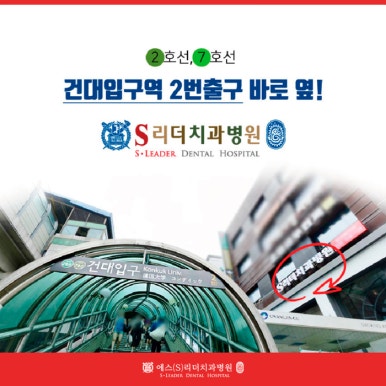
 Seoul dental clinic recommendation:: S Leader Dental Hospital