Hello, this is S Leader Dental Hospital, Gwangjin-gu Dental Clinic.

"It was fine at first, but now it’s getting more sensitive and painful"
At first, your front tooth may have only felt slightly sensitive, but over time, did it start throbbing even with cold water, or did you notice a subtle color change when looking in the mirror?
Many people think, “It’s probably nothing,” and let it go, but cavities in the front teeth progress faster than in other areas, and once damage occurs, it becomes noticeable right away, which makes early treatment especially important.
Front teeth are the first part people see when you speak or smile, so they are a major concern aesthetically. But it’s not just about appearance: if front tooth cavities are left untreated, they can weaken the tooth structure itself and lead to nerve damage.
In the beginning, it may only cause color changes or slight sensitivity, but as the pain gradually worsens, it can start affecting daily life.
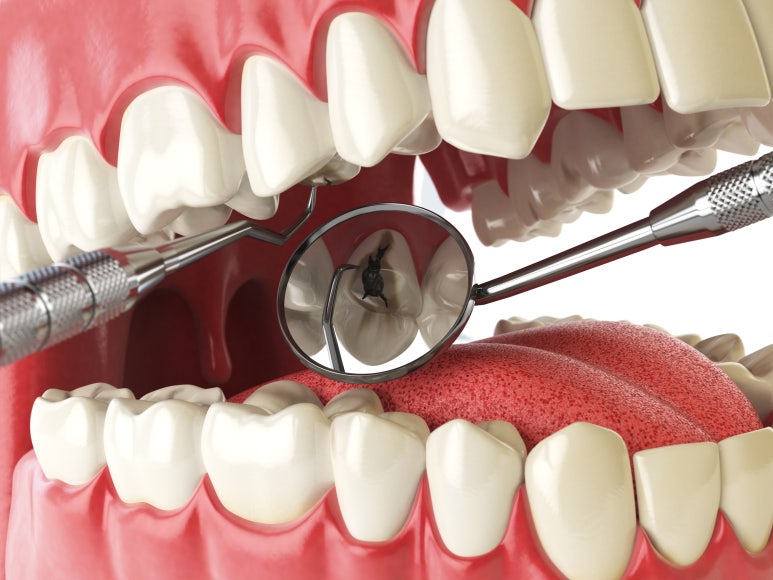
Why front tooth cavities need more attention than cavities in other areas
Front teeth have weaker chewing force and thinner enamel than molars.
Because of that, when decay starts, the protective layer wears away quickly and the problem progresses rapidly into the inner tooth. In addition, front teeth have narrow spaces between them and a flatter shape, so cavities are often not easy to see early on.
Foods and drinks with strong pigments or acidity, such as coffee, wine, and fruit juice, can easily cause staining and demineralization on the surface of front teeth.
When tiny cracks or erosion develop, cavity-causing bacteria spread quickly through those gaps. The problem is that if these cavities are left untreated, they may look small on the outside while already being deeply decayed inside.
Also, because the nerve in front teeth is closer to the surface than in other teeth, once decay advances beyond a certain depth, it quickly leads to pain.
Even if the initial symptom is just mild sensitivity, if it gradually changes into sharp pain → dull pain → pain without any stimulus, there is a high chance that inflammation has already reached the nerve.

How front tooth cavity symptoms progress
Decay is already progressing inside the tooth even before a visible hole appears.
The stages are as follows.
1 Early cavity (demineralization stage)
The enamel is dissolved by acid and turns white. There is no pain, but the surface may feel rough and sensitivity can appear.
2 Mid-stage cavity (enamel damage stage)
The surface turns brown or gray, and food begins to get stuck. Intermittent sensitivity and pain may occur.
3 Advanced cavity (dentin involvement)
The tooth reacts to cold water or sweets, and pain is felt continuously. From this stage, if treatment is delayed, there is a high possibility that inflammation will spread to the nerve.
4 Severe cavity (nerve inflammation stage)
The tooth throbs even without any stimulus, and pain worsens at night. Root canal treatment is needed, and pain relief from medication is only temporary.

[Why treatment should not be delayed when pain is severe]
Pain caused by cavities is a sign that the internal tissue of the tooth has already been damaged.
Many people think, “Should I just endure it a little longer?” and only take painkillers, or believe that if the symptoms subside, everything is fine. But in reality, even if the pain disappears, the cavity has not stopped.
In particular, the nerve in front teeth is narrow and sensitive, so if inflammation spreads, the nerve can die or the inflammation can reach the root tip.
Once this happens, simple resin treatment is no longer enough, and root canal treatment followed by prosthetic restoration (a crown) may be necessary.
As the scope of treatment becomes larger, more of the tooth’s natural structure is damaged, and both cost and treatment time increase.
Above all, because aesthetics are especially important for front teeth, one downside is that if root canal treatment or a crown is needed, it becomes difficult to fully restore the natural color and translucency.
Therefore, once pain appears, you should not think, “It will get better,” but rather take it as a sign that you need treatment right away.

Front tooth cavity treatment methods, by stage
Treatment for front tooth cavities varies depending on the depth and extent of the decay.
Early stage: If the cavity is not deep, the decayed area is removed and filled with resin (a restorative material that is similar in color to the tooth). In this case, there is almost no pain and treatment can be completed the same day.
Mid-stage: If the cavity has progressed to the dentin, it is removed and restored before the infection spreads too close to the nerve. At this point, temporary sensitivity may remain.
Severe stage: If inflammation has reached the nerve, root canal treatment is needed followed by a crown. For aesthetics in front teeth, ceramic crowns or zirconia crowns are often used.
If color change is severe: If pigmentation has occurred inside the tooth, whitening or laminate treatment may be combined after cavity treatment to restore the appearance aesthetically.
In other words, the earlier the treatment, the smaller the treatment area and the more of the natural tooth can be preserved.

[For front tooth cavities, prevention is best.]
Treatment is important, but above all, managing your oral health to prevent cavities is the best approach.
Front teeth are exposed to food, drinks, and staining, so even small changes in habits can make a big difference.
-
Use dental floss after brushing: Food gets stuck easily between front teeth, so flossing is essential.
-
Do not brush immediately after consuming acidic drinks: Brushing right away when the enamel is weakened can cause damage.
Rinse with water and brush after 30 minutes.
Small habits help prevent cavities and keep your teeth healthy for a long time.

If sensitive pain has started, now is the perfect time for treatment.
Front tooth cavities progress faster than you might think.
If a tooth that only felt sensitive at first has now become discolored and hurts when chewing, it is already at a stage that needs treatment.
In particular, because front teeth are visible cosmetically, the longer treatment is delayed, the more difficult restoration becomes, and the results may be less satisfying.
If your front teeth have recently become sensitive or changed color, we recommend getting a dental examination even if it’s just for a moment.
Front tooth cavity care, Gwangjin-gu Dental Clinic
Start at S Leader Dental Hospital
At S Leader Dental Hospital, Gwangjin-gu Dental Clinic, when treating front tooth cavities, we do not focus only on removing the decay; we provide customized treatment that considers both aesthetics and function.
To restore the tooth as close as possible to its natural color and minimize nerve damage, we combine microscopic diagnosis with precise resin procedures.
We also provide thorough guidance on tooth care methods, proper brushing habits, and dietary adjustments to help prevent recurrence after treatment and reduce the chance of future cavities.
Do not ignore minor pain. At S Leader Dental Hospital, Gwangjin-gu Dental Clinic, regain a healthy smile and confidence through accurate diagnosis and prompt treatment!!






Gwangjin-gu Dental Clinic :: S (S) Leader Dental Hospital