Everything about cavities, from treatment methods and treatment time to cost
Hello, this is Songjeong-dong Dental Clinic, S Leader Dental Hospital.

Cavities are a very common condition, but not all cavities are treated the same way. Many people ask when they visit a dental clinic, “Can’t you just fill the cavity?” In reality, however, the treatment method changes completely depending on the stage of the cavity, and the materials used, treatment time, and scope of treatment can all vary greatly.
Teeth have a much more delicate structure than they appear to from the outside, and because the available treatment options depend on how deep the cavity has progressed, an accurate diagnosis and a treatment plan matched to the stage are very important.
In this post, Songjeong-dong Dental Clinic, S Leader Dental Hospital, explains in detail how cavities progress and what treatment is needed at each stage.

Stage 1: Early cavity (enamel caries) - "The start of a cavity; management is key"
This is the earliest stage of a cavity. As the outermost layer of the tooth, the enamel, becomes demineralized, white or brown spots begin to appear. At this stage, patients usually feel almost no pain or discomfort, and it is often only found during a dental exam or on an X-ray.
The characteristic of this stage is that the tooth has not yet developed a hole. In other words, this is the only stage in which the cavity has progressed but can still recover with management rather than direct removal and filling. Fluoride application, sealants for tooth grooves, correction of brushing methods, and dietary adjustments are used to prevent the cavity from progressing deeper.
The problem is that most patients do not detect cavities on their own at this stage. Early cavities progress slowly, but because detection is delayed, they can easily move into a stage that requires treatment, which is why regular checkups are emphasized even more.
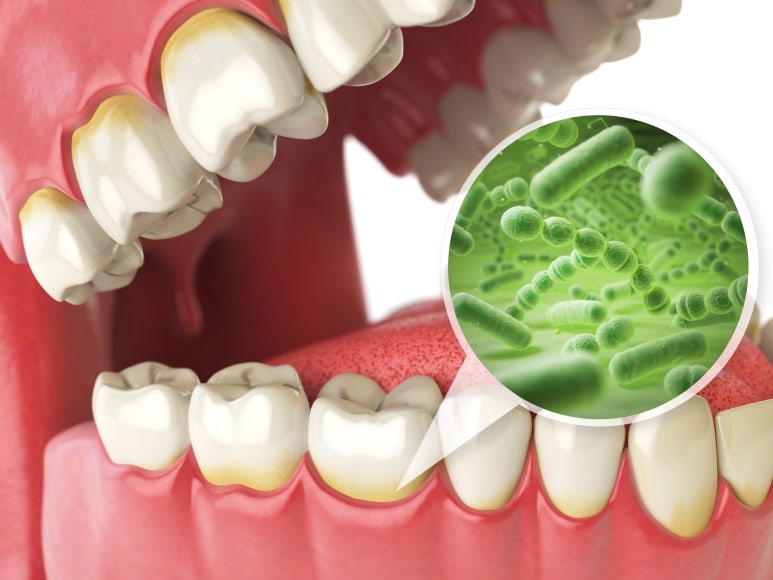
Stage 2: Small cavity (junctional enamel-dentin caries) - "Can be treated simply with resin"
When the cavity reaches the dentin layer beneath the enamel, it becomes a stage that requires dental treatment. If the hole is still small and not deep, resin (composite resin) treatment is usually enough.
Resin has a color similar to natural teeth, making it aesthetically pleasing, and because only the cavity area is minimally removed, it is advantageous for preserving the tooth. The treatment time is short, and because it can be completed on the same day, patient satisfaction is generally high.
However, even at this stage, pain is often minimal, so patients may find it difficult to notice the cavity themselves. Therefore, treating it before it grows larger is the most efficient approach. If treatment is delayed at this stage, the cavity can spread deeper into the dentin, potentially requiring larger restorative treatment.
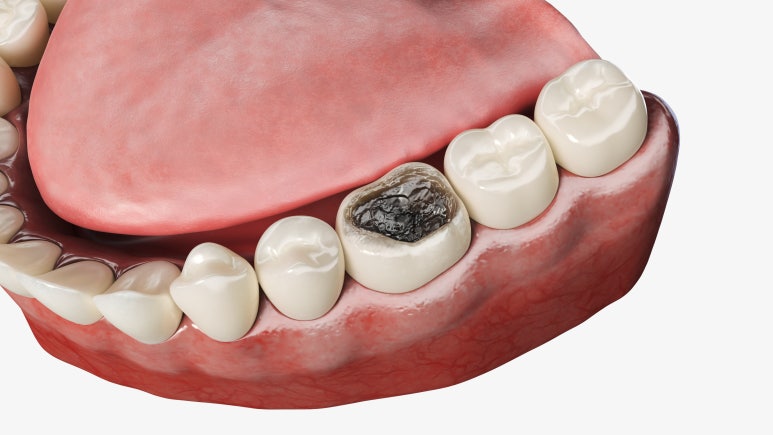
Stage 3: Moderate cavity (dentin caries) - "A stage where inlay/onlay treatment may be needed"
When the cavity digs deeply into the dentin, a significant portion of the tooth’s internal structure is weakened. At this point, simple resin may not be sufficient to maintain strength or shape, so restorative treatment such as an inlay or onlay is likely to be needed.
Dentin is softer than enamel and cavity progression is faster, so at some point the cavity may appear to have suddenly spread widely. If the cavity area is large, some of the tooth wall must remain, but that wall can become weak and easily fracture. Inlays and onlays protect this wall and restore the tooth’s shape so it can be used for a longer time.
At this stage, patients often complain of a sensitive feeling when cold or sweet foods seep in. But if it is left alone with the thought that “it just feels a little sensitive for now, so it should be okay...,” the cavity will progress deeper toward the nerve. In the end, the longer treatment is delayed, the greater the treatment scope and cost will become.
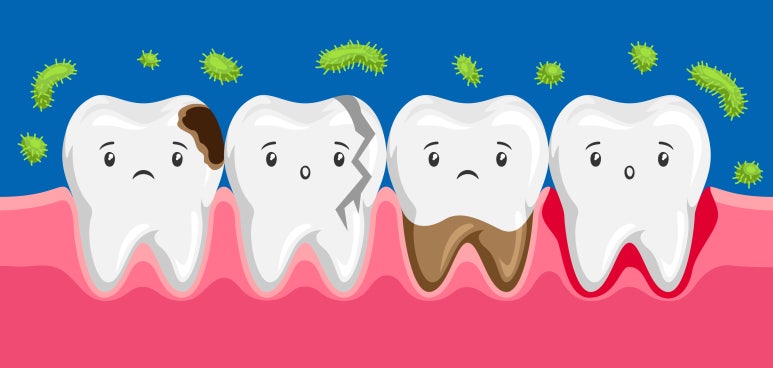
Stage 4: Deep cavity (cavity near the pulp) - "Right before root canal treatment, with a higher chance of a crown"
When the cavity reaches close to the nerve, it becomes more sensitive and pain occurs more frequently. Pain may be felt not only with cold and hot foods, but also in various situations such as drinking alcohol or carbonated drinks, or chewing hard foods.
At this stage, much of the healthy tooth structure has been damaged, so treatment may require a crown (full-coverage restoration) beyond an inlay or onlay. A crown is shaped to cover and protect the entire tooth, and if the remaining tooth walls are weak, it is the most effective way to protect them and restore function.
If the nerve is still alive at this stage, treatment may be attempted to preserve it without root canal treatment as much as possible. However, if the cavity is extensive and the symptoms are severe, root canal treatment must also be considered. Many people come in at this stage hoping that “it’s not too late.”

Stage 5: Cavity that has reached the nerve (pulpitis) - "Root canal treatment is essential"
When the cavity invades the pulp (nerve tissue), the intensity of the pain changes completely. You may feel a throbbing pain when lying down at night, a sudden sharp pain when chewing, and in some cases, a heartbeat-like pain even without any stimulus.
At this point, root canal treatment is absolutely necessary.
Root canal treatment is the process of removing the inflamed nerve tissue inside the tooth, disinfecting the internal space, and then filling it with a sealing material to save the tooth. The inflammation is removed and the pain is relieved through root canal treatment, but because a tooth without a nerve becomes weaker, a crown is needed in most cases after treatment.
Many patients say, “Root canal treatment sounds too scary,” but in reality it is a treatment performed to eliminate pain, so in most cases symptoms improve after treatment. However, because root canal treatment itself is complex and may require multiple visits, the treatment period can become longer.

Stage 6: Periapical inflammation (root inflammation) - "Root canal retreatment or surgical treatment is needed"
If a cavity is left untreated for a long time, the nerve dies and the inflammation can spread to the tip of the root, causing root tip inflammation (a periapical lesion). At this point, the tip of the root may appear dark, there may be tenderness when chewing, and the gums may swell or pus may come out.
There are two treatment options at this stage.
- Root canal retreatment – repeat the previous root canal treatment to remove the internal inflammation
- If it is difficult to resolve with root canal treatment, surgical treatment (apicoectomy)
Once it has progressed to this stage, the prognosis for the tooth becomes more complicated, the treatment period becomes longer, and the cost may also increase. In severe cases, extraction may be considered, so it is most important to treat cavities as early as possible.

An accurate diagnosis and stage-based treatment can change the prognosis of a cavity.
Songjeong-dong Dental Clinic, S Leader Dental Hospital, will help you.
A cavity is not simply a matter of “there is a cavity vs. there is no cavity.” The treatment method and prognosis vary completely depending on how deep it has progressed, how weakened the tooth structure has become, and how much distance remains from the nerve.
If it is caught early, it can be prevented with simple management and conservative treatment, but after a certain point it must progress to root canal and prosthetic treatment, and if delayed further, there is even a risk of losing the tooth. That is why what matters in cavity treatment is not “treated quickly,” but “received the right treatment at the right time.”
At Songjeong-dong Dental Clinic, S Leader Dental Hospital, we do not view cavities as a single simple disease. Instead, we analyze them in greater detail, from early lesions to intermediate stages, advanced stages, nerve involvement, and the risk of recurrence.
Even when the cavity depth is the same, the treatment plan is made by considering various factors such as the patient’s lifestyle habits, saliva flow, gum condition, existing restorations, and occlusion pattern, which allows for more accurate prognosis prediction and helps reduce unnecessary overtreatment.
We also apply 3D imaging equipment, microscope-based care, and a precision diagnostic system to examine the inside of the tooth carefully, and we explain things so that patients can understand for themselves “why this treatment is needed” and “at what stage it should stop.”



Songjeong-dong Dental Clinic :: S Leader Dental Hospital