We’ll explain at Sanggye-dong Dental Clinic.
Q&A for those who want to align only 1–3 teeth
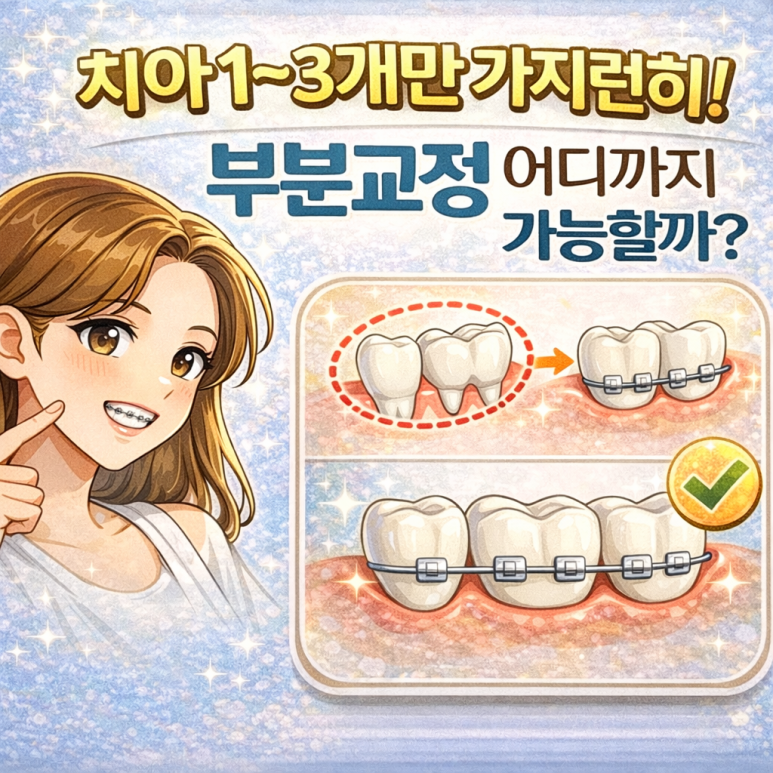
Hello, this is S Leader Dental Hospital, a Sanggye-dong dental clinic.
Many people are interested in orthodontic treatment, but hesitate to go through traditional full-mouth orthodontics.
“Only one front tooth is crooked, and the rest are fine. Do I really need full orthodontic treatment?”
“I want to straighten just a few front teeth before my wedding. Is that possible?”
“I had orthodontic treatment before, but my front teeth shifted a little. Do I need full treatment again?”
When only a few specific teeth are the problem like this, more and more people are considering ‘partial orthodontic treatment’ instead of full orthodontic treatment.
Today, based on questions commonly seen in real clinical practice, we will explain in Q&A form the possibilities, limitations, and suitable conditions for partial orthodontic treatment in detail.
Q1 What exactly is partial orthodontic treatment?
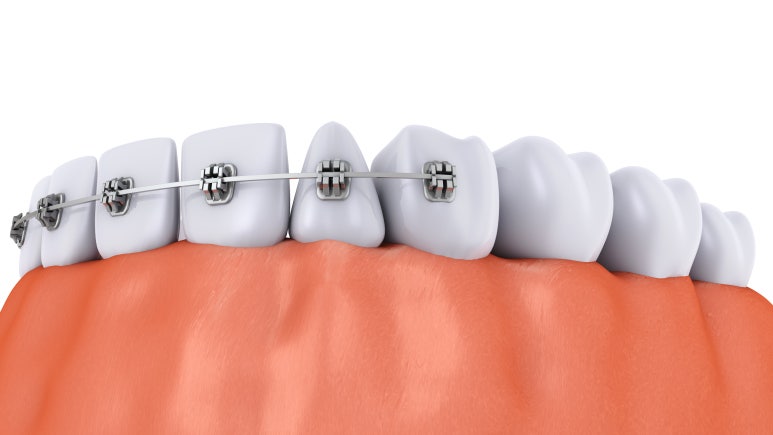
Partial orthodontic treatment is, as the name suggests, alignment treatment limited to only some teeth rather than the entire dentition.
It usually corrects the arrangement of just 2–6 front teeth, and it has the advantage of requiring less time and cost than full orthodontic treatment, while also causing relatively less inconvenience in daily life.
It is often done for the purpose of improving the aesthetics of the front teeth that show when smiling, and partial treatment is performed using clear aligners (such as Invisalign, Clippy-C, etc.) or small bracket appliances.
In this way, partial orthodontic treatment lowers the barrier to starting orthodontic care, and is often chosen by busy office workers or those preparing for a specific event such as a wedding or photo shoot.
However, even though it may seem like only a few teeth need to be straightened, side effects can occur if the balance of the overall bite and the condition of the alveolar bone are not considered. So rather than choosing it purely for cosmetic reasons, an approach based on an accurate diagnosis is important.
Q2 Is it really okay to correct only 1–3 teeth?
Many patients say, “I just want to straighten exactly three front teeth.”
In fact, if one or two teeth are slightly positioned inward or rotated, or if the gap between the front teeth is only slightly open, very satisfying results can often be achieved with partial orthodontic treatment alone. In such cases, the treatment burden is reduced while still achieving clear aesthetic improvement, making it suitable for those who want noticeable results in a short time.
However, what is important here is that even if only a few visible teeth seem to be the problem, the cause may lie elsewhere.
For example, the reason one front tooth is crooked may be due to an abnormal molar position, jaw asymmetry, or a general issue with pressure across the dentition. In such cases, forcibly moving only that tooth can eventually collapse the overall bite and may even cause recurrence or temporomandibular joint pain.
Therefore, even when partial orthodontic treatment is possible, rather than simply proceeding with the request to “straighten only the front teeth,” a precise diagnosis that identifies the overall structure through 3D CT or digital scanning and adjusts the scope of treatment should come first.
Q3 In what cases is partial orthodontic treatment suitable?
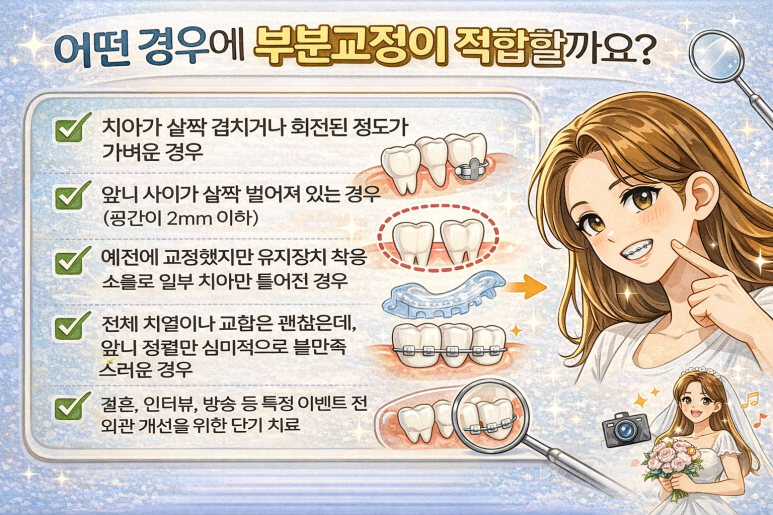
If the following apply, partial orthodontic treatment can be very effective and may be an option instead of full orthodontic treatment.
✔ When the tooth crowding or rotation is mild
✔ When there is a slight gap between the front teeth (space under 2 mm)
✔ When you had orthodontic treatment in the past, but some teeth shifted because you did not wear your retainer properly
✔ When the overall bite and dentition are fine, but the alignment of the front teeth is aesthetically unsatisfactory
✔ Short-term treatment to improve appearance before a specific event such as a wedding, interview, or broadcast
As such, when the conditions are right, partial orthodontic treatment is a practical method that can provide maximum satisfaction in a short period of time. In particular, in cases where retreatment is needed, improvement can often be achieved sufficiently with a partial “retouch” approach rather than repeating full orthodontic treatment.
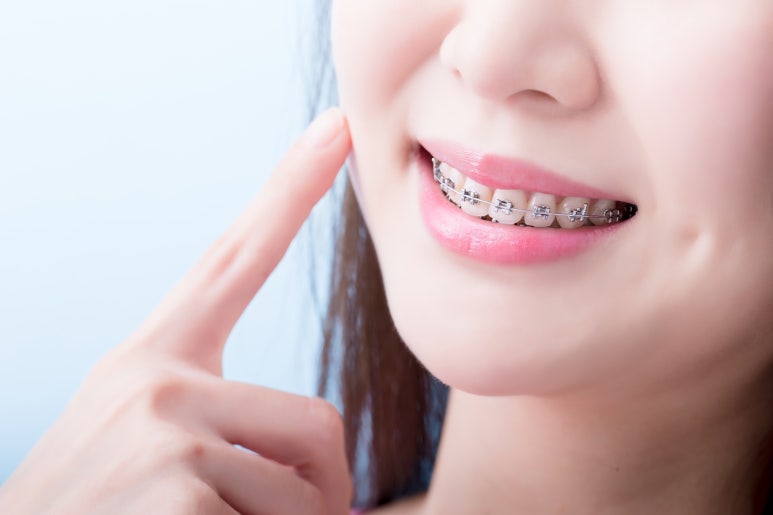
Q4 In what cases is partial orthodontic treatment not suitable?
Partial orthodontic treatment has many advantages, but because its scope is limited, trying to force it can actually lead to side effects.
The following cases may require full orthodontic treatment or a different treatment approach.
❌ When there is a jawbone problem (skeletal underbite, protruding mouth, etc.) ❌
❌ When the dentition lacks overall space more than it has an alignment problem ❌
❌ When the molar bite has collapsed or malocclusion is present ❌
❌ When there is a habit of chewing on one side or a temporomandibular joint disorder ❌
In particular, if the center of the bite does not match or the entire dentition is complexly misaligned, partial orthodontic treatment can make the problem worse.
That is because excessive force on one side can cause the teeth to become more misaligned and may affect speech or chewing function.
Therefore, the treatment approach should not be based on “making only the visible area pretty,” but on “achieving overall harmony.”
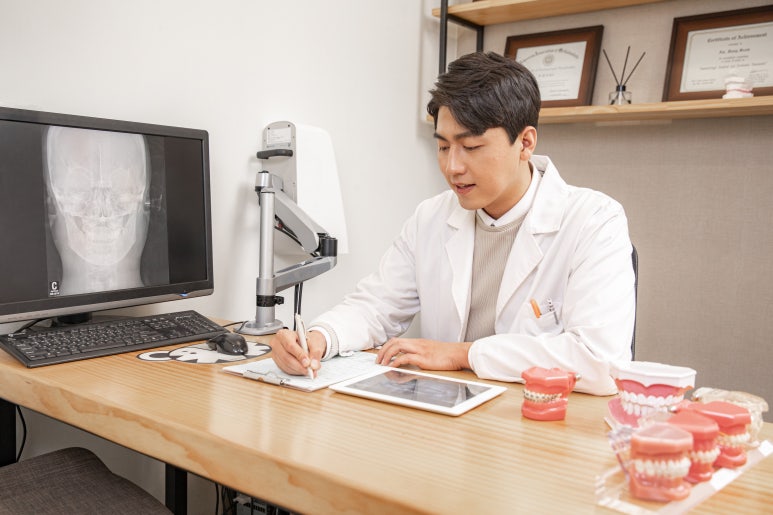
Q5 How long does it take and how much does it cost?
Partial orthodontic treatment generally takes less time and costs less than full orthodontic treatment.
In general, the treatment period is between 3 and 9 months, and in some cases it is often completed within 6 months.
The cost can also be around 30–60% of full orthodontic treatment, so it is often highly satisfying for patients because it greatly reduces the financial burden.
However, it should not be chosen simply because “partial treatment is cheaper.” The most important thing is whether it is the right treatment for the patient’s condition and treatment goals.
If the treatment scope is set incorrectly or if an unreasonable partial orthodontic approach is attempted, retreatment may be needed years later, or unwanted tooth movement may even cause functional problems.
In other words, partial orthodontic treatment is not “easier” or “simpler” than full orthodontic treatment; rather, it is a treatment that requires more precise judgment and must produce the best result within a limited scope. It should be understood as a highly skilled treatment.
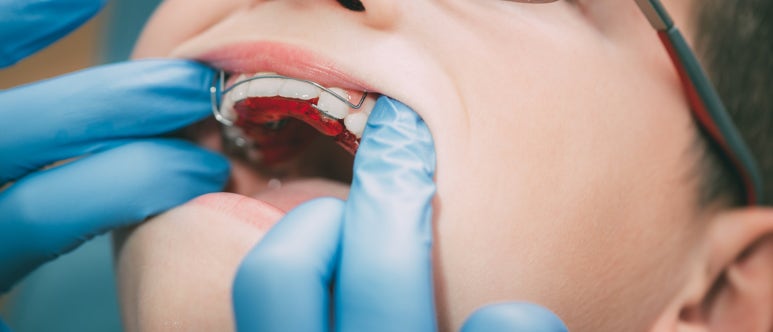
Q6 Are retainers necessary after partial orthodontic treatment?
The answer is “absolutely yes.”
Whether only part of the teeth was treated or the entire dentition was treated, teeth have a tendency to return to their original position. Front teeth, in particular, are used frequently and are exposed to many external forces, so if they are left without a retainer, they can quickly become misaligned again.
Therefore, after partial orthodontic treatment, a clear retainer or fixed retainer must be worn for a certain period of time, and regular checkups and retention monitoring at the dental clinic should also be carried out to maintain stable results for a long time.
There are many real cases in which patients neglect their retainers and then regret it when their teeth return to the pre-treatment state after a few years, so an orthodontic plan that includes retention management is important.
Although it is ‘partial’ orthodontic treatment, the diagnosis and plan must consider the ‘whole.’
If your front teeth are slightly spaced apart, or one side’s teeth are crooked, it is understandable to think, “Full orthodontic treatment is too burdensome.”
In such cases, partial orthodontic treatment is an excellent option that can achieve both aesthetics and practicality. However, rather than simply focusing on making a few teeth look better, it should be a diagnosis-centered treatment that also considers the balance of the bite, temporomandibular joint, and the entire dentition to lead to truly meaningful orthodontic results.
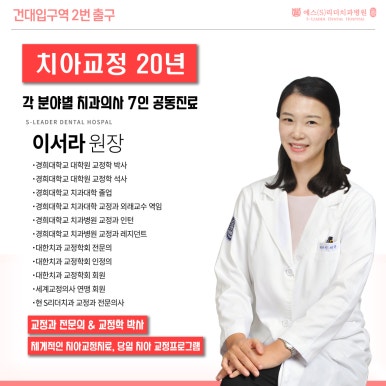
At S Leader Dental Hospital in Sanggye-dong, we propose orthodontic plans that can provide patients with sustainable results and satisfaction by considering not only the idea of “making only the visible teeth pretty,” but also the causes of tooth alignment, jawbone structure, the limits of tooth movement, and the prognosis.
If you are wondering whether partial orthodontic treatment is needed or whether full orthodontic treatment would be better, the first step is a consultation with a clinic that can accurately diagnose your current dental condition.
S Leader Dental Hospital, a Sanggye-dong dental clinic, is a dental clinic that stays with you from the beginning to the end of orthodontic treatment, including maintenance.
We hope you will begin your partial orthodontic treatment with S Leader: short but accurately diagnosed, less burdensome but clearly effective.


Sanggye-dong Dental Clinic :: S Leader Dental Hospital