Hello, this is S Leader Dental Hospital, a dental clinic in Sanggye-dong.

Many people who visit the dentist say this a lot.
“I really brush my teeth carefully... do I still need scaling?”
“I heard scaling wears down teeth.”
“I felt like my teeth got sensitive after one treatment, so I’m scared..."
In fact, scaling is not just an optional treatment you get at the dentist, but more like basic care to keep your gums healthy. And it makes sense why so many people put it off. It’s not something that hurts right away, so you have to make time for it, you worry you might feel sensitivity afterward, and you may also feel anxious, wondering, “Will this make my teeth weaker?”
Today, to help ease those worries a little, let’s go over why scaling is done, how it works, how often it’s good to have it done, and what to be careful about afterward.

Why is scaling needed?
Tartar can form even if you brush carefully.
Simply put, scaling is a treatment that removes tartar. But the important thing here is that tartar is not just “dirt”; it has hardened into something like a stone that keeps irritating the gums.
At first, a thin film forms on the tooth surface (a mixture of food debris and bacteria sticking together), and over time it hardens into tartar. The problem is that tartar tends to form in similar places.
Areas that are easy to miss no matter how carefully you brush, such as:
-
the inside of the teeth (toward the tongue)
-
the back side of the molars
-
the line where the gums and teeth meet
-
deep between the teeth
These are places where your hand does not easily reach and where it is easy to brush over carelessly out of habit. So for people who say, “I really brush well, so why do my gums keep bleeding?” it is often because tartar has built up in areas that are hard to reach.
When tartar builds up, the gums swell, they bleed when brushing, bad breath gets worse, and at some point the teeth may look longer (or the gums may seem to have receded), and sensitivity can appear. In other words, it is easier to understand scaling as not just something that makes things clean, but as prevention that helps stop gum breakdown.

Five common misconceptions about scaling
Is the worry that “it gets worse after getting it done” really true?
Because there are often stories like “I felt uncomfortable after scaling,” misconceptions can easily arise. But in most cases,
it is not that scaling caused a problem; it is closer to revealing an existing problem.
Misconception 1) “Does scaling wear down teeth?”
To begin with, scaling is not done to wear down teeth.
Scaling is not a treatment that removes tooth structure to change its shape; it is a process of removing tartar attached to the tooth surface. Of course, because of the sensation of the tool touching the tooth and the vibration, some people may feel like their teeth are being worn down, but that is not the same as intentionally grinding down the tooth.
Misconception 2) “Scaling makes the spaces between my teeth look wider”
This is a very common question. The reason the spaces may seem wider after scaling is usually because tartar was filling those areas. If tartar tightly fills the spaces between teeth, they can look like they are not open at all from the outside. But once it is removed, the original space becomes visible, and you think, “Oh, the gap is bigger?”
In other words, scaling did not create the gap; it simply revealed the space that was already there (or the state where the gums had receded).
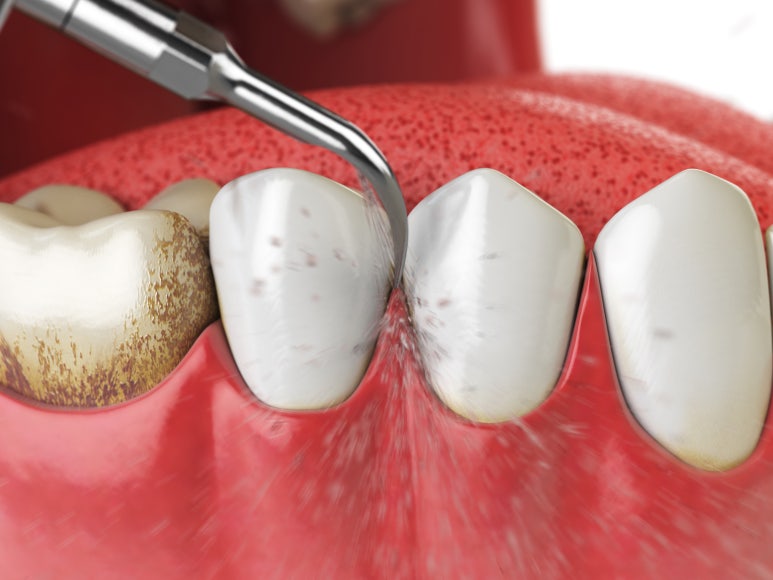
Misconception 3) “Scaling makes my teeth more sensitive”
Some people do feel sensitivity after scaling. In particular, if a lot of tartar has built up or the gums are sensitive, that can happen more easily. This is also because when tartar covering the gumline is removed, the tooth surface exposed to outside air or cold water increases, which can make it feel sensitive for a while.
In most cases, this gradually decreases over a few days to 1–2 weeks, and adjusting daily habits (such as not brushing too hard) often makes things much more comfortable.
Misconception 4) “My gums bleed during scaling. Does that mean they’ve become weak?”
Bleeding during scaling is usually not because the dental clinic was rough; in most cases, it is a sign that the gums are inflamed.
Healthy gums do not easily bleed just from being touched lightly. Bleeding means the gums are already swollen and sensitive, so that moment may actually be the right time for scaling.
Misconception 5) “Once a year should be enough, right?”
Actually, there is no single answer that is always correct.
For some people, once a year is fine, while others may need care every 3–6 months. What matters is not “how many times,” but the condition of your gums and how quickly tartar builds up.
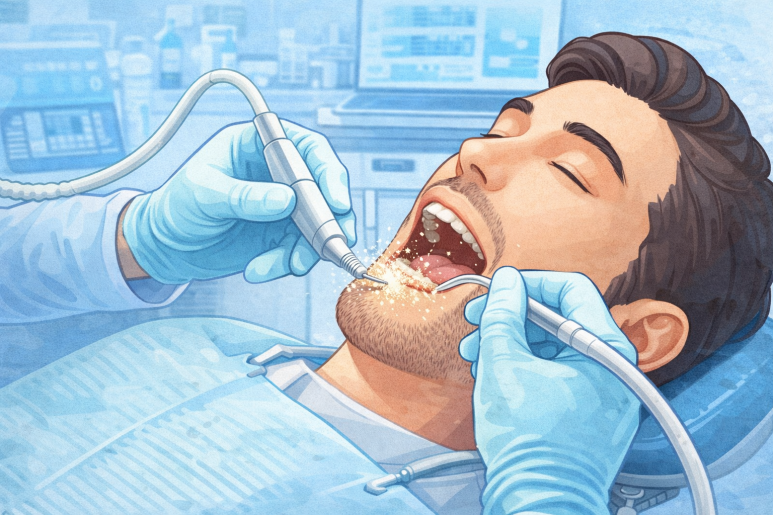
How is scaling performed?
What makes it feel vague and scary is that you do not know the process.
First-time patients often worry most about “how painful it will be.” In fact, in many cases scaling does not even require anesthesia, and the sensation varies depending on how much tartar there is and the condition of the gums.
Usually, scaling follows this flow.
Brief check of the inside of the mouth
The dentist checks whether the gums are swollen, bleed easily, or have tartar in certain areas.
Tartar removal
A tool that uses vibration and water together is used to remove tartar. Some people are nervous because of the sound, but many describe the feeling as “a tapping vibration.”
However, if the gums are already very sensitive or if the tartar is firmly attached near the gums, there may be a brief stinging or sharp sensation.
Additional guidance if needed
If tartar is deeply accumulated inside the gums, it may be more comfortable to proceed in stages rather than trying to finish everything at once. (This really varies a lot from person to person.)
Wrap-up explanation
After scaling, you will be given instructions on precautions and how to care for your mouth.
How should you decide the scaling interval?
Rather than just “roughly once a year,” it is better to set a schedule based on your own situation.
When deciding the scaling interval, it helps to think like this.
If your gums are stable and tartar does not build up much, managing it every 6 months to 1 year is often fine.
On the other hand, if tartar builds up easily or your gums are sensitive, checking in every 3 to 6 months is often helpful.
So, how can you tell which type you are? Here are some hints.
*Signs that it may be better to shorten the interval*
- Your gums bleed often when brushing.
- Bad breath has suddenly started to bother you.
- Your gums often feel swollen.
- Food keeps getting stuck between your teeth and causes odor.
- You are in orthodontic treatment, or you have many implants/prosthetics, making care harder.
- You smoke. (Gum recovery may be slower.)
In these cases, rather than waiting one or two years thinking, “It’ll be fine,” it is often much more comfortable to manage things a bit more closely.
Are these symptoms normal after scaling?
There are common reactions that can appear after scaling.
Common reactions (mostly within the normal range)
- A sensitive feeling for 1–2 days
- A slight amount of bleeding when brushing
- Feeling like the teeth suddenly became smooth and there is more space
- A feeling that the gums are “loose” (because the tartar has been removed)
On the other hand, if the following happen, it is better not to just endure them and to have them checked.
Cases that need checking
- The pain gets worse over several days.
- The gums swell, feel warm, or seem to have pus.
- The bleeding does not stop.
- The pain suddenly becomes strong when chewing.
Most cases pass without major problems, but checking “just in case” can actually help recovery go faster.
Practical ways to make the effects of scaling last longer
If tartar forms even though you brush carefully, the problem may be the “blind spots.”
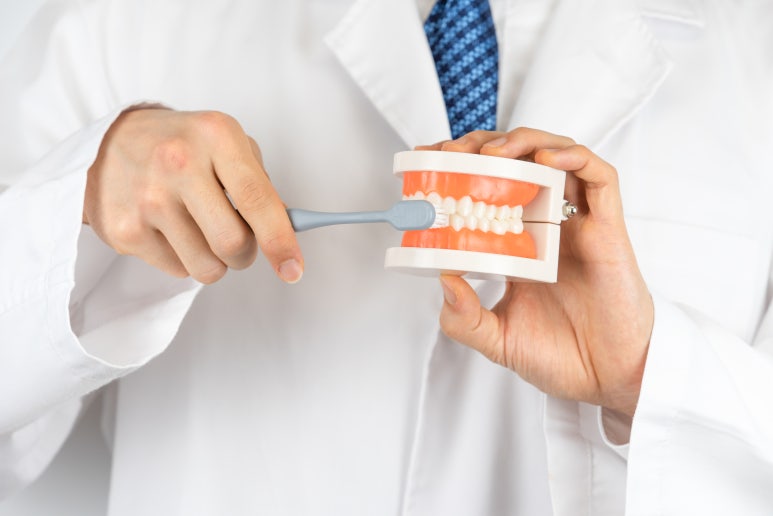
After scaling, your teeth may feel lighter and your mouth feels refreshed. To keep that feeling for longer, the key is not “brush harder!” but building habits that target the areas you usually miss.
Brushing is the basics, and for people whose teeth trap food easily, using dental floss or interdental brushes even just at night is very helpful.
Some people also find tools like a water flosser helpful as an extra aid.
The important thing here is not what is “best,” but finding a method you can keep up consistently. Doing your best for one or two days is less effective than maintaining one routine over a long time.
Scaling is not a treatment that “wears down teeth,”
it is one of the easiest ways to protect your gums.
If tartar is left to build up for a long time, at some point the gums keep swelling, bleeding, and discomfort starts to follow you around as if it were a habit. On the other hand, regular care often helps reduce the chance of leading to more extensive treatment rather than making you go to the dentist more often.
If your gums have been bleeding lately when you brush, if bad breath is bothering you, or if your gums often feel swollen, waiting until it hurts may not be the best idea. Checking your current condition now may be the most comfortable choice.
At S Leader Dental Hospital in Sanggye-dong, scaling is not just about removing tartar; we also check the condition of the gums and provide tips for daily care so that things can feel more comfortable next time. Please do not feel 부담, and start by simply checking what condition your gums are in.






Sanggye-dong Dental Clinic :: S Leader Dental Hospital