The more unsettling the moment,
we’ll help you organize “what to do now,” step by step.
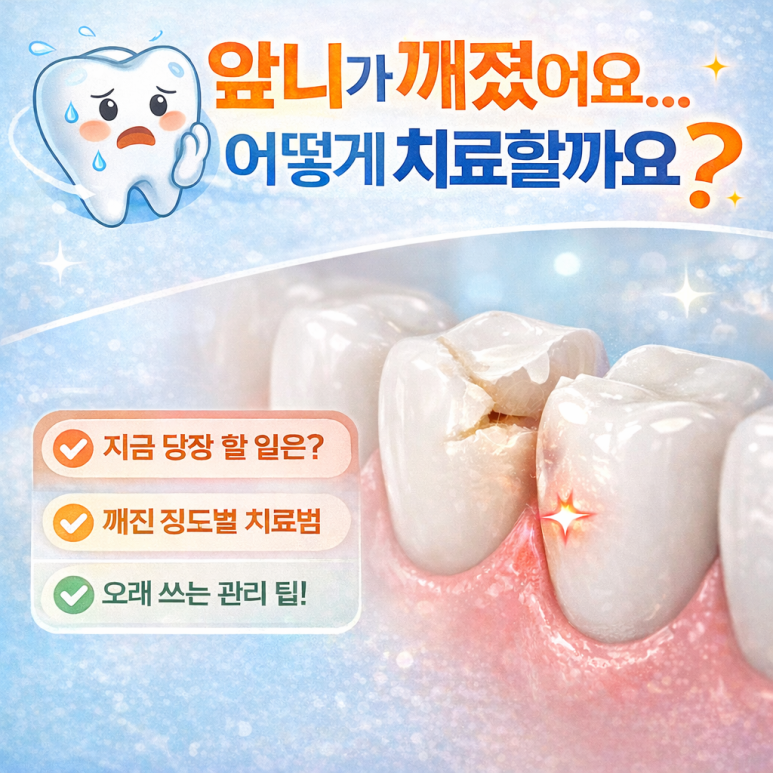
Hello, this is S Leader Dental Hospital in Gwangui-dong.
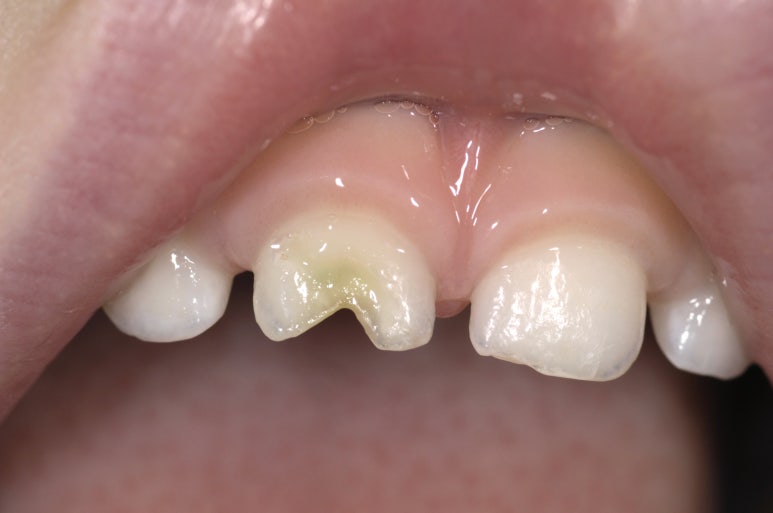
The moment a front tooth chips, it can be very upsetting. Unlike a molar, which is not visible, this is in a place that shows when you speak and smile, so the first thought is often, “What should I do?” In particular, people with upcoming photo shoots or a lot of face-to-face work tend to feel even more anxious.
Also, a chipped front tooth does not always mean the same treatment. If you only look at the size of the chip, you might think, “It can probably just be bonded with resin,” but in some cases the damage may extend close to the nerve or even involve problems near the root.
Conversely, there are also cases where it looks badly chipped on the surface but recovers more simply than expected.
Today, at S Leader Dental Hospital in Gwangui-dong, we’ll organize the topic of “when a front tooth chips” around the following:
-
What to do right now (emergency guide)
-
Why it chipped: causes
-
Treatment options based on the degree of damage
-
The diagnostic process at the dental clinic
-
The reality of the treatment process, duration, and pain
-
How to care for it after treatment (preventing recurrence)
First, this: 5 things to do right away when a front tooth chips (emergency guide)
When a front tooth chips, the most important thing is not just to “attach it quickly,” but to take actions that prevent further damage and keep more treatment options open. It’s helpful to remember the following five points first.
- If there is a broken fragment, do not throw it away; keep it
If a piece of the chipped tooth has fallen to the floor, it is best to find it and keep it if possible. In some cases, it may be useful depending on the condition of the fragment.
However, rather than wrapping it in tissue and letting it dry out, it is more recommended to store it in water or saline. (If it is left dry for a long time, the surface can become rough.)
- If there is bleeding, apply pressure to stop it and use a cold compress to reduce swelling
If there is bleeding from the lip or gums, gently press the area with clean gauze or tissue to stop the bleeding. If the face is swollen, a cold compress from the outside may help.
- Avoid hard foods for now, and do not tear things with your front teeth
A chipped front tooth means the tooth structure has weakened. If you tear bread with your front teeth or chew hard foods in this condition, the crack may deepen or the chip may become larger. It is better to focus on soft foods for the time being.
- If there is sensitivity or pain, reduce exposure to cold and hot stimuli
If the damaged area is deep, it may feel sensitive to cold water or hot soup. Since these stimuli can worsen pain, it is safer to reduce irritation until your visit.
- In the following cases, it is better to visit quickly
The situations below are better checked sooner rather than “wait and see for a few days.”
-
The chipped area is large (clearly badly chipped at a glance)
-
The pain is severe, or it throbs even at rest
-
It is extremely sensitive to cold water and the pain lasts a long time
-
There is bleeding from the chipped area, or the nerve seems to be visible
-
There was trauma such as a fall or collision (including pain in the lip or jaw)
At this stage, what matters is not “just endure it somehow,” but confirming the extent of the damage and deciding on the treatment plan.
Why did the front tooth chip? Understanding the cause makes recurrence easier to prevent.
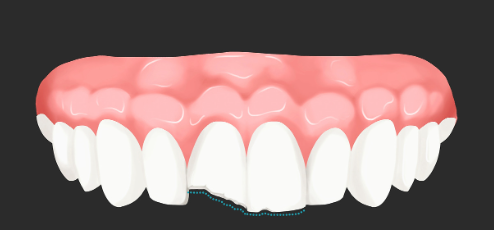
When a front tooth chips, it is important not only to “restore it with treatment,” but also to prevent it from breaking again. Front tooth fractures are often not caused by simple accidents alone.
- Trauma such as a fall or collision
This is one of the most common causes. In particular, children, people exercising, or those in slipping accidents may hit the front teeth and chip them. Trauma can affect not only the tooth surface but also the root area, so an examination is important.
- Hard foods (nuts, ice, bones, etc.)
Many people have a habit of “tearing” things with their front teeth. Repeatedly tearing open snack bags with your teeth or using the front teeth to break off food with bones can lead to accumulated microcracks and chipping.
- Wear of old resin or prosthetic restorations
Among people who had front tooth resin treatment in the past, the margins can weaken over time and that area may chip again. It may feel like “the tooth chipped,” but in reality it can be “the existing restoration chipped.”
- A tooth weakened by decay
When decay becomes deep, the tooth weakens from the inside and can chip even with a small impact. In particular, decay between teeth is not easy to see on the surface, so some people do not realize it until it is discovered through chipping.
- Bruxism/clenching (a habit that accumulates force)
If you grind your teeth while sleeping or habitually clench them tightly during stressful situations, force can accumulate on the front teeth as well. Bruxism and clenching can be important background factors for cracks and fractures, so it is a good idea to address them in aftercare as well.
The treatment changes completely depending on the degree of the chip.
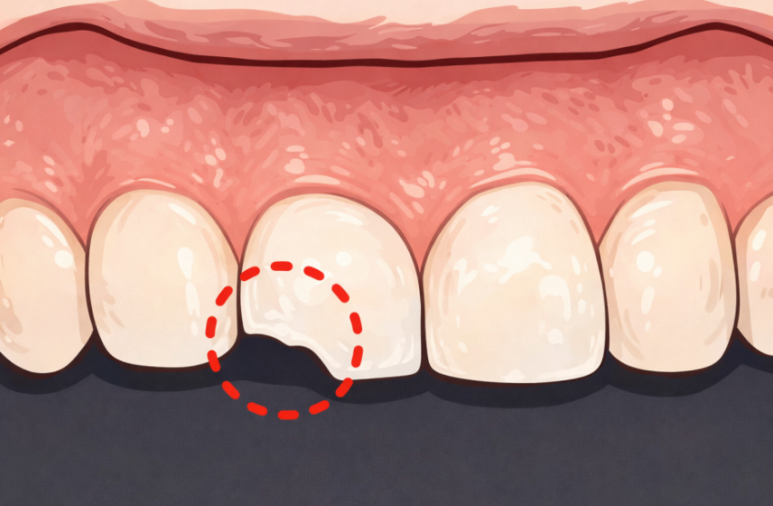
For front tooth treatment, the size of the chip matters, but in reality the depth (whether the nerve is affected) and whether there is a root problem determine the treatment direction. This is why the treatment can be completely different even for the same “chipped front tooth.”
Very small fracture (just a slightly chipped edge)
If the edge of the front tooth is only slightly chipped and only the corner feels rough, it can often be restored the same day with a relatively simple resin restoration.
The important point here is not just “bonding it back.” Because the front teeth are especially visible, matching the color, gloss, shape, and margins naturally leads to greater satisfaction. Even if a small fracture seems simple to treat, the quality of the result can have a big impact on how it feels.
Moderate fracture (fairly visible chip, with sensitivity)
If the tooth is chipped a bit more, is visibly concerning, and feels sensitive to cold water or uncomfortable when air touches it while speaking, the restoration scope may need to be broader.
At this stage, resin may still be enough in some cases, but depending on the extent of the chip and the remaining tooth structure, other options may be discussed. The key is not to assume “it must be a laminate veneer,” but to look at both how much tooth can be preserved and whether the strength is sufficient.
Large fracture (close to the nerve / pain / suspected nerve exposure)
If the damaged area is large, the pain is severe, or the chipped area looks red (suggesting nerve exposure), or if it throbs even at rest, it is necessary to check whether the nerve has been irritated.
In this case, root canal treatment may be needed depending on the situation, and after root canal treatment the tooth can become more fragile, so it is often followed by reinforcement (core) plus a crown. Front teeth are important functionally, but they are also a more aesthetically sensitive area, so there may be a process of first stabilizing the appearance with a temporary tooth.
If there is a crack extending into the root area (tooth crack/fracture)
Even if the front tooth only looks slightly chipped on the surface, there may be cases where the crack extends down toward the root.
In such cases, the prognosis can differ, so it is important to confirm the extent through examination.
It cannot be assumed to be “necessarily extraction,” but if the root is deeply affected, the treatment plan can become more complex, so careful planning is needed.
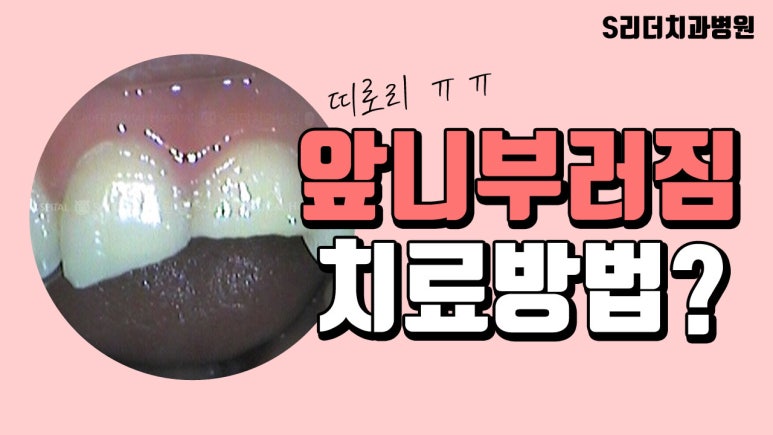
Treatment options: Which treatment is commonly chosen?
Treatment for a chipped front tooth is a process of balancing “quick repair,” “long-term durability,” and “natural appearance.” If we organize the commonly chosen methods realistically, they are as follows.
- Resin (same-day restoration possible, but the case matters)
Resin is a method that allows relatively quick and less burdensome restoration. It may be possible for small fractures and even moderate ranges. However, if the fracture is large and the tooth is subject to significant chewing force, resin alone may not be sufficient to maintain it, so case assessment is important.
- Laminate veneer (aesthetics-focused, with conditions for use)
A laminate veneer can help with the aesthetics of front teeth, but it is not a method that is automatically applied to every fracture case. The decision should be made after looking at the amount of tooth removal, the remaining tooth structure, and the bite relationship.
- Crown (for strength and reinforcement, often chosen especially after root canal treatment)
A tooth with a large fracture or one that has undergone root canal treatment can become structurally weaker, so a crown is often chosen to protect it. Because front tooth crowns need natural color and gingival margins to look good, aesthetic design is important.
- Temporary tooth (for front teeth, reducing daily inconvenience is important)
Because front teeth are visible, the process of first stabilizing appearance with a temporary tooth has a major impact on treatment satisfaction. During treatment, it helps reduce the stress of “feeling embarrassed to meet people.”
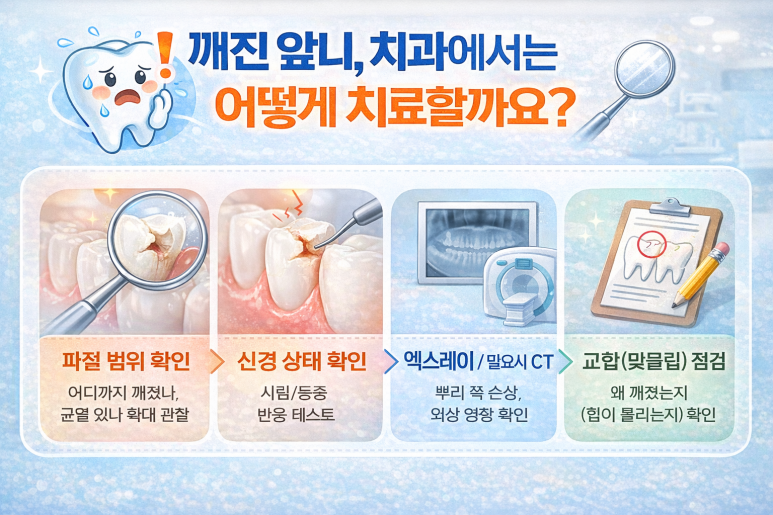
How is it diagnosed at the Gwangui-dong dental clinic? (Examination flow)
When a front tooth chips, diagnosis at the dental clinic is not simply about “looking only at the broken part.” To decide on the treatment direction, the following are checked together.
-
Check the fracture extent: observe closely how far the damage goes and whether there is a crack
-
Check the nerve condition: degree of sensitivity, pain pattern (response to cold/hot, whether there is spontaneous pain)
-
X-ray / CT if needed: check root damage, effects of trauma, and whether there is inflammation around the area
-
Check the bite (occlusion): confirm why the front tooth chipped in the first place (whether force is concentrated there)
The appearance is important for front teeth, but if the cause is not addressed together, there may still be a risk of re-fracture, so the diagnostic stage is important.
How to care for it long-term after treatment (preventing recurrence)
Front teeth are important both functionally and aesthetically, so aftercare is quite important.
-
Avoid habits such as tearing bread with the front teeth or opening snack bags with the teeth
-
Be careful with hard foods (nuts, ice, bones)
-
If you have bruxism or clenching habits, consider a mouthguard if needed
-
Through regular checkups, inspect wear at the margins of resin/prosthetics and check for secondary decay
A chipped front tooth can become a treatment that lasts much more comfortably when the cause is controlled together, rather than “one treatment and done.”
At Gwangui-dong Dental Clinic, S Leader Dental Hospital
Key diagnostic points for front tooth fractures
When a front tooth chips, the most important thing is not how visibly the tooth looks chipped, but how close it is to the nerve and whether there is a root crack or fracture. Small fractures can often be restored beautifully the same day with resin, but in cases of larger fractures or nerve involvement, stepwise treatment and reinforcement may be necessary. And above all, because front teeth are a very noticeable area, it is important to make a plan that satisfies both function and aesthetics.
At S Leader Dental Hospital in Gwangui-dong, for patients visiting with a chipped front tooth, we check the fracture extent, nerve condition, and bite together, then guide you to a treatment direction that fits your current condition. If you were suddenly startled by a chipped front tooth, rather than putting it off for a long time, please have the current condition checked accurately now and solve it step by step, starting with the least burdensome option.
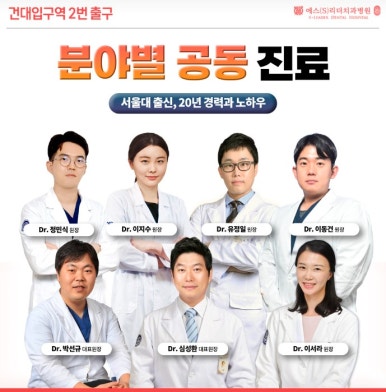

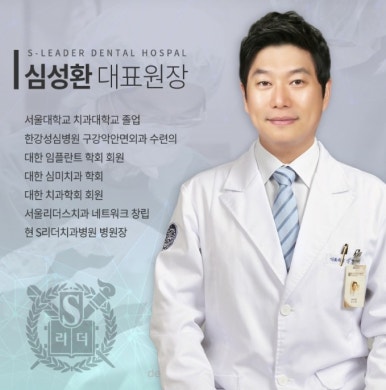
 Gwangui-dong Dental Clinic :: S Leader Dental Hospital