Hello, this is S Leader Dental Hospital, Dongdaemun-gu Dental Clinic.
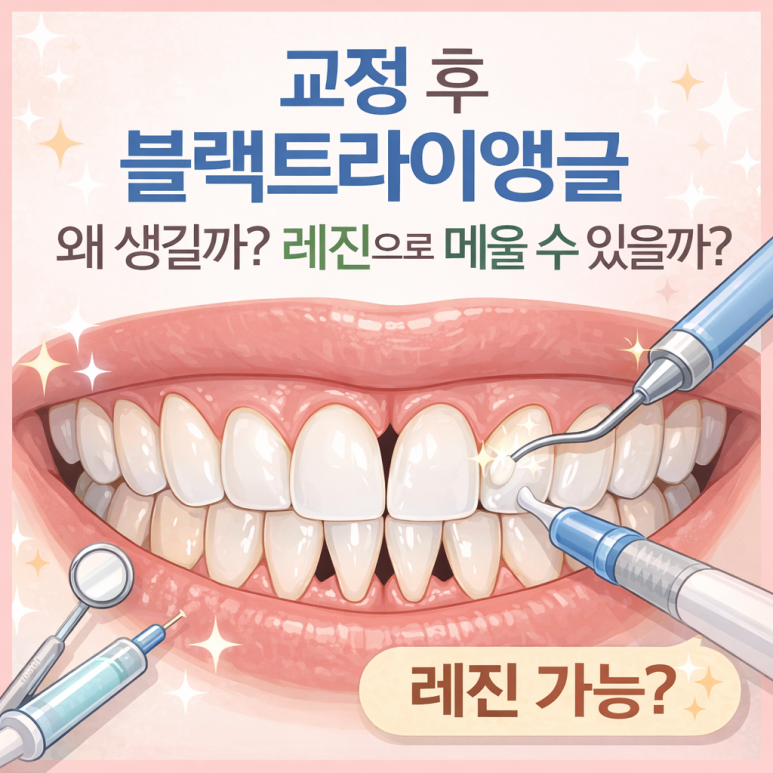
After finishing orthodontic treatment, people usually feel something like this: “It’s finally over.” “Now I can smile nicely.” But when
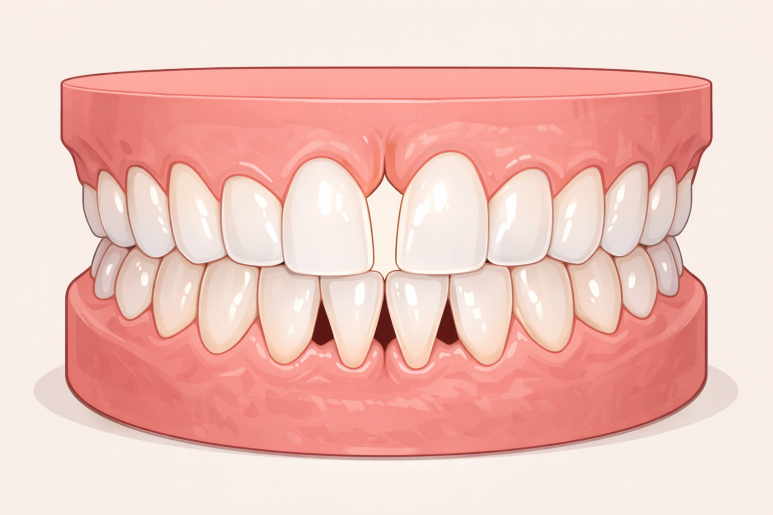
they actually look in the mirror or take photos, some people start noticing an unexpected area. This is the phenomenon where the lower part between the front teeth looks black and triangular, known as a black triangle.
This is a question we hear very often in the clinic.
“Doctor, I finished orthodontic treatment, but the space between my front teeth looks open.”
“The teeth seem to be touching, so why does it look black?”
“Can’t this just be filled with resin?”
To begin with, a black triangle is not so much a rare accident that happens after orthodontic treatment, but rather a case where the gum, tooth
shape, and jawbone conditions that were already there become more clearly visible after treatment. And while there are certainly cases where resin can improve it, it is not something that can simply be “filled and done” for everyone. Depending on the case, resin may be helpful, it may require caution, and sometimes another approach is better.
Today, at S Leader Dental Hospital, Dongdaemun-gu Dental Clinic, we will go over:
-
what a black triangle exactly is
-
why it appears after orthodontic treatment (summary of causes)
-
whether it can be prevented
-
which cases are suitable for filling with resin, and the limitations
-
what other options exist besides resin
-
what should be checked before treatment
-
why management is even more important when a black triangle is present
We’ll go through each point step by step.
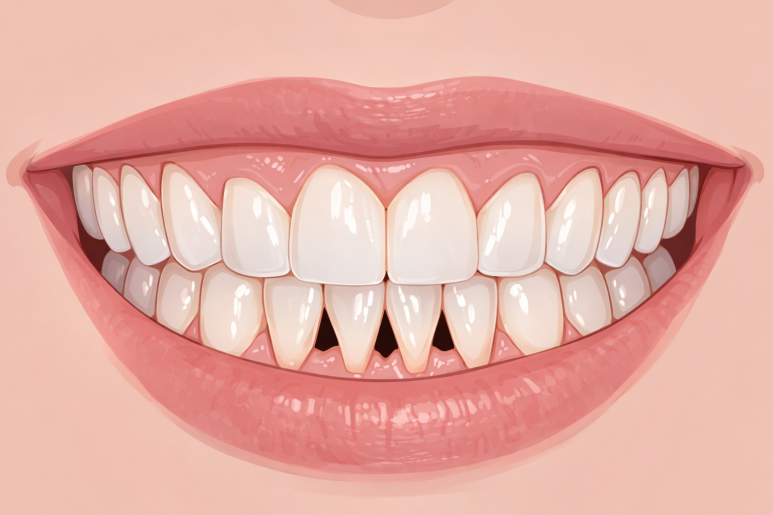
What is a black triangle? It is different from “teeth being spaced apart.”
A black triangle is, simply put, a blank space created because the gum tissue between the teeth does not fully fill the area. The teeth may appear to be
in contact at the top, but the lower part (near the gums) looks triangularly empty and therefore looks “black.” That is why people often think,
“Are the teeth spaced apart?” but in reality, it is different from general spacing between teeth.
Teeth spacing: The gap between the teeth itself is wider, so the space is often visible from the top.
Black triangle: The teeth appear to touch, but the gum area looks empty, so the lower part looks black.
Why does this matter? It is not only about appearance. When a black triangle is present, food particles can get trapped more easily in that space,
and some people feel odor even when they floss, or their gums become more sensitive. In particular, quite a few people experience discomfort such as,
“There’s always something bothering me between my front teeth,” or “There’s a smell when I floss.”
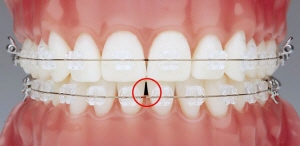
Why do black triangles appear after orthodontic treatment? 7 causes??
A black triangle does not occur for just one reason. Usually, it appears due to a combination of “tooth shape + gum condition + orthodontic process.” This also explains why it becomes more noticeable after treatment.
- A reduced gum papilla (the gum tissue between the teeth) (periodontal issues / reduced jawbone support)
The key to a black triangle is the gums rather than the teeth. If the gum tissue between the teeth (the papilla) is fully filling the space, less of it is visible. If the papilla has decreased, the space becomes visible. If there is a history of reduced jawbone support or the gums are naturally weak, the black triangle may be more noticeable.
- Why it tends to stand out more in adult orthodontics
In adults, the gums may have limited ability to “fill back in” the way they do during growth. Of course, this varies from person to person, but this is one reason black triangles can become more bothersome in adult orthodontic treatment. It is not so much because of the orthodontics itself, but because of the gum environment adults already have.
- When the tooth shape is closer to triangular (contact point forms higher up)
The closer the tooth shape is to a triangle, with a wider top and narrower bottom, the more likely the contact point between teeth is to form relatively higher up. Then, space remains near the gum area below, making a black triangle more visible.
- When rotated teeth are corrected and the space becomes more visible
Before treatment, teeth are often rotated or twisted. When orthodontics corrects the rotation and aligns the teeth, the wider surfaces of the teeth face forward, and “spaces that were not visible before” can become more apparent. In other words, the space did not necessarily newly appear; the way it is seen changed.
- Cases where the front teeth were already spaced apart
For people who already had spaces between the front teeth before orthodontic treatment, the gum papilla may not fully fill the space. Even if the tooth gaps are closed through orthodontics, a black triangle may remain if the lower gum area does not fill in completely.
- When gum recession is also present
If the gums have receded, it may be harder for the gum papilla to fill back in. That can make the black triangle stand out more. In particular, if someone feels that “my gums seemed to go down during orthodontic treatment,” it is a good idea to check this point together.
- When gum inflammation or tartar repeated during orthodontic treatment made the gums unstable
During orthodontic treatment, food particles can get trapped more easily and cleaning becomes more difficult, so some people experience swollen or bleeding gums. If the gums repeatedly swell and calm down, it can be difficult for the tissue to stay stable. In the end, the black triangle may become more visible or the discomfort may increase.
A black triangle is often not a problem caused by incorrect orthodontic treatment, but rather something that becomes visible after treatment because of the gums, tooth shape, or hygiene condition. So instead of insisting on one method, it is important to first identify the cause and then approach it in the right way.
Can black triangles be prevented? The goal is not “0%/100%” but lowering the risk.
Many people ask:
“Doctor, could this have been prevented before orthodontic treatment?”
To be realistic, in some cases a black triangle can be predicted to a certain extent. In particular, the risk may be higher if the gums are thin, the tooth shape is triangular, or the jawbone condition is not good.
When talking about prevention, it is more realistic to set the goal like this:
1 Lower the chance of it appearing
2 Make it less noticeable even if it does appear
3 Reduce food trapping/inflammation to prevent it from getting worse
And this prevention does not work with just one “orthodontic appliance.” It is most effective when finishing design, gum care, and daily habits all work together.
Can it be filled with resin?
“So then, can’t it just be filled with resin?”
There are certainly cases where resin can improve the situation. Especially for front teeth, where appearance is important, there are many cases where making the space less visible with resin improves satisfaction. At the same time, there are also cases where resin can make maintenance more difficult or the margins can become bothersome. So rather than “possible or impossible,” the key is whether it is the right case.
- Cases where resin is a good fit (suitable cases)
-
The black triangle space is not large, and a natural boundary can be created
-
The gum condition is relatively stable, with no severe bleeding or inflammation
-
It is not only visually bothersome, but food trapping is also significant and functional improvement is needed
-
The tooth color and surface condition work well with resin, making it less noticeable aesthetically
In these cases, resin often makes the black space less visible and also reduces everyday discomfort.
1-2) Cases where resin should be used with caution (less favorable cases)
-
The space is too large, or the gums are unstable and the margins keep becoming sensitive
-
If resin is placed before gum inflammation is resolved, the gums may become even more uncomfortable
-
If resin is made too large to block the space, flossing/interdental care can become more difficult
-
The main cause is actually tooth spacing rather than a black triangle
→ In such cases, resin alone may be difficult to rely on, or another treatment plan may be more appropriate.
In other words, resin is not a universal solution, but rather a method with high satisfaction when used in the right case.
1-3) Pros and cons of resin
Pros: relatively quick cosmetic improvement (same day or after a short visit), less food trapping, relatively low burden
Cons: discoloration/wear may occur over time, margin care is important, and re-treatment may be needed in some cases
“How long does it last?” honestly varies a lot from person to person. It can depend on coffee and staining food habits, interdental care routines, clenching habits, and more. So if you choose resin, it is better to think not only about “one treatment and done,” but also about regular checkups and maintenance.
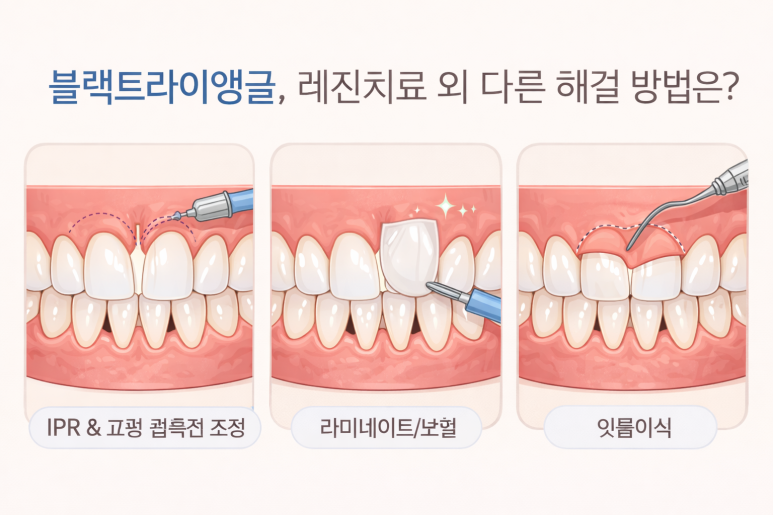
What other solutions are there besides resin treatment?
There is more than just resin for solving a black triangle. Depending on the situation, there may be more suitable options.
- IPR (very small contouring between teeth to adjust the contact point)
During the finishing stage of orthodontic treatment or as a follow-up after treatment, if needed, IPR may be discussed to adjust contact point formation. This is not applied to every case, but in certain cases it may help make the black triangle less noticeable.
- Finishing orthodontics / partial retreatment to readjust the contact point
Even after orthodontic treatment is fully finished, there are cases where a very fine adjustment of the contact point or tooth alignment can improve the situation. However, there are limits to what can be done, and realistic expectations are still necessary.
- Laminate or prosthetic approach
When the cosmetic goal is very important and the tooth shape itself needs to be changed, a prosthetic approach may be discussed. However, this may involve tooth reduction, and careful case selection is important, so it is not something that can be “universally recommended.”
- Gum treatment / gum grafting (limited, requires case selection)
An approach to restoring the gum papilla itself is difficult to apply to all cases, and the results vary depending on the case. For that reason, this method is only possible in certain situations and is usually discussed after a precise diagnosis rather than being stated definitively.
- Sometimes, leaving it alone and managing it is the better option
If the black triangle is very mild and food trapping/inflammation are not severe, management-focused care rather than active treatment may be better. That is because in some cases, “it looks bothersome, but the burden of treatment may be greater than the benefit.”
Black triangle: checks that must be done before treatment
The most common failure when addressing a black triangle is “filling it without checking the cause.”
Before treatment, the following must be checked:
-
Whether there is gum inflammation, tartar, or bleeding (stabilization may be needed first)
-
The condition of the jawbone (confirm with imaging if necessary)
-
Whether the space is due to “tooth spacing” or “lack of gum papilla”
-
Whether there is clenching or excessive bite force (affects resin longevity)
-
Treatment goals: is the focus cosmetic improvement, or is it solving food trapping/odor?
If the goal is different, the method should also be different. If you only focus on appearance and ignore function, discomfort may come back. If you only focus on function and ignore appearance, satisfaction may drop. That is why it is good to organize the goals together during diagnosis.
Why management becomes even more important when a black triangle is present
When a black triangle appears, the added “space” makes it easier for food to get trapped and creates an environment where the gums can become more sensitive. That is why management becomes much more important.
-
Floss/interdental brush routine: Doing it consistently at least once a day makes the biggest difference.
-
If resin has been placed, margin care: The boundary between the resin and the tooth must be kept clean to reduce discoloration and inflammation.
-
If bad breath or bleeding occurs, it is better to check the condition promptly rather than simply brushing more.
-
Regular checkups/scaling intervals: For people with sensitive gums, shorter intervals can be helpful.
Remember that a black triangle is often not something that is “solved once and done,” but something that is maintained more stably with ongoing care.
Dongdaemun-gu Dental Clinic, S Leader Dental Hospital’s standard:
Considering both aesthetics and function together
Solving black triangles
Just because a black triangle appears after orthodontic treatment does not mean the orthodontic treatment failed. In most cases, it is a change that becomes visible as the gum condition, tooth shape, and pre-treatment conditions are more clearly revealed after treatment. That is why the solution should not be “resin no matter what.” Instead, it is more satisfying to first sort out why it happened and then decide whether resin is beneficial in your case or whether another method is better. Resin can be a quick and effective solution, but in cases with unstable gum conditions or large spaces, management may actually become more difficult, so case selection is important.
At S Leader Dental Hospital, Dongdaemun-gu Dental Clinic, for people worried about black triangles after orthodontic treatment, we check the presence of gum inflammation, tooth shape, contact point condition, and the degree of food trapping, then guide you in a direction that balances both “aesthetics” and “function” while minimizing burden and maximizing satisfaction. If you are bothered by the space between your front teeth after finishing orthodontic treatment, rather than deciding on your own, it is best to accurately check your current condition and organize the most suitable method for your case step by step.





Dongdaemun-gu Dental Clinic :: S Leader Dental Hospital