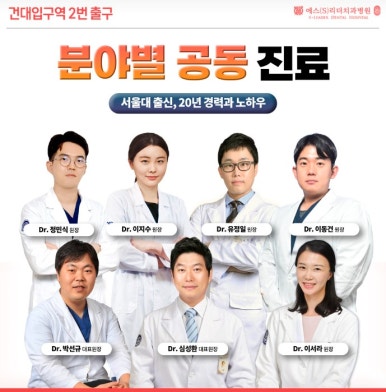
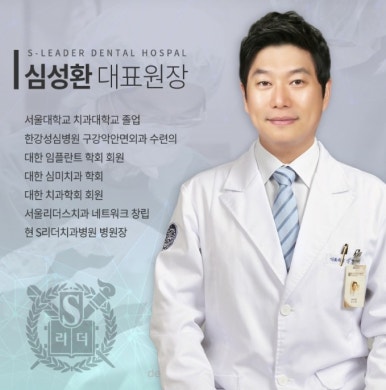
Hello, we are S Leader Dental Hospital, a Guwi Station dental clinic that is celebrating its 22nd year since establishment this year.
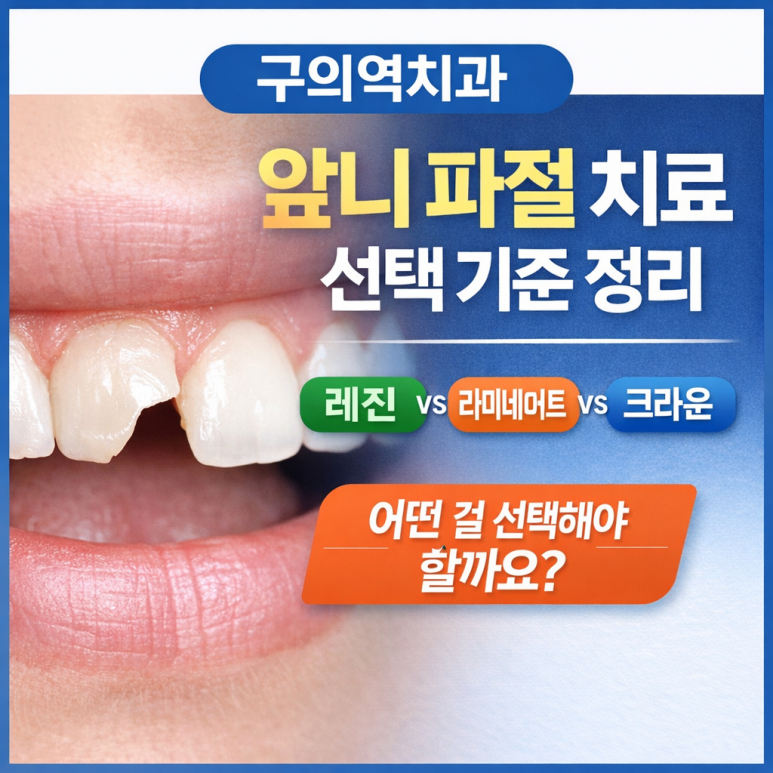
When a front tooth breaks, it is natural to feel flustered. Unlike a molar, it is not in a hidden area; it is visible when you speak and also when you smile, so many people first worry, “What if it looks obvious?”
But when you actually search for a solution, it becomes even more confusing. Resin, laminate, crown... because many posts emphasize only the advantages of each, the question of “What should I actually do?” grows even bigger.
In fact, the important question is not ‘which treatment is better,’ but which method best matches the current condition of your tooth.
Because front tooth fractures differ from case to case, the treatment choice can also vary from person to person.
-
The size and depth of the fracture (whether it is close to the nerve)
-
How strong the remaining tooth structure is
-
Aesthetic goals (making it look natural and inconspicuous)
-
Habits (biting hard / tearing food with the front teeth, etc.)
These factors should all be considered together to lead to a satisfying result.
Today, at S Leader Dental Hospital near Guui Station, we will organize the criteria you should look at when deciding on front tooth fracture treatment, and explain step by step when resin, laminate, and crown may each be considered.
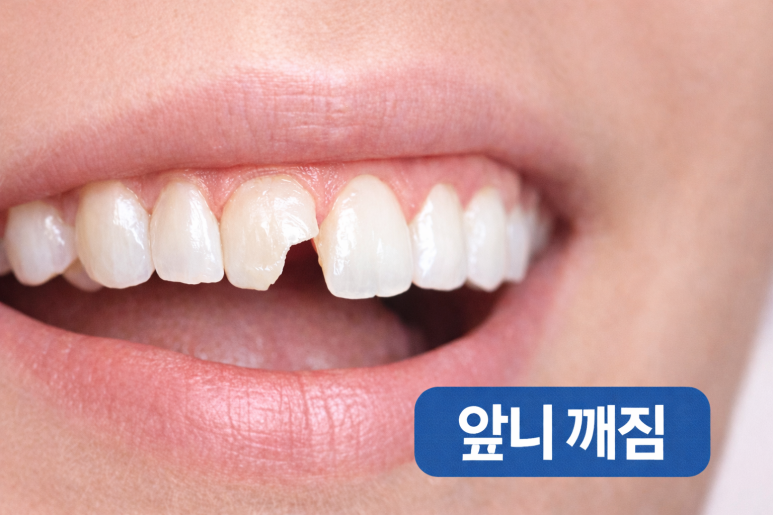 A front tooth fracture is determined by 'depth' (nerve/root), not 'size.'
When a front tooth breaks, many people estimate the treatment based only on the broken ‘size.’
A front tooth fracture is determined by 'depth' (nerve/root), not 'size.'
When a front tooth breaks, many people estimate the treatment based only on the broken ‘size.’
“Since it’s only a small chip, it must be simple.”
“Since it’s badly broken, it must definitely need a big treatment.”
But in reality, the opposite is sometimes true. If the damage looks small on the surface but reaches close to the nerve, pain can be significant and treatment can become more extensive. On the other hand, even if it looks quite broken, if it is far from the nerve, it can sometimes be restored relatively simply.
So the most important things in front tooth fractures are:
-
How far the fracture extends (surface only, or into the inner structure)
-
Whether the nerve is affected (sensitivity/pain pattern)
-
Whether the crack extends toward the root (whether trauma was involved)
These should be checked first. Only after this diagnosis is it possible to choose between resin, laminate, and crown in a way that suits your tooth.
Immediate first aid right now (brief summary)
When a front tooth breaks, the following measures before coming to the clinic can help reduce further damage.
If there is a broken fragment, do not throw it away; keep it stored (if possible, in water or saline)
- Do not tear bread with your front teeth or chew hard foods
- If cold or hot stimuli cause sensitivity, reduce the刺激
- If there is gum bleeding, apply pressure with clean gauze
- If the fracture is large or the pain is severe, do not delay and visit promptly
In particular, if “the pain gets worse, the broken edge is sharp enough to cut the tongue or lip, or the bleeding continues,” it is safer to get checked quickly.
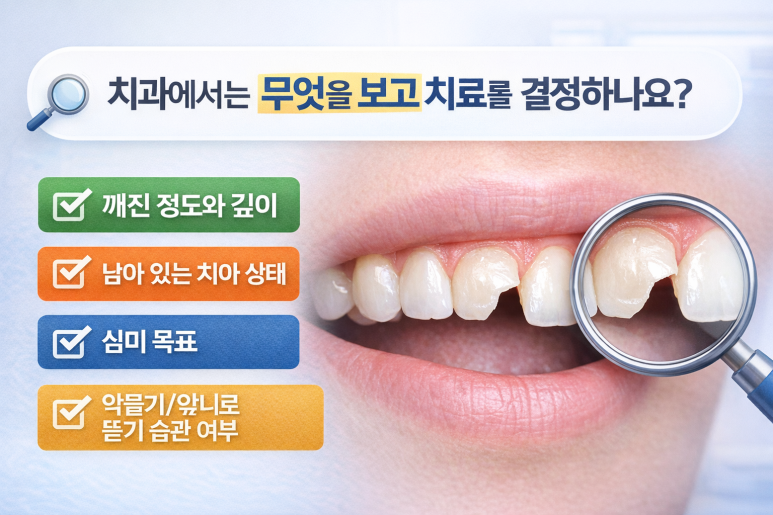 What do we look at to decide treatment at a Guui Station dental clinic? (Diagnostic points)
Front tooth fracture treatment is not simply “bond it and done.” In a dental clinic, the following are usually checked.
What do we look at to decide treatment at a Guui Station dental clinic? (Diagnostic points)
Front tooth fracture treatment is not simply “bond it and done.” In a dental clinic, the following are usually checked.
- Extent and depth of the fracture
Whether only the surface is slightly chipped or the inner part is exposed changes the treatment. If the inner structure is exposed, the tooth can become sensitive and pain may increase.
- Pain pattern (sensitivity vs. spontaneous pain)
Only briefly sensitive to cold water, then quickly fine → often relatively mild (though there are exceptions).
Throbbing even at rest, pain at night, or prolonged pain from hot things → the nerve may be irritated, so it should be examined more carefully.
- Check for root-related problems with imaging
If there was trauma from a fall or a strong impact, not only the surface but also the root area may be affected, so imaging can be helpful.
- Bite relationship (occlusion) and habits
We also look at why the front tooth broke in the first place. Habits such as frequently tearing food with the front teeth, bruxism/clenching, or an occlusion in which the front teeth frequently collide can increase the risk of re-fracture even after treatment.
- Aesthetic goals
For front teeth, function is important, but natural appearance has a major impact on satisfaction. A plan is made while considering color, shape, gloss, and the gum margin.
Treatment selection criteria: 5 key points (this is the core part.)
Now let’s organize the criteria for choosing between resin, laminate, and crown.
In the end, decisions are often made based on these 5 points:
-
Extent of fracture: only the edge? mid-level? wide?
-
Nerve condition: is there ongoing sensitivity or pain?
-
Remaining tooth structure: is there enough ‘support’ to hold the restoration?
-
Aesthetic priority: do you want it to look natural, match the color, and improve the shape?
-
Habits and occlusion: do you tear food with the front teeth, clench, or have frequent front-tooth collisions?
If you look at each treatment with these criteria in mind, the choice becomes much easier.
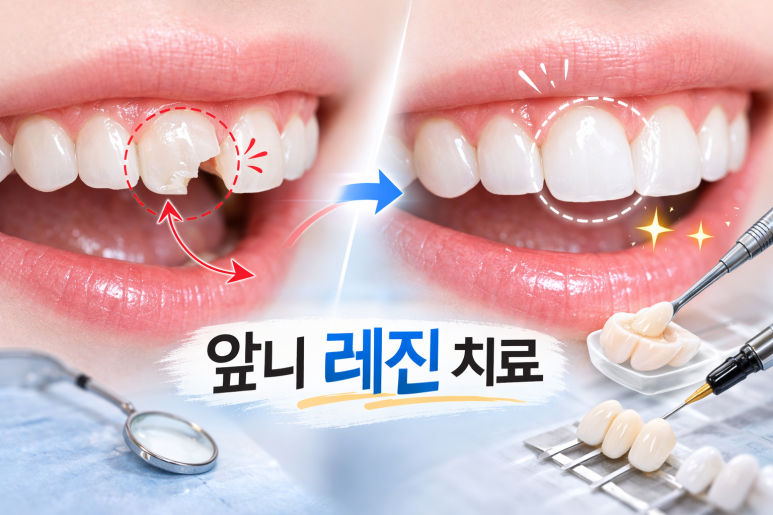 Resin treatment: suitable in these cases. (Including pros and cons)
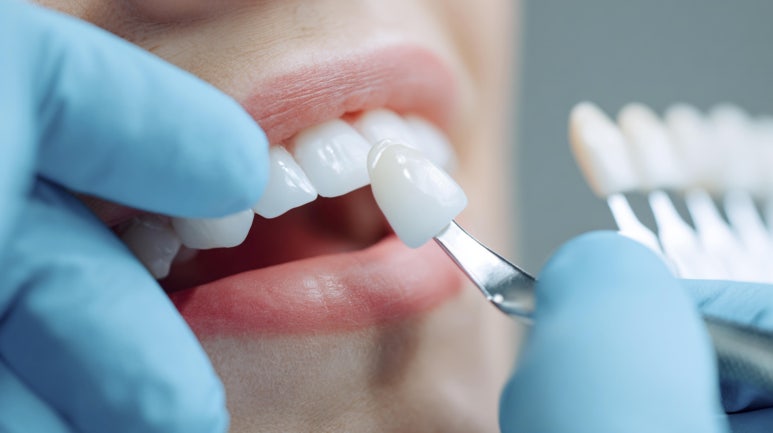
Resin is one of the most commonly used methods in front tooth fracture treatment. Satisfaction is especially high for small fractures, and in many cases, restoration can be completed on the same day.
Resin treatment: suitable in these cases. (Including pros and cons)
Resin is one of the most commonly used methods in front tooth fracture treatment. Satisfaction is especially high for small fractures, and in many cases, restoration can be completed on the same day.
Cases where resin is a good fit
-
The tip of the front tooth is slightly chipped and the edge is rough
-
The broken area is not large, and there is enough remaining tooth structure
-
You want a quick, natural restoration
-
You want a treatment that can be repaired later if needed
Advantages of resin
-
Relatively quick restoration is possible (usually the same day)
-
Little to no tooth reduction
-
Additional repair or adjustment is relatively easy if needed
Disadvantages / practical points of resin
-
There may be strength limitations for large fractures
-
Discoloration may occur depending on coffee, staining foods, and lifestyle habits
-
It may come off if you have habits like tearing food with the front teeth or clenching
When we see people whose resin keeps coming off, there is usually a cause.
Habits such as tearing bread with the front teeth, biting nails, clenching, or an occlusion that causes the front teeth to hit are common examples. So even when resin treatment is done, checking “why it broke” together can help reduce recurrence.
 Laminate: considered in these cases. (Including clarification of misconceptions)
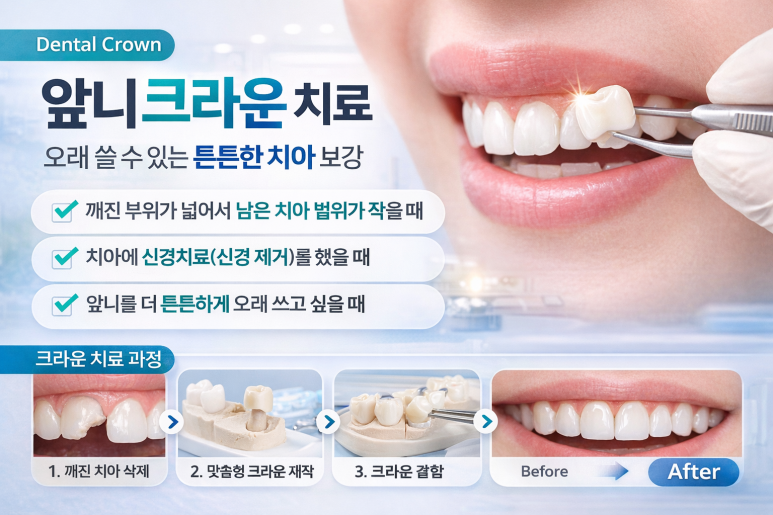
Laminate is a method that thinly covers the surface of the front teeth, and it may be chosen when aesthetics are the main goal. However, laminate is not a treatment you do “whenever a front tooth is broken.” Case selection is important.
Laminate: considered in these cases. (Including clarification of misconceptions)
Laminate is a method that thinly covers the surface of the front teeth, and it may be chosen when aesthetics are the main goal. However, laminate is not a treatment you do “whenever a front tooth is broken.” Case selection is important.
Cases where laminate may be considered
-
When you want to improve color and shape along with fracture restoration
-
When part of the tooth surface has weakened and you want to organize the aesthetics at the same time
-
Cases without excessive bite stress (if too much force is placed on the front teeth, it may be disadvantageous)
Advantages of laminate
-
It can improve color and shape together, so aesthetic satisfaction can be high
-
The front-tooth line and balance can be designed
Disadvantages / cautions for laminate
-
Tooth reduction may be necessary depending on the case
-
If strong force habits (clenching/bruxism) are present, the risk of fracture may increase
-
Its purpose is more about “aesthetic improvement” than “strongly protecting the broken tooth”
In other words, laminate can look very beautiful when the conditions are right, but it should be approached carefully to think of it as “laminate for strength” unconditionally.
 Crown: may be necessary in these cases (the most realistic part)
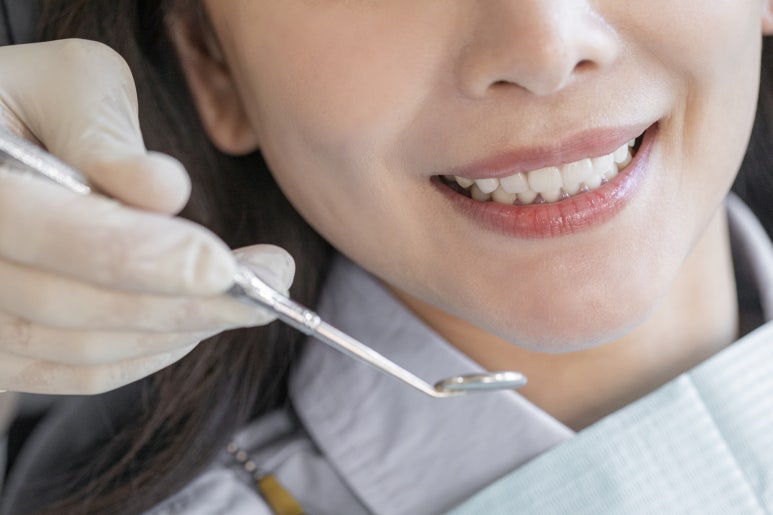
A crown is a method that covers and protects the entire tooth. In front tooth fractures, a crown is usually considered when the fracture is large or the tooth itself has become weakened.
Crown: may be necessary in these cases (the most realistic part)
A crown is a method that covers and protects the entire tooth. In front tooth fractures, a crown is usually considered when the fracture is large or the tooth itself has become weakened.
Cases where a crown may be needed
-
The broken area is so large that resin alone is difficult to rely on
-
Root canal treatment is needed (the tooth can become more fragile)
-
The remaining tooth structure is thin or easy to fracture
-
There have been repeated fractures (for strength and protection)
Advantages of a crown
-
Because it covers the tooth overall, it can provide good strength and stability
-
It is often advantageous for protecting a tooth after root canal treatment
Disadvantages / practical points of a crown
-
It requires a fabrication process, so the number of visits and treatment period may increase
-
Tooth reduction is necessary to place the crown
-
Since front teeth are important aesthetically, color, translucency, and the gingival margin design are very important
For a front tooth crown, it is not simply a matter of “just putting one on.” Natural color and translucency, the boundary with the gum line, and balance with neighboring teeth determine the result. That is why planning is truly important for front tooth crowns.
 Treatment process · duration · pain, realistically summarized
People also often ask, “How long will it take?” for front tooth fracture treatment.
Treatment process · duration · pain, realistically summarized
People also often ask, “How long will it take?” for front tooth fracture treatment.
If we organize the reality by case, it feels like this.
Resin: many cases can be restored on the same day
Laminate / crown: fabrication is required, so multiple visits may be needed (temporary teeth may be included)
Pain: rather than the treatment itself, how sensitive the nerve is has a greater effect
*If the nerve is sensitive, pain before and after treatment may be greater
*If only the outer surface is broken, there are many cases with almost no pain
And after treatment, it is very important to control the habit of tearing food with the front teeth and eating hard foods. This is the key to preventing re-fracture.
How to manage it long-term after treatment (to prevent recurrence)
Front tooth fracture treatment does not end with “treatment”; it also includes “using it well over time through management.”
- Do not tear bread or snack bags with the front teeth
- Be careful with nuts, ice, and hard foods
- If you have bruxism/clenching, consider a protective device (mouthguard)
- Check the margin for wear and secondary decay through regular checkups
- Resin may discolor or wear down, so care and monitoring help
Especially for those with clenching habits, “how you manage the force” is just as important as “which treatment you choose.”
 If you are curious about the treatment approach for front tooth fractures at
S Leader Dental Hospital near Guui Station
Front tooth fracture treatment cannot be decided by “trend” or “simple comparison,” whether it is resin, laminate, or crown. Satisfaction is highest when you consider not only the visible size, but also the depth (distance to the nerve), the remaining tooth structure, how biting force is applied, and the aesthetic goals you want. The sooner treatment is received, the wider the choices often are, and the more natural the result can be, so rather than delaying with “should I wait a bit longer,” it is better to first check the condition.
If you are curious about the treatment approach for front tooth fractures at
S Leader Dental Hospital near Guui Station
Front tooth fracture treatment cannot be decided by “trend” or “simple comparison,” whether it is resin, laminate, or crown. Satisfaction is highest when you consider not only the visible size, but also the depth (distance to the nerve), the remaining tooth structure, how biting force is applied, and the aesthetic goals you want. The sooner treatment is received, the wider the choices often are, and the more natural the result can be, so rather than delaying with “should I wait a bit longer,” it is better to first check the condition.
And above all, front teeth are an area where both function and aesthetics matter at the same time. It is important not just to “bond it,” but to plan it so that it looks natural when speaking and smiling, and is comfortable to use for a long time.
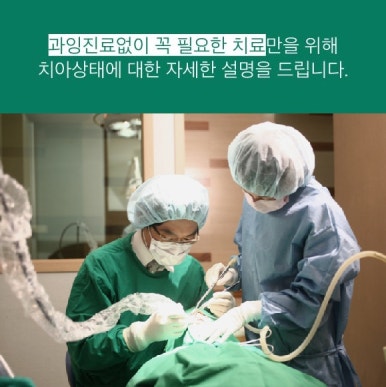
At Guui Station dental clinic, S Leader Dental Hospital, for patients visiting with front tooth fractures, we check the fracture extent, nerve condition, occlusion (bite relationship),
and lifestyle habits (tearing food with the front teeth / clenching) together, and then guide you step by step on which choice among resin, laminate, and crown will be the least burdensome and produce the most natural result.
In particular, because the biggest goal of front tooth treatment is often to make it look inconspicuous, we carefully check the process of matching color and shape as well (gloss, margins, and balance with neighboring teeth). If you are flustered because a front tooth has broken, rather than trying to decide on your own, we recommend receiving an accurate diagnosis of the current condition and solving it step by step with the safest and most natural method.

 Guwi Station Dental Clinic :: S Leader Dental Hospital