Hello, this is S Leader Dental Hospital, a Konkuk University dental clinic, now celebrating its 22nd anniversary since its founding.
When you hear at the dentist that you have a cavity, the first questions that come to mind are usually similar.
“Do I need treatment even if it doesn’t hurt?”
“Can’t it just be filled simply with resin?”
“Is it going to end up needing root canal treatment…?”
Cavities are a rather ambiguous condition.
They can look fine on the surface, and in the early stages there is often almost no pain, so many people think, “I can probably keep an eye on it a little longer.” Then there are also quite a few people who suddenly come in urgently one day because the pain becomes severe.
So today, rather than judging cavities based on vague feelings or a “hunch,” I’m going to organize how treatment changes depending on how far the cavity has progressed.
First, a common misconception: cavities progress “silently,” not when they “hurt.”
Many people think of cavities as “if it hurts, it’s a cavity.” But in reality, cavities often do not cause pain in the early stages.
In particular, early cavities that start on the outer surface of the tooth (the hard layer) are often difficult for a person to notice.
The problem comes when pain appears. By the time pain starts, the cavity may already be quite deep, or the nerve may have become irritated. Then the treatment can become more extensive, and the number of visits may increase.
So the most practical key point in cavity treatment is this.
“If it is found before it hurts, the treatment is more likely to stay small.”
This is not meant to scare you, but because in actual cases, the smaller the treatment area, the more of the tooth can be preserved and the less inconvenience there tends to be in daily life.

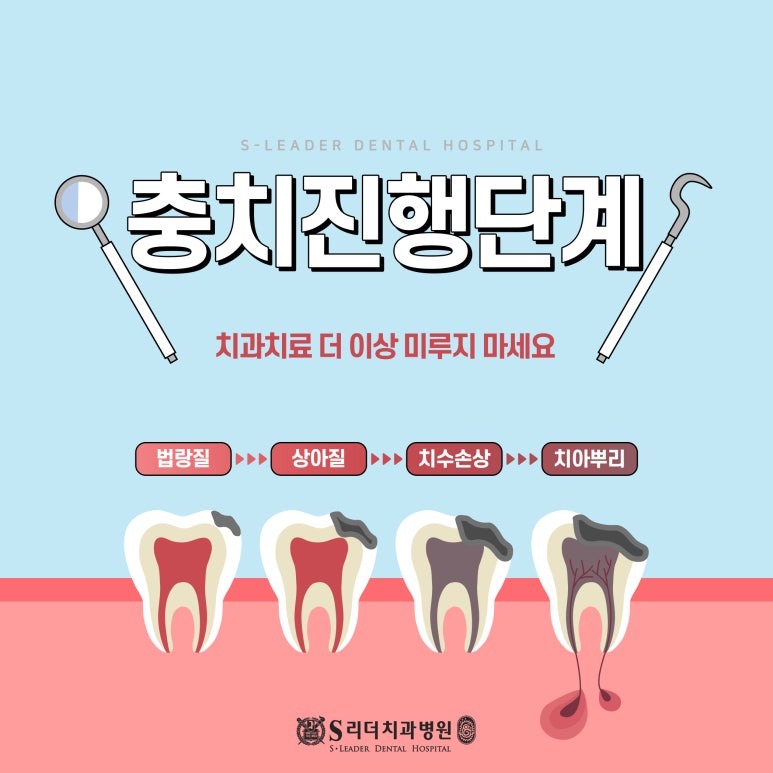
How are cavity stages divided?
The key to cavity stages is how deeply they have progressed.
You can think of them broadly like this.
*Early stage (outer layer): a stage starting near the surface
*Middle stage (inner layer): a stage where the cavity has moved further inward
*Deep stage (near the nerve): a stage approaching close to the nerve
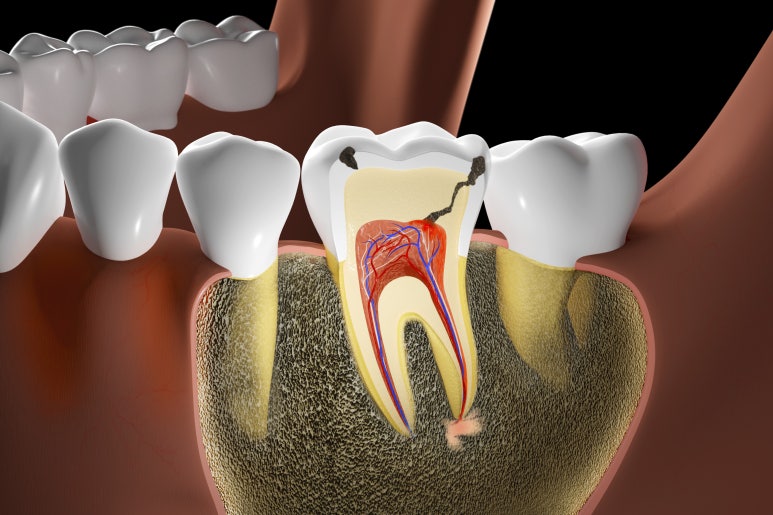
*Root canal stage: a stage in which the nerve may be inflamed or damaged
Even though they are all called “cavities,” the treatment can be completely different depending on the stage. That is why it is important to organize the stages before talking about treatment methods.
Checklist of symptoms by stage (for self-checking)
Symptoms alone cannot confirm the depth of a cavity 100%. Still, they can help you get a sense of “which stage it might likely be” based on the pattern.
Early cavity signs (often barely noticeable)
- A dark spot or discoloration is visible on the tooth.
- There is a brief sensitive feeling to cold water from time to time (it goes away quickly)
- The grooves of the molars look especially black
- Food seems to get stuck between the teeth more often
Early cavities often have “no symptoms.” That is why they are often found during regular checkups.
Middle-stage cavity signs (mild discomfort begins in daily life)
- Sensitivity to cold or sweets becomes more noticeable
- A certain area feels uncomfortable when chewing, or food keeps getting stuck there
- Even after brushing, a “nagging unpleasant feeling” remains in that area
- A brief sharp sensation occurs when food touches the tooth
At this stage, people often feel, “This is starting to bother me.”
Signs suggesting proximity to the nerve / possible root canal treatment (a stage that can become difficult if delayed)
- The tooth throbs even when you are still, or the pain keeps coming back
- The pain gets worse at night and disturbs sleep
- Hot things are especially painful, and the pain lasts a long time
- It hurts enough that you cannot manage without painkillers
- The pain comes and goes, but gradually becomes more frequent
If you have these signs, it is better to get checked quickly rather than think, “Should I just endure it?” However, these symptoms do not always mean a cavity, so a diagnosis is needed.
A quick summary of treatment by stage (the most important part)
From here on, I’ll organize what treatment is used at each stage of a cavity. The important thing here is not the name of the treatment,
but how much of the tooth can be preserved.
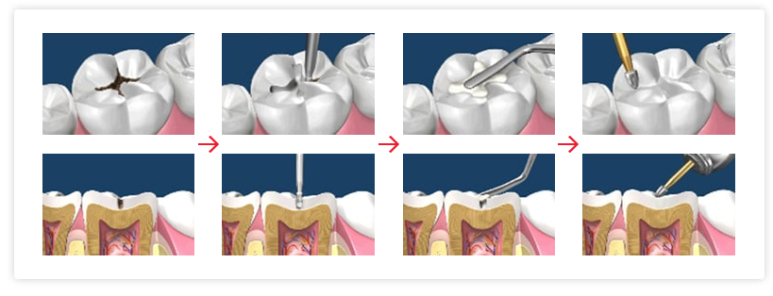
Early stage: monitoring + small restoration (mainly resin)
Early cavities are often small in extent. In many cases, treatment ends with removing a small amount and filling a small area.
Resin treatment is commonly used for this.
- Advantage of resin: treatment is relatively quick, often possible on the same day, and tooth reduction is relatively minimal
- Disadvantage of resin (in real life): over time, wear or discoloration can occur, and there may be limits for cavities that are large in extent
If it is caught at the early stage, the treatment burden is usually not large, so the conclusion is often, “It’s better to do it now.”
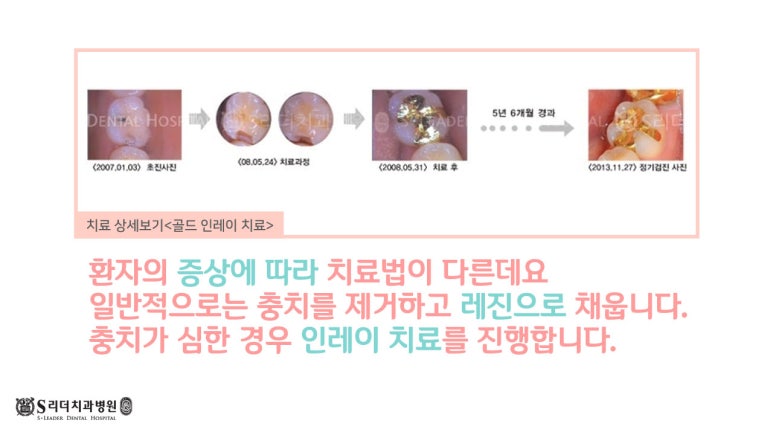
Middle stage: inlay
When the cavity becomes larger, simple resin may not provide enough strength. This is especially true in areas with strong chewing forces, like molars.
At this point, the treatment chosen is an inlay. Put simply, you can think of it as a prosthetic restoration that partially reinforces and fits into the inside of the tooth.
Why is an inlay needed?
Because as the cavity becomes larger, filling it with resin can increase the risk of breakage or detachment. An inlay is made to fit the tooth and inserted, which can help provide more stable strength and shape.
Further progression: crown (covering the whole tooth)
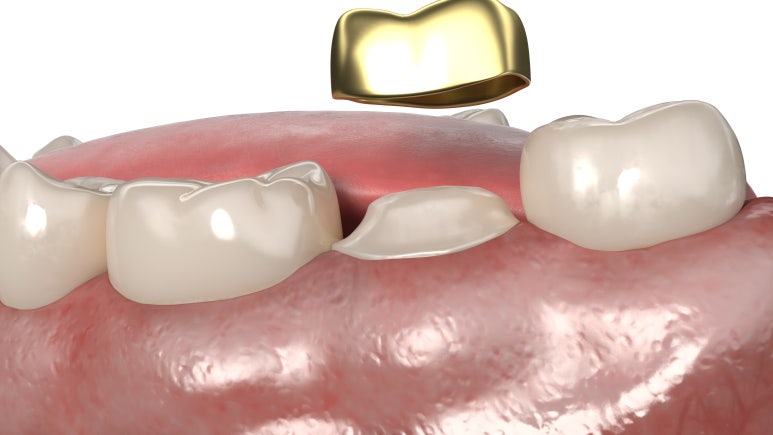
If the cavity has progressed further and the tooth walls have become significantly weakened, partial reinforcement alone may increase the risk of fracture. In that case, a crown is considered to protect the tooth by covering it entirely.
Typical situations where a crown is needed
- When the cavity is extensive and the remaining tooth is thin
- When the risk of fracture is high in a molar subject to strong chewing force
- When even a large inlay appears structurally unstable
A crown is easy to understand as functioning like “armor” to protect the tooth. However, some tooth reduction is necessary to place it, and because there is a fabrication process, multiple visits may be required.
Root canal stage: root canal treatment + reinforcement + crown (in many cases)
If the cavity has progressed close to the nerve or the nerve has become inflamed, root canal treatment may be necessary. Root canal treatment is not a procedure to “pull out the tooth,” but a treatment that helps save the tooth by cleaning out the nerve inside.
And because a tooth that has had root canal treatment can become structurally weaker, a plan to reinforce it (core) and protect it with a crown is often included afterward.
One important point to know here is that root canal treatment is not something to fear as “if it fails, it’s the end,” but rather a choice that, if done appropriately at the right time, can help you use the tooth for a long time.

What does Konkuk University Dental Clinic look at to determine the “stage”? (diagnostic process)
When determining “which stage am I at?”, the dentist usually looks at the following.
- Visual examination + checking with instruments
We check visible cavities, changes in the molar grooves, damage to the tooth surface, and more.
- X-rays (especially important for checking cavities between teeth)
Cavities often start between teeth. These are not easy to see with a mirror. That is why it is important to identify “hidden cavities” with X-rays.
- Pain pattern and response testing
By checking how the tooth responds to cold or hot stimuli and how long the pain lasts, we estimate the condition of the nerve.
How long does treatment take, and how many visits are needed? (realistically)
Cavity treatment may require different numbers of visits depending on the stage.
Resin: often completed in a single day (varies by extent)
Inlay/crown: because fabrication is needed, 2–3 visits may be required. A temporary protection process may also be included in between.
Root canal treatment: usually requires several visits. The number of visits can vary depending on the level of inflammation and the condition of the tooth.
Busy people often want to “finish it in one visit,” but with cavities, a plan that cleans things up accurately and helps the tooth last longer is often more important than doing it “quickly.”
After treatment precautions & how to prevent recurrence (secondary cavities)
Even after treatment is finished, that tooth is not safe forever. Cavities can return (secondary cavities), and especially the margins of treated areas require careful maintenance.
Common reactions right after treatment (generally within the normal range)
- A slight lingering sensitivity for a few days after treatment
- An awkward feeling when chewing (the height may need adjustment)
- A temporary sensitivity to sweets or cold things may remain
However, if the pain gradually worsens, throbs at night, or sharp pain continues when chewing, an examination may be needed.
Realistic routine to reduce secondary cavities
- Floss / interdental brushes (especially essential for preventing cavities between teeth)
- Reduce how often you eat sweets (the frequency often matters more than the amount)
- Catch early cavities through regular checkups
- If you are undergoing orthodontic treatment, be even more diligent with interdental care (blind spots around the appliances)
It is good to remember that cavities are not something that end with “one treatment,” but a condition where the smaller they are caught, the less burden they bring.

Konkuk University dental clinic S Leader Dental Hospital cavity consultation,
we explain by stage
Cavity treatment is not decided only by the “name” of the treatment, such as resin, inlay, or crown. Even if two cases look like cavities, the treatment direction changes depending on how deeply they have progressed (the stage), whether the nerve has been affected, how strong the remaining tooth is, and whether the location receives a lot of chewing force.
So the best choice is not to pick the “cheapest” or the “most commonly used” treatment, but to make a plan that treats only as much as needed for your tooth condition and helps it last longer. In particular, if you delay because there is no pain and feel reassured, the treatment area can become larger at some point, so “checking before it hurts and finishing it small” often reduces the burden in the end.
At S Leader Dental Hospital, a Konkuk University dental clinic, when counseling for cavity treatment, we do not simply stop at saying, “You have a cavity here.” Instead, after checking the depth and extent of the cavity through imaging and examination, we explain step by step whether resin is sufficient, whether an inlay/crown would be safer, and whether there is a possibility of root canal treatment.
Also, to help you use the tooth comfortably for a long time after treatment, we provide guidance on bite height adjustment and care methods (flossing, interdental care, regular checkup routines) together. If you suspect a cavity but have been putting it off, rather than letting your anxiety grow, we recommend checking your current condition accurately and choosing the treatment that fits your tooth.





 Konkuk University dental clinic :: S Leader Dental Hospital