�
Hello, this is S Leader Dental Hospital, Gwangnaru Station Dental Clinic, celebrating its 22nd anniversary this year.
�
�
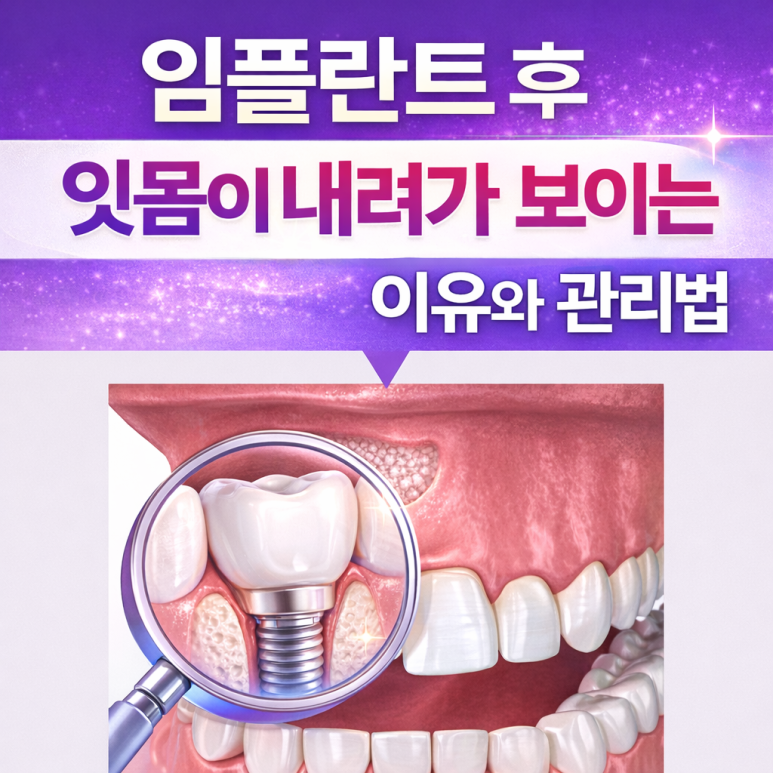
After getting an implant, many people feel relieved for a while, thinking, “Now chewing should be easier,” and then one day, while looking in the mirror, they start thinking this.
�
“Wait, does the gum on one side of the implant look lower...?”
“My tooth looks longer.”
“Could the implant be done wrong?”
�
Whether it is an anterior tooth or a molar, an implant is a treatment that requires mental preparation as well as time and money, so even small changes can easily cause anxiety. In particular, the gum line is very noticeable even with tiny differences, and it can stand out even more depending on photos or lighting.
�
To say it first: the feeling that the gums around an implant look lower may be a “normal change (including an optical illusion),” or it may be a sign that needs to be checked. The important thing is not to jump to conclusions based only on the feeling that “it seems lower,” but to check whether there are accompanying signs such as bleeding, odor, swelling, pain, food trapping, or a change in height.
�
Today, Gwangnaru Station Dental Clinic, S Leader Dental Hospital, will explain these criteria in an easy way.
�
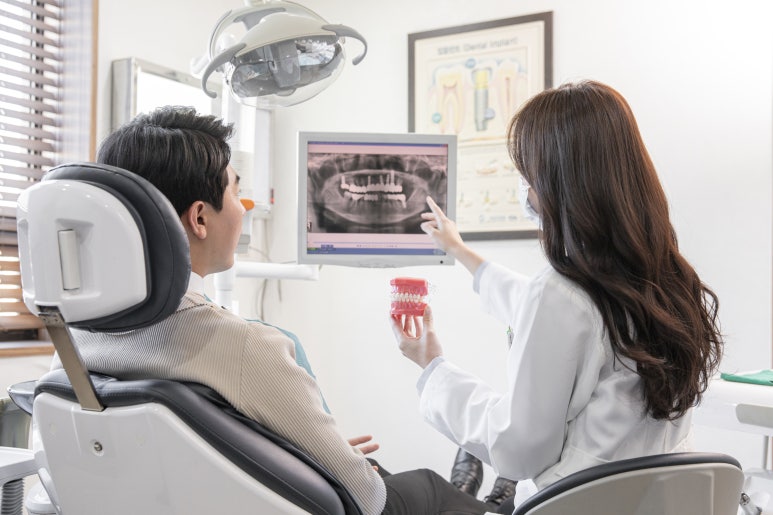
There is a difference between a “real gum recession” and an “optical illusion.”
Just because the gums look lower does not always mean the gums have actually receded quickly.
After an implant, the following reasons can create the illusion that it looks “lower.”
�
- The gum line looks clearer as swelling goes down
In the early period after implant surgery, the gums may be swollen, or for people who had inflammation, the gum line becomes more defined as swelling goes down after scaling or care. At this point, many people feel as if “the gums have receded.” In reality, the swelling may simply have gone down and the normal gum line may be showing.
�
- The crown shape on the implant and light reflection can make it look longer
The crown (the tooth-shaped restoration) placed on top of an implant can reflect light differently from a natural tooth. In particular, if the crown looks whiter and shinier under lighting, the boundary may appear clearer and the tooth may look longer.
�
- Optical illusion from photos, lighting, and angle
Photos especially exaggerate the gum line. Under flash, bright lighting, or when the mouth is opened wide, the gum boundary can look clearer, which can make the “lowered” feeling seem stronger.
That is why many people look fine in the mirror but seem especially severe only in photos.
�
This kind of illusion does not mean “there is no problem,” but it does mean you do not need to panic on your own.
�
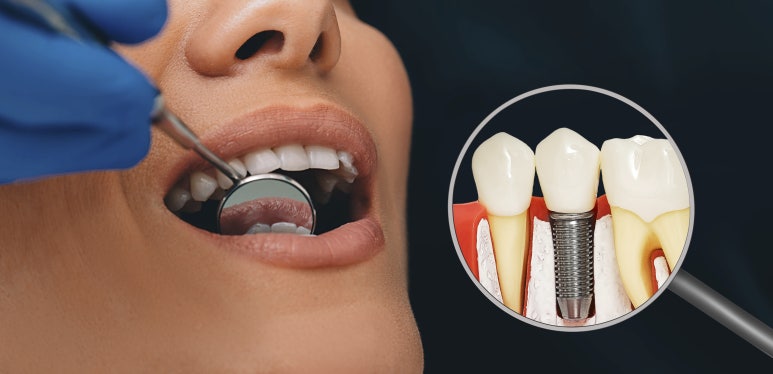
6 common causes of gums appearing to recede after an implant
Now let us look at the representative causes that can actually make the gums appear to recede.
�
- Gum inflammation / early peri-implantitis (bleeding, swelling, odor)
Implants do not get cavities, but gum inflammation can occur. If the gums around the implant swell, bleed, or
a fishy taste or odor appears, you should check for possible “peri-implantitis.” If peri-implantitis repeats, the gums can become sensitive and the gum line may become unstable.
�
- When plaque and tartar build up and weaken the gums (blind spots in care)
The area around an implant is somewhat difficult to care for because of its structure. If food remains around the lower edge of the crown or between teeth,
there can be areas that are difficult to clean completely with a toothbrush alone. When plaque (bacterial film) and tartar accumulate, the gums can be irritated and become sensitive, eventually causing the gum line to become unstable.
�
- When chewing force is concentrated on one side (high contact / teeth grinding)
If the implant feels like it is “hitting high,” or if you have a strong habit of grinding or clenching your teeth, force may be concentrated on a specific area. When force keeps concentrating there, the gums can become tired and inflammation may be more likely to develop. In particular, if you feel “it only bothers me when I chew” or “it feels worse when I chew hard foods,” an occlusion check may help.
�
- Naturally thin gums (constitution / structure)
People whose gums are thin and sensitive from the start may notice gum line changes more clearly. Even with the same treatment, people with thicker gums and people with thinner gums may feel a different level of stability in the gum line. For this type, a post-treatment care routine is especially important.
�
- Prosthetic design / marginal issues (repeated food trapping)
If food keeps getting stuck around the implant crown and the area always feels uncomfortable, the gums can become sensitive. When “food trapping � irritation � inflammation” repeats, the gum line can become unstable. In such cases, improvement may be possible by checking and adjusting the prosthetic margin or occlusion.
�
- Natural gum line changes during the surgical and healing process (case by case)
An implant goes through a healing process after surgery, and the gums need time to “settle” during this process. In particular,
the line may look different when temporary teeth are changed to the final restoration. This may fall within the normal range, but it is important to check whether the following “warning signs” are also present.
Cases that may be within the normal range (changes that can be observed)
So what patterns may mean “it may not be a big problem right now”? If it is close to the following, it is often okay to observe the progress while managing it.
�
- There is no pain, bleeding, or odor, and it only looks different.
- It gradually becomes more stable over time.
- The discomfort decreases when brushing and cleaning between teeth well.
- During regular checkups, you are told that the inflammation is not severe.
- The gums feel more comfortable after scaling or care.
�
In these cases, it may often be a mix of “optical illusion + adjustment.” However, if you still feel anxious, taking photos to keep a record (from the same angle) and showing them at your next visit can help with diagnosis. On the other hand, if the signs below are present, it is better to get checked rather than dismissing it as “probably just an illusion.” Early checks are really important for implants.
�

8 care tips you can do at home?
Post-implant care is not about doing something grand; the key is to reduce blind spots. Many people notice improvement if they consistently do just 3 or 4 of the following.
�
- Use interdental brushes/floss carefully and correctly
Around implants, there are often areas where a toothbrush alone is not enough. Use floss or an interdental brush, but if you force in an interdental brush that is too large, it can irritate the gums. It is important to use the right size tool.
�
- Use a water flosser as a supplement
A water flosser can help remove food particles. However, since it is difficult to fully replace floss, it is better to think of it as “floss/interdental brush + water flosser (supplement).”
�
- Brush gently along the gum line
If you scrub the gum line too hard, the gums may become even more sensitive. It is safer to use a soft toothbrush and gently brush along the gum line.
�
�
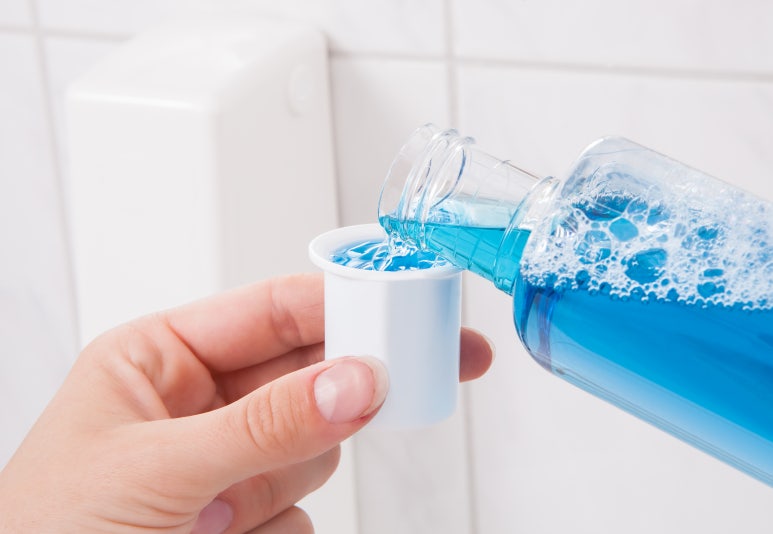
- Do not overuse mouthwash (reduce irritation)
Some people use mouthwash frequently to cover up odor, but mouthwash is only a supplement and does not solve the cause. In particular, overusing a strongly irritating product can make the mouth even drier.
�
- Adjust habits such as chewing hard foods or tearing food with the front teeth
If excessive force is repeated on an implant, the restoration may become uncomfortable or problems such as screw loosening may occur. Be careful about habits like chewing hard foods on one side continuously.
�
- Manage smoking / dry mouth
Smoking can affect gum healing and inflammation. Also, when the mouth is dry, bacteria can multiply more easily, making odor and inflammation worse. Drinking water is basic, but its effect is significant.
�
- If you suspect teeth grinding, try “relaxing the force” + discuss protective appliances
If your jaw feels tired in the morning or someone has told you that you grind your teeth while sleeping, there may be an occlusal overload. In such cases, considering a protective appliance if needed can help the lifespan of the implant.
�
- If bleeding/odor keeps recurring, checking comes before “more intensive care”
If bleeding and odor keep recurring even when you try hard at home, there may be a cause under the gums or a problem with the prosthetic margin. In this case, checking is faster than brushing more forcefully.
What does Gwangnaru Station Dental Clinic check? (Diagnostic process)
At the clinic, the feeling that the gums look lower is not just brushed off with “that can happen.”
�
Usually, the following are checked.
- Check for gum bleeding/swelling/tartar location (whether peri-implantitis is present)
- Take images if needed to check bone status (whether inflammation is progressing)
- Check occlusion (whether it feels like it is hitting high)
- Check the prosthetic margin and whether the screw is loose
- If necessary, plan professional cleaning / inflammation treatment
In particular, with implants, it is much easier to address small problems before they become bigger.
�
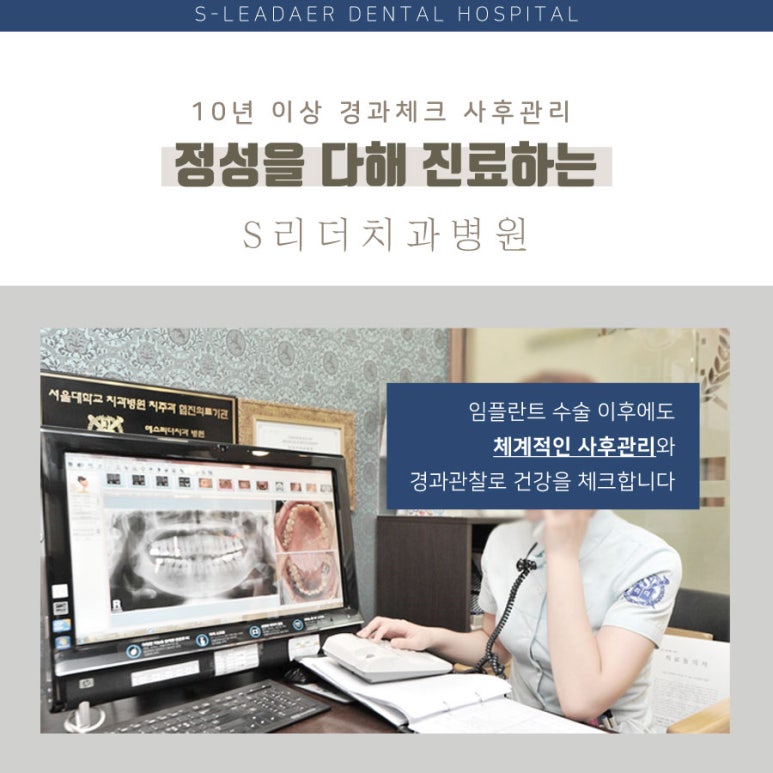
At S Leader Dental Hospital, Gwangnaru Station Dental Clinic,
we check the gum condition after implants in this way.
There are more causes than you might think for gums appearing to recede after an implant. It may be within the normal range, such as changes in swelling or an optical illusion from lighting, or it may be a sign of inflammation in a blind spot or occlusal overload.
�
So rather than panicking just because it feels like “the gums have gone down,” the most practical approach is to first check whether there are accompanying signs such as bleeding, odor, swelling, food trapping, or a change in height. If these signs repeat, it is much safer to get checked without delay, and the solution is often found faster.
�
At Gwangnaru Station Dental Clinic, S Leader Dental Hospital, for people who are concerned about the gum line after an implant or who repeatedly have odor or bleeding, we check the peri-implant gum condition (bleeding, tartar, inflammation), food trapping around the prosthetic margin, and occlusion (chewing height), and then guide you with a post-care plan suited to your condition.
�
An implant is a treatment where the process of using it comfortably for a long time becomes more important than the moment it is placed. Before anxiety grows, we recommend getting it checked once and establishing a care routine that fits your condition so you can maintain it comfortably.
�




Gwangnaru Station Dental Clinic :: S Leader Dental Hospital