
Hello, this is S Leader Dental Hospital, a Gunja Station dental clinic that is celebrating its 22nd anniversary this year.
When we show patients their X-rays in the treatment room, many people have the same reaction.
“Uh... the wisdom tooth is lying sideways.”
And the next question is almost always the same.
“But doctor, it doesn’t hurt right now. Do I really have to remove it?”
That is completely understandable. If a wisdom tooth does not hurt, people often forget it exists, and the word “extraction” itself can feel burdensome.
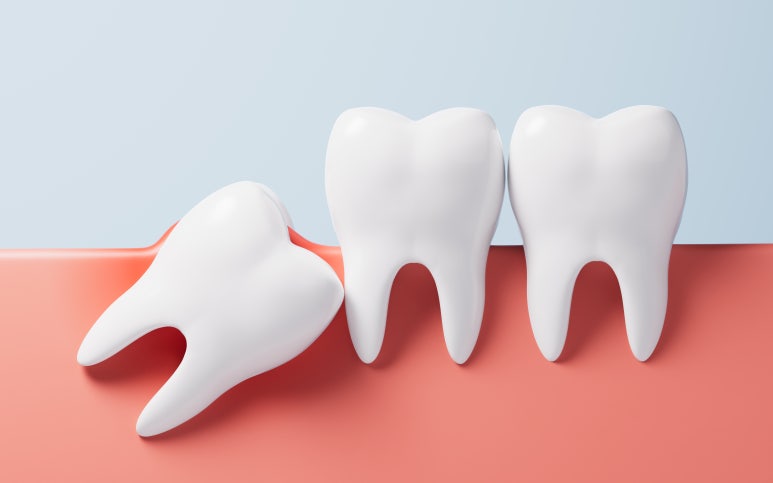
However, the reason impacted wisdom teeth are concerning is that problems can progress quietly even without pain.
In particular, impacted wisdom teeth often damage the adjacent tooth first—specifically the molar right in front of it. So if you keep postponing treatment with the idea of “let’s remove it if it hurts,” there may come a time when treatment is needed not only for the wisdom tooth but also for the adjacent molar.
Today, at S Leader Dental Hospital, the Gunja Station dental clinic, we will go over the following step by step:
- What an impacted wisdom tooth is (and how it differs from partial eruption)
- Why it can be risky even when it does not hurt
- Problems that can occur if it is left untreated (especially cavities and gum damage in the adjacent tooth)
- Cases where extraction is advantageous and cases where observation may be possible
- What examinations are used at the dental clinic to make the decision
- The extraction process and recovery/precautions
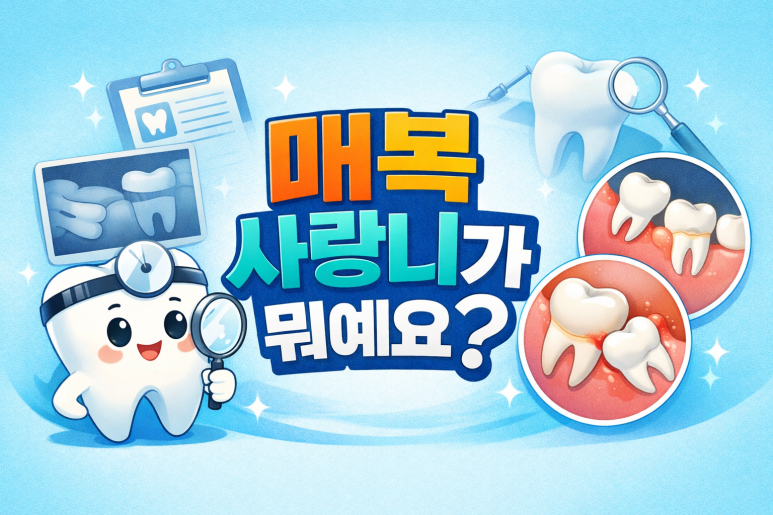
What is an impacted wisdom tooth? (Difference from partial eruption)
First, let’s define the term “impacted.” An impacted wisdom tooth is, quite literally, a wisdom tooth that is hidden in the gums or bone and has not properly emerged into its correct position. It may not be visible at all, or only a small part may show.
A similar concept that often comes up is partial eruption.
- Impacted wisdom tooth: A tooth hidden in the gums/bone that has not properly emerged (it may be almost invisible from the outside)
- Partially erupted wisdom tooth: A tooth that has partly emerged but is still covered by gum tissue, creating a gap
They have one thing in common: they are difficult to care for. Toothbrush bristles may not reach them properly, flossing is difficult, and food debris can easily get trapped. This creates an environment where inflammation and cavities can develop.
Also, with impacted wisdom teeth, the problem is often the direction they are growing in. If the tooth is lying sideways and pushing against or digging into the tooth next to it,
the adjacent tooth can be damaged even when there is no pain.
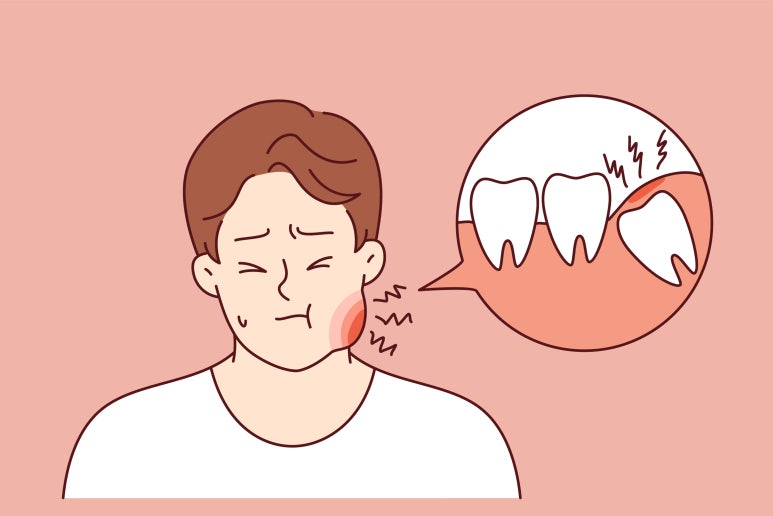
Why can it be risky even when it does not hurt? 4 reasons
1) Pain comes late, while the problem can progress quietly
Cavities and gum problems often do not cause obvious pain in the early stages. In particular, around wisdom teeth, by the time pain starts, the problem may already be fairly advanced. So relying on pain as the deciding factor can mean it is already too late.
2) Structure that the toothbrush cannot reach → bacteria/food buildup
An impacted wisdom tooth is located at the very back of the mouth, and the angle is often unfavorable. Toothbrush bristles have a hard time reaching it, and floss is difficult to insert. As a result, food debris and bacteria naturally accumulate, making inflammation more likely.
3) Contact with the adjacent tooth creates problems
If a wisdom tooth is lying sideways, it can continuously touch or press against the side of the molar in front of it (the second molar), causing damage. This is one of the biggest problems with impacted wisdom teeth. It is not uncommon for the adjacent molar to develop cavities before the wisdom tooth itself does.
4) Risk level varies greatly depending on position and angle
Even among impacted teeth:
- Teeth deeply impacted in a straight position with little effect on surrounding structures
- Teeth lying sideways and digging into the adjacent tooth
- Teeth partially covered by gum tissue, where food debris keeps getting trapped
The level of risk and the treatment approach differ. So rather than assuming “impacted = must be extracted,” it is important to first look at the position of your wisdom tooth and the condition of the adjacent tooth.

Top 6 problems that can happen if it is left untreated (focused on the adjacent tooth)
In this section, let’s look more closely at the changes that can occur if an impacted wisdom tooth is left as it is. In particular, we will organize the effects on the adjacent tooth and the gums, which many people are curious about.
1) Cavities in the adjacent molar (second molar) — the most common problem
When an impacted wisdom tooth is lying sideways, a tiny gap can easily form between the wisdom tooth and the molar in front of it.
This area is hard for a toothbrush to reach, and it is also not an easy place to remove food debris once it gets trapped.
If this continues, cavities can develop on the side surface of the front molar. The problem is that this is a “proximal side cavity” that is not easily visible from the outside.
Because it is hard to see with the naked eye and pain often appears late, diagnosis may be delayed. If it is found late, treatment may not end with a simple filling and could require an inlay, crown, or in some cases even root canal treatment.
In other words, there are quite a few cases where the treatment needed for a healthy adjacent molar becomes more extensive than treatment for the wisdom tooth itself.
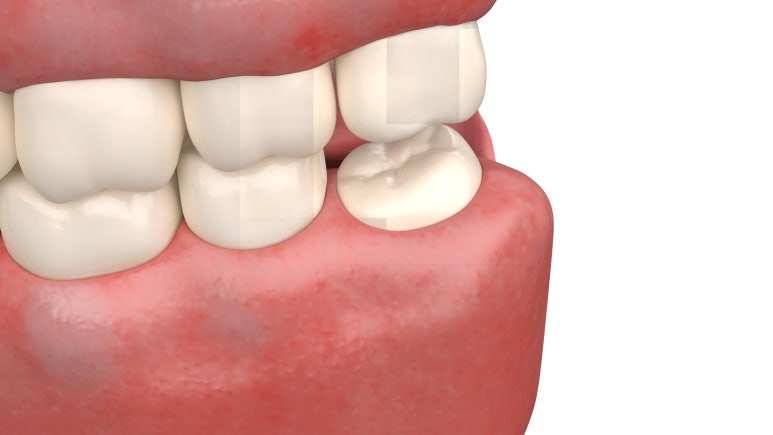
2) Gum damage around the adjacent molar (periodontal problems)
Not only cavities but also the gums can be affected. If the wisdom tooth presses against the adjacent tooth, or if tartar and inflammation repeatedly build up in that area, the gums around the adjacent molar can weaken. When the gums weaken, food gets trapped more easily, bad breath develops, bleeding occurs... and a vicious cycle begins.
3) Recurrent gum inflammation (pericoronitis)
In cases that combine partial eruption and impaction, bacteria can enter the gap under the gum and cause repeated inflammation.
Swelling goes down and then comes back, and then comes back again... when this pattern occurs, recurrence is often the result.
4) Bad breath / a fishy taste / food getting stuck
The odor around wisdom teeth can be stronger than people expect. Many patients say, “It smells really bad when I floss” or “I get a fishy taste.” This can be a sign of repeated gum inflammation and food buildup.
5) Sudden severe acute inflammation (swelling and difficulty opening the mouth)
You may feel fine most of the time, and then one day it suddenly swells up, the pain becomes severe, and it becomes difficult to open your mouth. When this kind of acute inflammation occurs, daily life becomes difficult, and in many cases the inflammation must be calmed first before extraction can be planned.
6) Rarely, cysts or other space-related changes may occur
Most commonly, the issues above are what appear. In rare cases, changes such as cysts may also occur, which is one reason why regular imaging follow-up is sometimes recommended. (This is not common for everyone, but it is something often mentioned when explaining why follow-up observation is needed.)
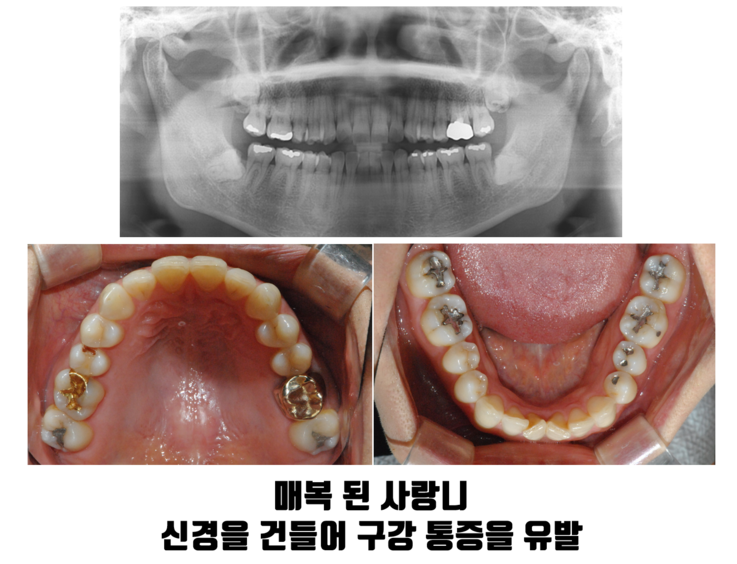
Cases where extraction is especially advantageous for an impacted wisdom tooth
1) When it is tilted sideways and pushing against or digging into the adjacent tooth
This type has a high risk of causing cavities in the adjacent molar. Side-surface cavities that are not visible are likely to occur, so delaying treatment can increase the amount of treatment needed for the adjacent tooth.
2) When cavities have already developed in the adjacent molar or are suspected
If decay is already progressing in the adjacent molar, leaving the wisdom tooth in place can continue to worsen the problem. In this case, extraction is often chosen to help save the adjacent tooth.
3) When the gum covers part of the tooth and food keeps getting trapped repeatedly
If it keeps getting trapped, causing bad breath and swelling even with only a little carelessness, it may mean the structure is difficult to manage.
4) When inflammation keeps recurring (even after it settles down)
If inflammation occurs once, improves after medication, and then swells again a few months later, recurrence is likely. In such cases, extraction is often discussed as a way to stop the recurrence.
5) When it interferes with orthodontic or prosthetic treatment plans
Depending on the case, wisdom teeth may affect orthodontic planning or prosthetic treatment. This is also determined after diagnosis.
What does the Gunja Station dental clinic look at when making the decision? (Diagnostic process)
When deciding whether extraction is needed, the dental clinic usually checks the following:
1) Panoramic X-ray (full-mouth X-ray)
This is used to check the position of the wisdom tooth, its angle, the condition of the adjacent tooth (suspected cavities), and the shape of the roots.
2) CT if needed
For lower wisdom teeth, the distance to the nerve can be important, and if the impaction is deep or the case is expected to be difficult, CT is used for a more accurate evaluation. CT is not something that is taken in every case; it is often used when needed to make a safer treatment plan.
3) Check for inflammation
If the gums are currently very swollen and inflamed, it may be safer to first stabilize the inflammation before planning extraction.
4) Evaluate extraction difficulty
The shape of the roots, depth of impaction, and position within the bone all affect the difficulty. Knowing this in advance and planning accordingly can make recovery easier.
The impacted wisdom tooth extraction process is more straightforward than you might think.
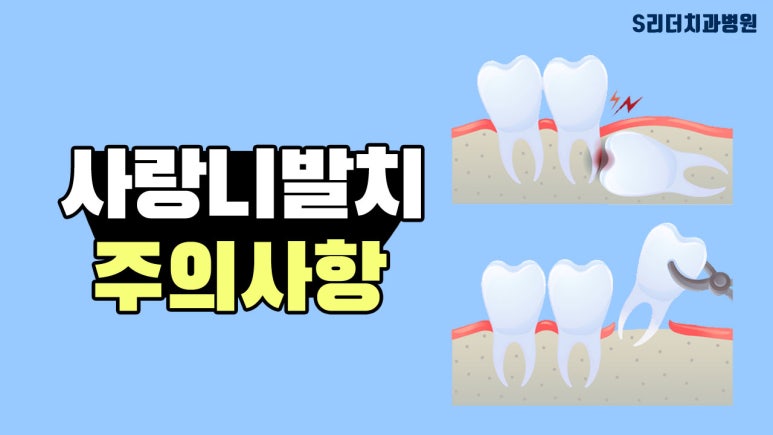
Thinking of an impacted wisdom tooth being “just pulled out” can make it seem frightening. But in reality, it is done safely in stages.
- After anesthesia, the gum is opened
- If needed, the tooth is divided and extracted in sections
- The area is cleaned thoroughly
- If necessary, it is sutured
Depending on the case, the time required varies, and if the inflammation is severe, it may be more comfortable to first calm the inflammation and then perform the extraction.
The important thing is to hear in advance what form your wisdom tooth is in and what process will be followed.
Recovery and precautions after extraction (practical tips)
After impacted wisdom tooth extraction, recovery usually follows this kind of pattern. It varies from person to person, but the overall course is similar.
1) Swelling/pain usually peak around days 2 to 3
Swelling often reaches its peak 2 to 3 days after extraction and then gradually goes down. Ice packs and resting without overexertion can help.
2) Start with soft foods
At first, start with soft foods such as porridge, steamed eggs, or tofu, and try to chew on the opposite side.
3) Key points: bleeding control, rinsing, straws, and smoking are off-limits
In the early stage after extraction, the blood clot needs to settle well for recovery to go smoothly.
- Using a straw
- Rinsing forcefully
- Smoking
These can interfere with healing, so it is best to be careful.
4) Preventing dry socket
If pain suddenly becomes severe and the smell worsens starting around 2 to 3 days after extraction, it may need to be checked. Rather than trying to endure it alone, it is better to contact the clinic.
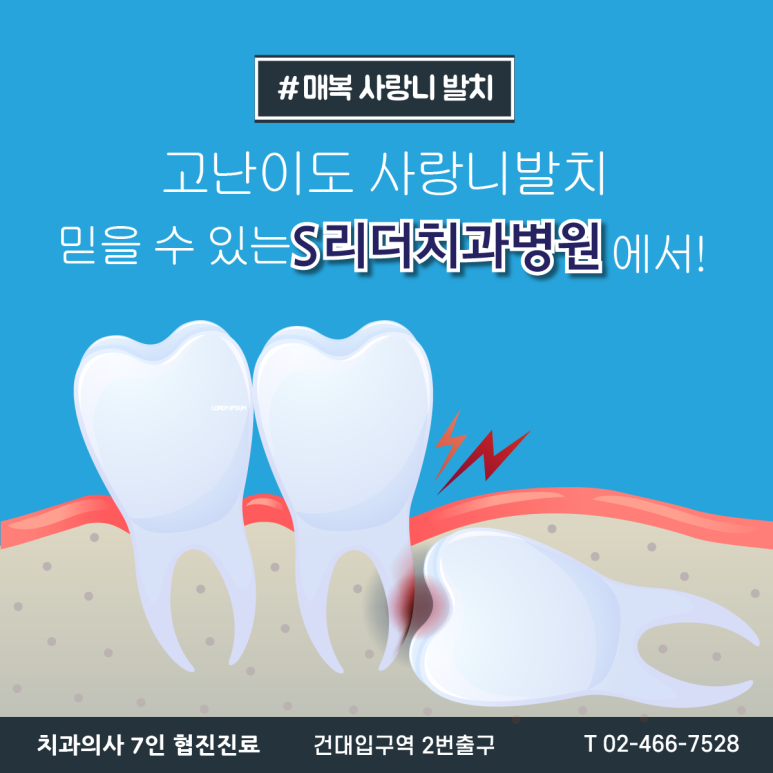
An impacted wisdom tooth can damage the adjacent tooth before it starts hurting.
It is often difficult to feel safe just because an impacted wisdom tooth does not hurt. In particular, when the tooth is lying sideways, cavities and gum damage in the adjacent molar often progress first. So if you keep postponing it with the thought, “I’ll remove it when it hurts,” there may come a time when you need treatment for both the wisdom tooth extraction and the adjacent molar. On the other hand, if you are properly diagnosed now and the risk is checked, you can reduce unnecessary worry and, if treatment is needed, resolve it neatly at the right time.
At S Leader Dental Hospital, the Gunja Station dental clinic, when consulting about impacted wisdom teeth, we do not simply stop at “remove it” or “leave it.” We check the position and angle of the wisdom tooth, the risk of cavities in the adjacent molar, and whether there is any current inflammation, then guide the patient toward a treatment plan that fits their situation.
Because preventing damage to the adjacent tooth is the most important point, we clearly explain whether a case can be observed or whether extraction is more advantageous. If you currently have an impacted wisdom tooth but are hesitating because it does not hurt, we recommend having it checked accurately once and making a plan that fits your condition rather than worrying about it alone.



 Gunja Station Dental Clinic :: S Leader Dental Hospital