Hello, we are S Leader Dental Hospital, a Junggok-dong dental clinic that is celebrating its 22nd anniversary this year.
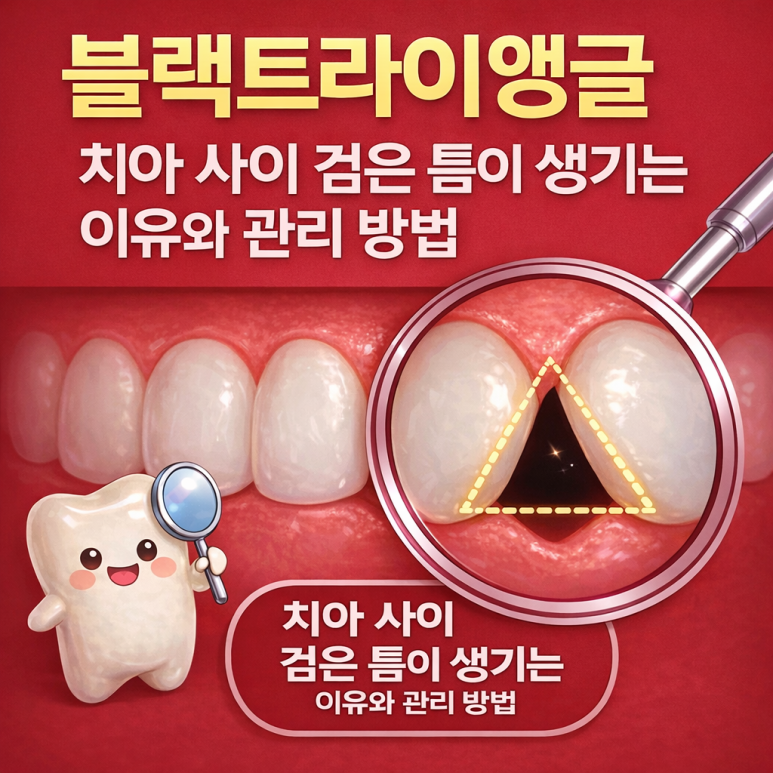
Sometimes, when you suddenly look in the mirror, you may be startled to find a black space-shaped gap between your teeth. You may not have noticed it before, but it can stand out more when taking photos or smiling under bright lights.
“Have my teeth separated?”
“Has my gum receded?”
“I think it appeared more after orthodontic treatment...”
As these concerns continue, many people become even more self-conscious and cover their mouths when they smile.
This “black space” is commonly called a black triangle. It is not simply an appearance issue; it can also lead to discomfort such as food getting stuck more easily, bleeding when using dental floss, and bad odor. That does not mean that it must always be treated, but it is important to first analyze why it appeared and then choose management and treatment directions that fit your condition.
Today, at S Leader Dental Hospital, a Junggok-dong dental clinic, we will go over the following step by step in an easy-to-understand way for patients:
-
What a black triangle is
-
Why it happens (causes)
-
Why it can be a problem (discomfort and risks)
-
Treatment methods (resin, gum tissue treatment, use of auxiliary devices, etc.)
-
Management methods you can do at home
-
Finally, a summary and key points for consultation at the hospital
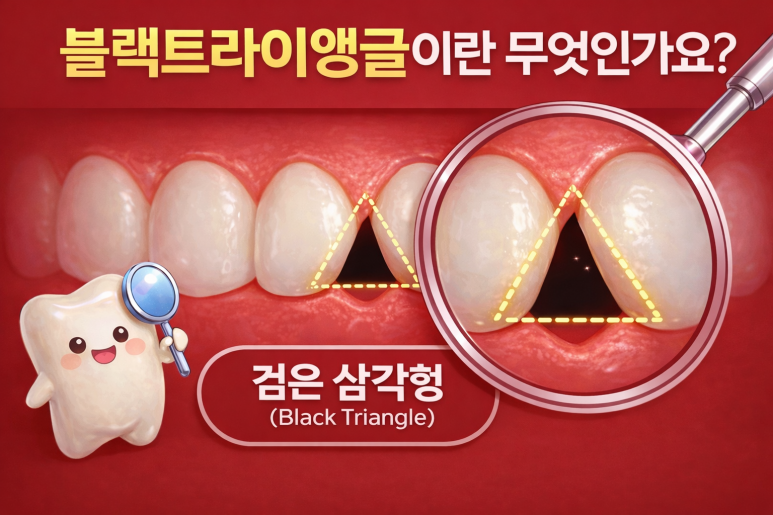
What is a black triangle?
A black triangle is, as the name suggests, a phenomenon in which a triangular empty space forms near the gums between teeth and appears black.
There is an important point here. Many people think a black triangle means “the teeth have separated,” but in reality, it is a little different from teeth simply moving apart.
Gap from separated teeth: The space often appears open from the top between the teeth.
Black triangle: Even though the teeth may look like they are touching, the lower gum area appears empty, creating a triangular black-looking
feeling.
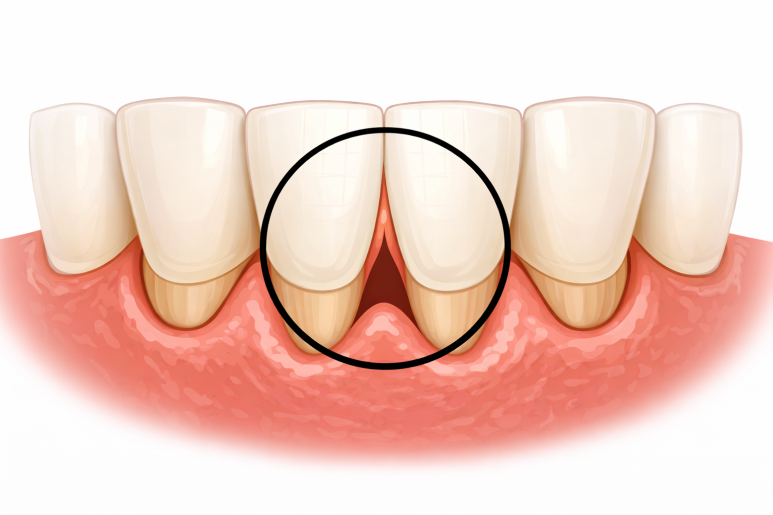
Why does this happen? There is gum tissue that is supposed to fill the space between teeth. When the gum between teeth is full, the gap is less visible, but if this gum cannot fill the space sufficiently for various reasons, the lower area appears empty and looks black. The reason it stands out more under lights or in photos is also due to this “shadow.”
In other words, it is easy to understand a black triangle as something created not only by tooth alignment but also by a combination of gum condition and tooth shape.
So why do black triangles occur? (Let’s organize the main causes.)
Black triangles do not appear for just one reason. They usually occur when gum condition, tooth shape, lifestyle habits, and orthodontic/treatment history overlap.
Let’s organize the main causes in simple terms.
- When the gums are weakened by gum inflammation (gingivitis/periodontitis)
Before gums hurt, they often send a signal through “bleeding.” If bleeding occurs during brushing, swelling appears, and a bad odor is noticed when flossing over a long period, it becomes difficult for the gum between the teeth to stay healthy. When the gums weaken, the ability to firmly fill the space between teeth decreases, and black triangles can become more noticeable.
- When the gum type is thin or the gums have receded
Gum thickness differs from person to person. For people with naturally thin and sensitive gums, the gum line may appear to change more easily even in the same situation. Also, those with a habit of brushing too hard or those whose gums seem to be gradually receding (gingival recession) may notice black triangles more easily.
- When they become more noticeable after adult orthodontic treatment
Orthodontic treatment straightens the teeth. However, as the teeth become more aligned, spaces that were not noticeable before may start to show.
In particular, adult orthodontic treatment may have a more limited gum-filling response than during growth, so some people find black triangles more noticeable after treatment. Rather than meaning the orthodontic treatment was wrong, it is often the case that the original condition has simply become visible.
- When the tooth shape is close to triangular (contact point is higher up)
If the tooth is wider at the top and narrower at the bottom, the point where the teeth touch tends to form higher up. Then the lower gum area may appear relatively empty. This can be considered a case in which the “tooth shape” itself is part of the cause.
- When the space becomes visible as tooth rotation is corrected (common after orthodontic treatment)
In cases where the teeth were twisted, when orthodontic treatment corrects the rotation and the teeth face forward, the space below may appear more noticeable in the process. It is not actually newly created; the way it looks has changed.
- Insufficient care between the teeth (lack of floss/interdental brush routine)
The spaces between teeth are the hardest areas to care for. There are areas that cannot be fully cleaned with a toothbrush alone, and if food debris and plaque remain there, the gums can become sensitive and black triangles may become more noticeable. Many people who say, “I had resin, but it still feels uncomfortable,” often have a weak interdental care routine.
- The influence of force (occlusion), such as teeth grinding/clenching
If you have a strong habit of clenching your teeth, repeated force may be applied to the gums and teeth. Of course, it cannot be concluded that this alone causes black triangles, but for people with sensitive gums, clenching can be a factor that worsens the condition.
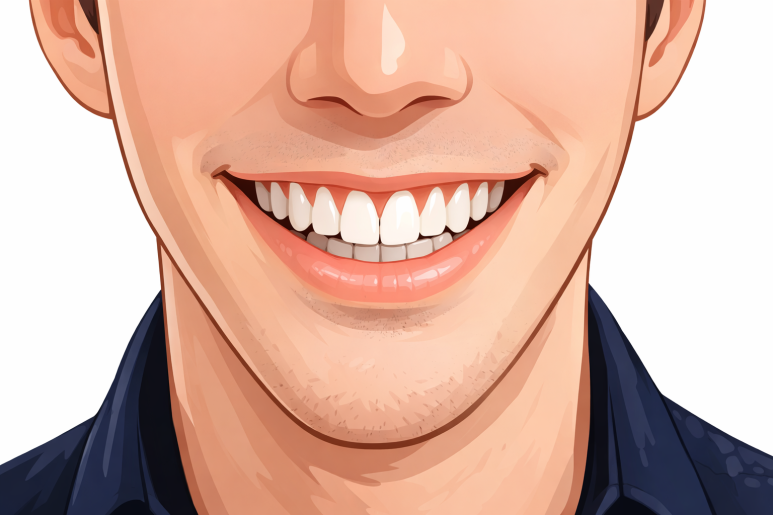
Why black triangles can be a problem
A black triangle does not always end with just “it looks bad.”
It may become more concerning when the following discomforts come with it.
- Food gets stuck more often, and the feeling of discomfort repeats.
When a gap forms, food gets stuck more easily. In particular, if it gets stuck between the front teeth, it can also be distracting when speaking, and you may be left with a feeling that “even after brushing, it still doesn’t feel fresh.”
- There may be bleeding when flossing, or a smell may come from the floss.
If there is inflammation between the teeth, bleeding may occur when flossing. Also, if food debris and plaque remain, floss may seem to carry an odor. In such cases, checking the gum condition often comes before focusing on the black triangle itself.
- Bad breath or a fishy taste may become bothersome.
It cannot be concluded that bad breath is caused only by black triangles, but if food remains between the teeth and inflammation repeats, the odor can worsen.
- It may look worse in photos, increasing psychological stress.
Black triangles often appear darker in photos and under lighting. As a result, they may feel larger than they really are, and some people lose confidence when smiling. This psychological stress is also an important factor when deciding on treatment.
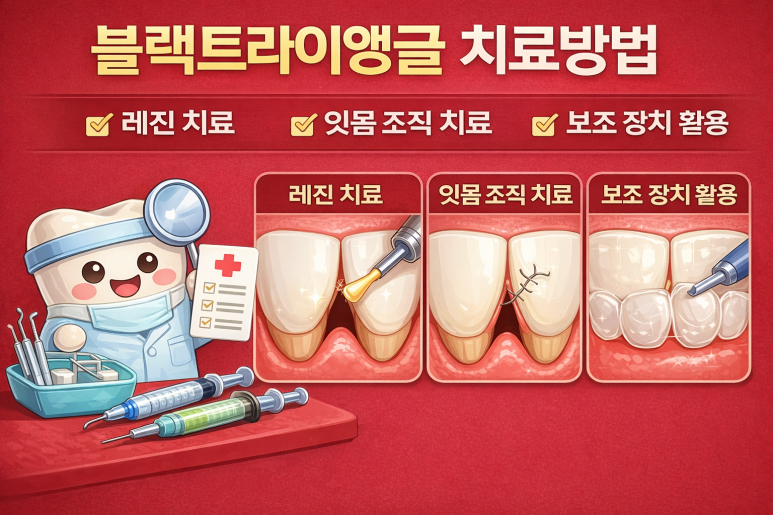
Treatment methods for black triangles (resin, gum tissue treatment, use of auxiliary devices)
Here, the goal is often divided into two types.
-
Reduce the visible space that bothers me (aesthetic)
-
Reduce discomfort such as food getting stuck, odor, or bleeding (function/hygiene)
The treatment approach changes depending on this goal.
- Filling with resin (improving tooth shape + reducing food trapping)
Resin is a method that slightly reinforces the tooth shape to make the black triangle less noticeable. The advantages are that it is relatively quick and less burdensome. Satisfaction is especially high when the space is not large and the tooth shape can be naturally enhanced.
However, resin creates a boundary between the tooth and the resin, so management may become even more important. If food debris remains at the boundary, odor or bleeding may occur, so after resin treatment, a floss routine is often essential.
- Gum tissue treatment (case selection is important)
Treatment that improves the gums themselves cannot be applied to every case, and the results may differ from case to case. In cases where the gums have receded significantly or the gums are thin, the treatment direction may differ, so it is necessary to confirm the possible scope after an accurate diagnosis.
- Using auxiliary devices (finishing orthodontics/interdental care tools/habit management)
If the black triangle has become more noticeable after orthodontic treatment, fine adjustments to the contact points or alignment of the teeth may be discussed during the finishing stage (depending on the case).
Also, auxiliary devices do not only mean treatment devices; they also include care tools such as interdental brushes and water flossers.
Proper “care between the teeth” is very helpful in reducing actual discomfort.
What about management? (What you can do at home)
Management is just as important as treatment. In particular, for people with black triangles, “care between the teeth” has a major impact on the results.
Let’s organize the routine below realistically without making it excessive.
- Use dental floss once a day, even if only at night
Many people try to do it perfectly after every meal and end up giving up. It is much better to do it properly just once at night. Floss is not simply something you insert and remove; it is important to move it along the sides of the teeth as if “wiping” them. (A method of cleaning each side of the tooth individually.)
- The key with interdental brushes is the “size”
If you force a brush that is too large between the teeth, the gums may become more sensitive. It is better to use a smaller size gently, and it works well as a “support” along with floss.
- Brush gently, not forcefully (especially along the gum line)
Some people brush harder when they are worried about black triangles, but the gums do not improve from being scrubbed hard. It is safer to gently brush along the gum line with a soft toothbrush.
- Manage dry mouth (drink water often)
When the mouth is dry, odor can worsen and the gums can become more sensitive. The habit of drinking water often helps more than you might think. If you drink a lot of coffee, be sure to replenish with water.
- If bleeding/odor repeats, do not just increase cleaning force—get checked
If bleeding continues when flossing and the odor is strong, it is faster to check the gum condition rather than brushing harder. Tartar or inflammation under the gums may be the cause.

How S Leader Dental Hospital, a Junggok-dong dental clinic,
checks black triangles
A black triangle is not simply a problem of “the teeth have separated”; it is a phenomenon that appears because gum condition, tooth shape, and habits all influence it together. Therefore, the safest solution is not to simply choose “resin” or “treatment” unconditionally, but to first check why it appeared and then decide on treatment and management directions that match your goal (aesthetics/discomfort relief). In particular, many people find that if they properly establish a flossing and interdental care routine, odor and discomfort are greatly reduced, so in many cases the care plan becomes more important than the treatment itself.
At S Leader Dental Hospital, a Junggok-dong dental clinic, for patients worried about black triangles, we do not stop at simply asking, “Should we fill it?” Instead, we check gum bleeding, tartar location, tooth shape, and food-trapping patterns together to first determine whether the cause is a gum issue or a shape issue, and then guide you toward the least burdensome and most maintainable method.
If a case needs resin, we also explain the flossing routine and boundary-area care after treatment so that you can establish a management direction that will help “prevent it from becoming uncomfortable again.” If the black triangle is becoming more bothersome, or if food trapping, odor, and bleeding keep recurring, rather than worrying alone, it would be best to have your current condition accurately checked once and resolve it more comfortably.





 Junggok-dong Dental Clinic :: S Leader Dental Hospital