Hello, this is S Leader Dental Hospital, a Sagajeong Station dental clinic that is celebrating its 22nd anniversary this year.
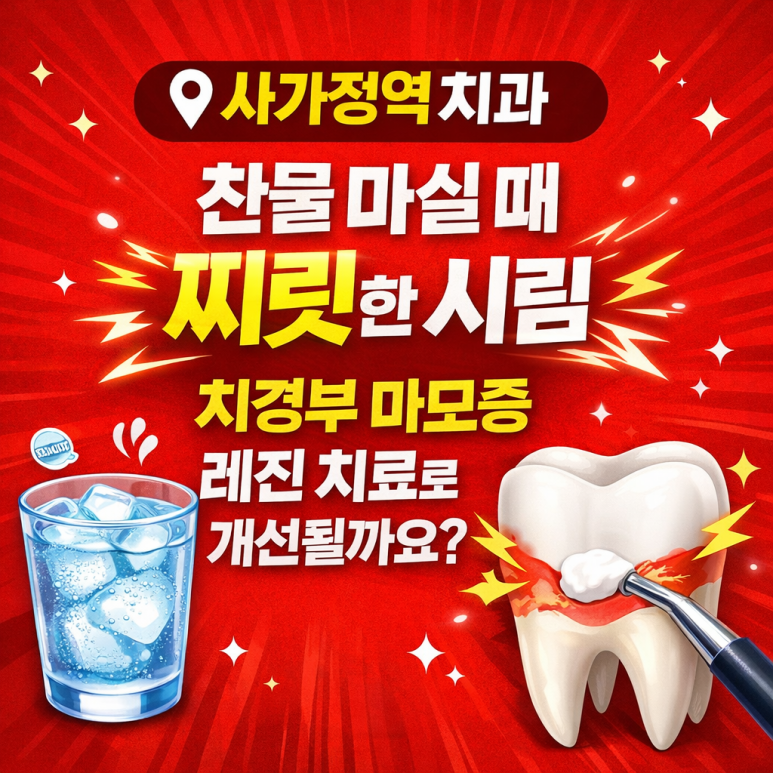
There are people for whom a sip of iced Americano or a sip of cold water suddenly becomes difficult to drink.
“Ah... there it is again. That sharp sting.”
Even when a toothbrush touches the teeth while brushing, it feels sensitive, and in winter, even a cold breeze makes the teeth feel so sensitive that you end up clenching your teeth without meaning to. You may try toothpaste for sensitive teeth or switch mouthwash, but if it only gets a little better and then comes back, it can make you anxious.
“Could it be a cavity?”
“Do I need root canal treatment?”
“Can I just put up with it?”
Sensitivity is a common symptom, but the problem is that there is not just one cause. Some cases are caused by cavities, some by receding gums, and some by tiny cracks in the teeth. Another cause that many people experience more often than expected is cervical abrasion, which is the wearing away of the gum-line area.
Today, at S Leader Dental Hospital, a Sagajeong Station dental clinic, we will take a step-by-step look at why that “sharp sting when drinking cold water” happens, what cervical abrasion is, when resin treatment can help, and what habits are worth changing to help prevent recurrence.
Sensitivity is common, but the 'cause' is different, so the treatment is different.
When people say their teeth are sensitive, many first think of cavities. Of course, cavities can be the cause. But in the clinic, the causes of sensitivity are truly varied. That is why there are many people who keep enduring it by using toothpaste for sensitive teeth, only to end up visiting when the discomfort has become worse.
The most important first step in addressing sensitivity is simple.
First, identify what is causing the sensitivity.
Even if the symptom is the same “sharp sting,” the treatment direction changes depending on the cause. In some cases, resin can bring quick relief, but in other cases, another treatment or checkup may need to come first.

Sharp sensitivity to cold water: what are the 5 causes?
The reason cold water feels especially sensitive is that the stimulus is transmitted more easily into the tooth.
Let’s organize the main causes into five categories.
- Cervical abrasion (wear at the gum line)
This is one of the most common causes. As the area where the gums and teeth meet becomes worn down, the sensitive inner part is exposed and becomes sensitive to cold stimuli. If it feels like the side of the tooth is slightly worn down, this may be worth suspecting.
- Receding gums (root exposure)
When the gums recede, the root area of the tooth may become exposed, causing sensitivity. It is especially common in people with thin gums or those who have a habit of brushing too hard.
- Early cavities (especially between the teeth)
If cavities between the teeth, which are not easily visible from the outside, progress, sensitivity can occur. If only certain teeth feel unusually sensitive or if sweets also cause sensitivity, an examination is needed.
- Tooth cracks (tiny fractures)
If, after biting something hard, a specific tooth stings when chewing, or if it hurts only in certain directions, a tiny crack may be the cause. In such cases, simple sensitivity treatment alone may not solve the problem.
- Temporary sensitivity after scaling
After scaling, as plaque and tartar are removed and the tooth surface is exposed, temporary sensitivity can occur. It usually decreases over time, but if it lasts too long, another cause may be hidden underneath.
In other words, “a sharp sting from cold water” is only one symptom, and the causes can vary. So to determine cervical abrasion with confidence, it is necessary to check whether the area is actually worn down, what the gum condition is like, and whether cavities or cracks are present.
What is cervical abrasion? Why does the gum line wear away?
Cervical abrasion literally means that the gum-line area of the tooth has worn away. The outside of the tooth is hard, but when the gum line is worn down, the sensitive inner area can be exposed. That is why cold water or wind can cause a sharp sting.
There is also a typical pattern in where cervical abrasion develops.
It is often seen around the canines and premolars in the front, and sometimes only one or two teeth are affected, while in other cases it appears across several teeth. When you look in the mirror, the side of the tooth may appear slightly hollowed out.
The important thing is that cervical abrasion does not end with simply saying “the tooth has worn down.”
- Sensitivity can gradually worsen
- If the worn area becomes deeper, food can get stuck and the gums can become even more sensitive
- It may also become a cosmetic concern
That is why it is one of the common causes of sensitive teeth that should not be overlooked.
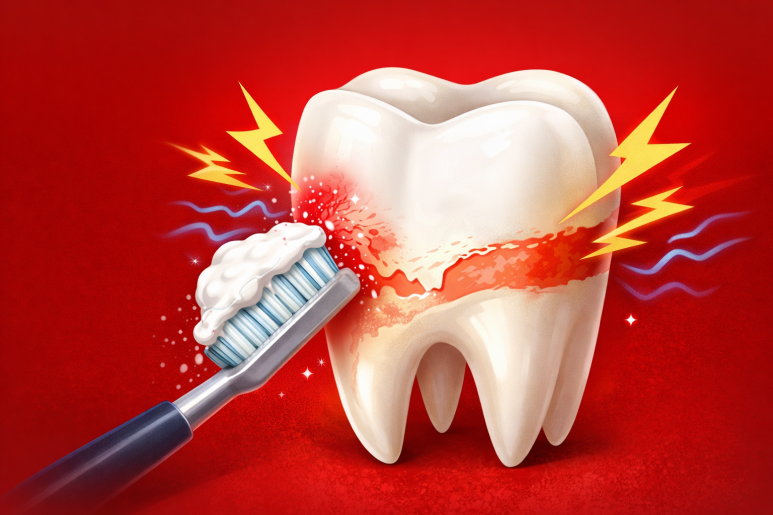
6 habits that cause cervical abrasion
Cervical abrasion usually does not appear all at once; in many cases, it progresses as daily habits accumulate over time.
Let’s summarize the common causes.
- Brushing too hard and scrubbing horizontally
This is the most common one. If you scrub back and forth horizontally with the intention of cleaning thoroughly, repeated irritation can occur at the gum line. In particular, if you have a habit of brushing too hard on only one side, that side may wear down more.
- Hard toothbrush bristles / toothpaste with strong abrasives
If the bristles are too hard or the toothpaste contains strong abrasives, wear may progress more easily. Some people who have used whitening toothpaste for a long time may show this pattern.
- Teeth grinding / clenching (concentrated force)
If you have a habit of clenching your teeth, force is repeatedly applied to the teeth, and the gum line can become more sensitive. In particular, if you unconsciously clench or grind your teeth while sleeping, you may not even notice it yourself.
- Cases where acidic drinks and fruits add chemical erosion
Acidic foods such as carbonated drinks, lemons, and vinegar can make the tooth surface more sensitive. If wear and acid erosion progress together, sensitivity can become worse.
- Thin gum type / gingival recession
If your gums are naturally thin, the same stimulus can make them more sensitive. Also, when the gums recede and the roots are exposed, sensitivity is felt more easily.
- Changes in force distribution after orthodontic treatment or prosthetic work (case-by-case)
After orthodontic treatment or prosthetic work, chewing force may become concentrated on a specific area. This does not apply to every case, but if only a particular tooth feels unusually sensitive or worn down, it may be worth checking the bite as well.
So when is resin treatment needed? (Treatment criteria)
Not every case of cervical abrasion requires resin treatment.
However, resin treatment is often helpful in the following situations.
- When sensitivity is so uncomfortable that it interferes with daily life (cold water, brushing feels burdensome)
- When the worn area is deepening and seems to be progressing
- When food gets stuck or the area keeps feeling rough
- When toothpaste for sensitive teeth or fluoride application does not provide enough improvement
- When the appearance of the worn side of the tooth is bothersome
- When other causes (cavities/cracks) have been ruled out
Because resin covers the worn area and blocks stimulation, many people feel a significant reduction in sensitivity in appropriate cases.
How resin treatment helps sensitive teeth (expected effects)
The core problem of cervical abrasion is that the sensitive area is exposed.
By covering that area, resin can
- prevent cold water and wind from directly reaching the tooth
- smooth the surface and help reduce further wear
- reinforce the tooth shape and reduce food trapping or discomfort
That said, to be honest, resin does not remove the underlying cause itself.
For example, if the habit of brushing too hard continues, the resin may come off or the margin may become rough. If clenching is strong, wear may progress more quickly. That is why resin treatment tends to be more satisfying over time when combined with habit correction.
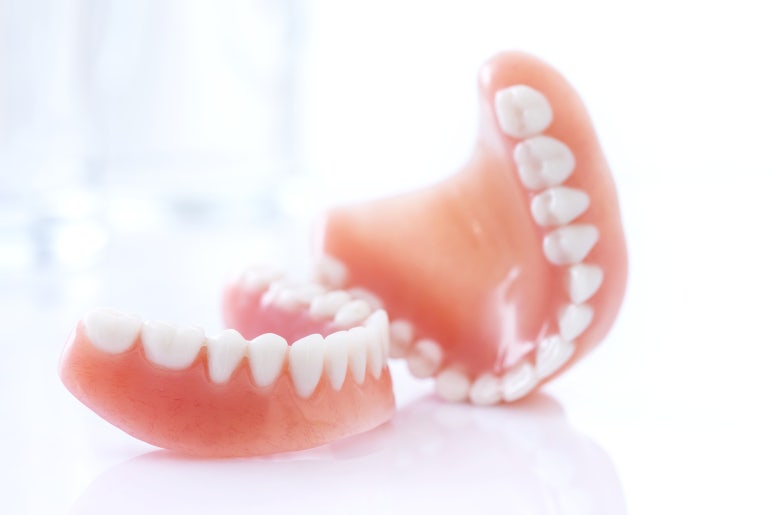
Cervical resin treatment process (including pain / anesthesia / time)
Cervical resin treatment often finishes relatively quickly. However, since the area can be highly sensitive, whether anesthesia is used depends on the situation.
When anesthesia may be needed vs. not needed
If the worn area is shallow and not very sensitive, treatment may proceed without anesthesia.
If sensitivity is severe or the worn area is deep and sensitive, anesthesia is often used to make the procedure more comfortable.
The treatment process goes like this.
1 Clean and prepare the worn area
2 Apply the bonding process and fill with resin
3 Shape it naturally
4 Finish the surface smoothly at the end (polishing)
Treatment time varies by case, but it is usually less of a “complicated procedure” and more of a “precise shaping and restoration” treatment.
Can there be temporary sensitivity after treatment?
Yes, some people may still feel sensitivity for a few days immediately after treatment. However, in most cases it settles over time, and many people notice a significant reduction in sensitivity. That said, if the pain gradually worsens or only a specific tooth hurts unusually, it may need to be checked.
Other treatments and support methods besides resin (combined options)
Cervical abrasion is sometimes resolved with resin alone, but there are methods that work even better when used together.
- Coating for sensitive teeth / fluoride application (can help relieve sensitivity)
- Mouthguard consultation if grinding/clenching is strong
- Brushing correction: brush type, angle, and pressure adjustment
- Toothpaste selection: avoid products with overly strong abrasives, and use toothpaste for sensitive teeth
- Adjust acidic drink habits: especially do not brush immediately after acidic drinks (timing matters)
Because cervical abrasion is strongly influenced by lifestyle habits, small changes can help maintain the results for longer.
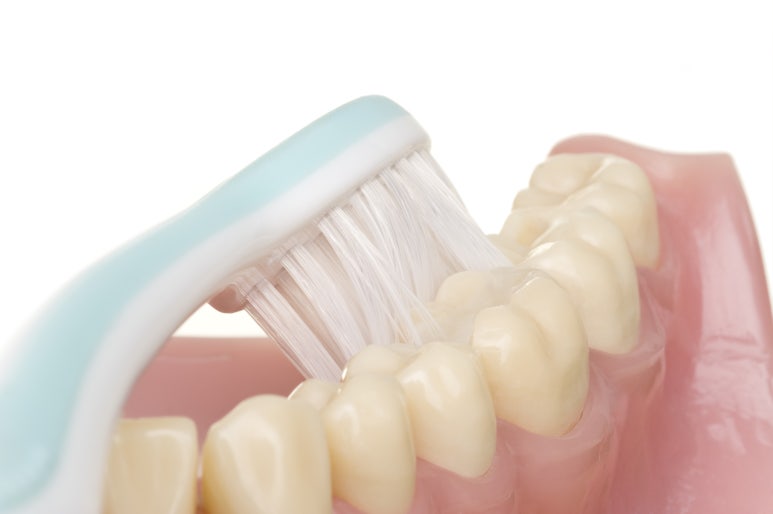
7 ways to prevent recurrence
Even after resin treatment, it is very important to manage the condition so sensitivity does not return and the worn area does not progress again.
- Brush gently and vertically (reduce horizontal scrubbing)
- Use a soft-bristled toothbrush and avoid toothpaste with overly strong abrasives
- Reduce gum inflammation with floss / interdental care (when the gums are stable, sensitivity is reduced too)
- After consuming acidic drinks or fruits, rinse with water and wait before brushing rather than brushing immediately
- If teeth grinding / clenching is suspected, seek consultation (an unconscious habit can be a major variable)
- Check for wear progression through regular checkups (it is easier to catch early)
- If sensitivity becomes severe again, do not endure it; get it checked early
Among these, the biggest change often comes from adjusting brushing force. Brushing harder does not mean cleaner, and gently cleaning the gum line is actually more helpful.
Sagajeong Station Dental Clinic ::
Check the cause first when cold water causes a sharp sting
Sharp sensitivity when drinking cold water is a common concern, but the solution differs depending on the cause. Cervical abrasion is one of the most common causes, and in appropriate cases, many people feel a significant reduction in sensitivity with resin treatment. However, it is not just about resin alone; if you also address causes such as brushing too hard or clenching, you can stay comfortable for much longer.
At S Leader Dental Hospital, a Sagajeong Station dental clinic, for patients who visit with sensitivity, we first check whether the cause is cervical abrasion, receding gums, or another issue such as cavities or cracks. If needed, we provide resin treatment along with realistic guidance on brushing habits, toothpaste selection, and clenching management.
If the sharp sting from cold water keeps bothering you, rather than just putting up with it, we recommend identifying the cause accurately and improving it in a way that fits your dental condition.



 Sagajeong Station Dental Clinic :: S (S) Leader Dental Hospital