Hello, this is S Leader Dental Hospital, a Myeonmok-dong dental clinic now celebrating its 22nd anniversary since establishment.

There is a phrase we hear very often in the treatment room.
“Doctor… I think my tooth has a crack.”
It looks fine on the outside, but when you bite into certain foods, you feel a sharp, lightning-like sting, or when you chew on one side, it feels like it catches with a “click.” Then, one day, your tooth starts to hurt with cold water, and your worry suddenly grows. What is even more frustrating is that tooth cracks are often not clearly visible like cavities, so it is difficult to judge them on your own.
But if you just brush it off as “maybe it’s just a little sensitive,” the pain can worsen and the scope of treatment can become larger at some point. On the other hand, if you check it early, adjust your lifestyle habits, and receive the necessary treatment, there are many cases where you can reduce the burden and keep using the tooth for a long time.
-
Definition of a tooth crack (cracked tooth)
-
Why does a fracture happen? Causes and risk factors
-
Actions you should absolutely not take when a tooth fracture is suspected
-
What problems can occur if it is left untreated?
-
What diagnosis will the dentist make?
-
Frequently asked questions (Q&A) and checkpoints
Today, I will organize this in the order that patients are most curious about.
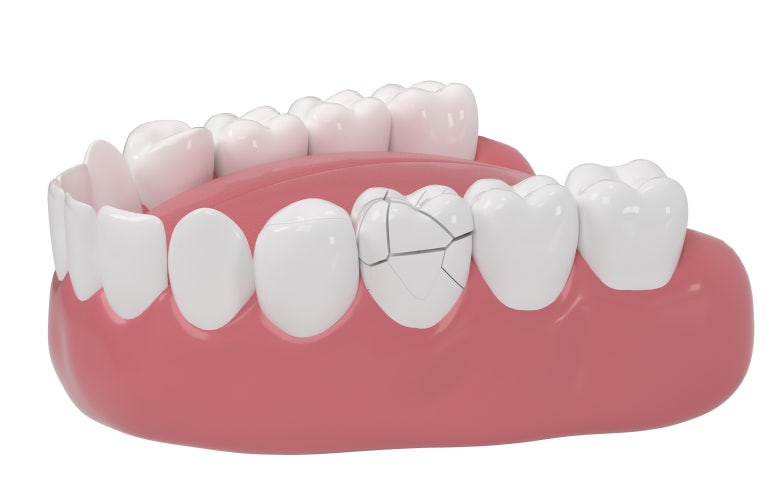
What is a tooth crack (fracture)? Let’s start with the definition.
A tooth crack refers to a state in which a very fine line crack has formed in the tooth. The important point here is not the “degree to which the crack is visible,” but how deep the crack goes.
A tiny crack only on the outer surface may sometimes be monitored without any major issue, but if the crack becomes deeper and approaches the nerve inside the tooth, sharp pain may occur. If it progresses further, it may hurt every time you chew, and root canal treatment or a crown may become necessary.
Patients often think of a “crack” as a tooth that has split open, but in reality, very fine cracks often start first. The problem is that these fine cracks are hard to see, and the symptoms can come and go, making them easy to miss early on.
There is another term that can be confusing.
Crack (fissure): a state in which a crack has formed (fine to moderate)
Fracture (break/chip): a state in which the crack has progressed and an actual piece has fallen off or the structure has broken
In the end, it is the same problem, but depending on how far it has progressed, it is classified as either a crack or a fracture, and the treatment plan changes accordingly.
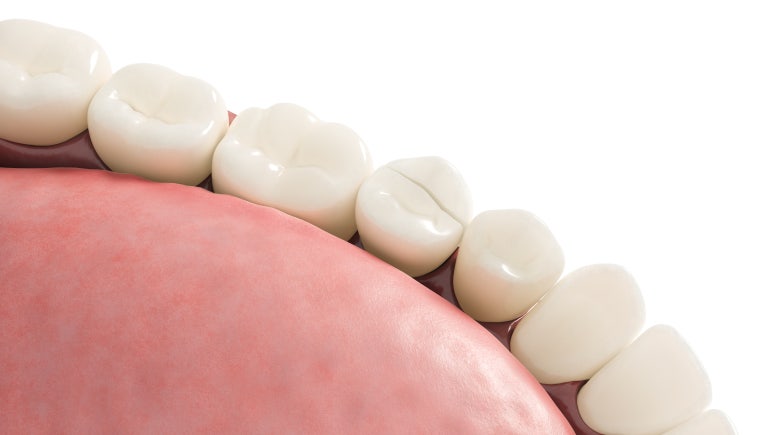
Why does a fracture (crack) happen? Causes and risk factors
“Nothing special happened to me.”
We really hear this from many people. Teeth are under a lot of force every day, and small habits can build up and cause cracks.
Here is a summary of the main causes.
- Habit of clenching your teeth and bruxism
This is one of the most common causes. People who unconsciously clench their teeth during the day or grind their teeth while sleeping place repeated pressure on their teeth. Molars, in particular, receive a lot of force, so cracks can form more easily.
- Habits involving hard foods (ice, nuts, squid, bones, etc.)
Teeth are hard, but they can be vulnerable to “sudden strong force.” Chewing ice, chewing very hard nuts only on one side, or frequently chewing tough foods like dried squid can also increase the risk of cracks.
- Leaving a large cavity untreated for a long time (the tooth becomes thinner)
When a cavity becomes large, the tooth walls become thinner. A tooth weakened this way can crack even under a small amount of force. Some patients say, “I had a cavity, but I postponed treatment because it didn’t hurt,” and then later come in with crack-related pain.
- Teeth with existing restorations such as large composite fillings/inlays
When a tooth has had extensive treatment, the way chewing force is transmitted through the tooth may change. This does not mean the treatment itself is the problem, but rather that over time, if force becomes concentrated, a crack can develop.
- Age and tooth wear (changes that make teeth gradually drier and harder)
As we age, wear on the teeth accumulates little by little. If this is combined with clenching habits, the risk of cracks can increase.
- Sudden trauma (falling, being hit)
Front teeth are often chipped or cracked due to trauma. Even if there is no major visible break, if you feel sensitivity to cold water or a sharp sting when chewing after being hit, an examination is needed.
What should you absolutely not do when a tooth fracture is suspected? (Important!)
If you mishandle a tooth crack by saying, “It doesn’t hurt that much for now,” it can worsen.
Please be especially careful with the following actions.
- Continuing to chew on the painful side (especially hard foods)
Even if you feel a sharp sting, if you keep chewing on that side thinking, “I can still chew on it,” the crack may deepen further. Cracks can progress as small impacts accumulate.
- Continuing to eat hard foods like ice, nuts, or dried squid
If you repeatedly eat hard foods on a tooth that may already have a crack, the risk of the crack progressing into a fracture can increase.
- Enduring it for a long time by only using toothpaste for sensitive teeth
Toothpaste for sensitive teeth may help in some cases, but crack-related pain is often different from simple sensitivity. In particular, if you feel a sharp sting when chewing or the pain gradually gets worse, toothpaste alone will not solve it.
- Repeatedly testing hot and cold stimuli on purpose
If you repeatedly apply stimuli, such as trying to see “whether it hurts with something hot,” the tooth can become even more sensitive. It is better to have the test done safely at the clinic.
- Enduring severe pain with painkillers alone
Painkillers can reduce pain, but they do not solve the cause. In particular, a pattern in which the pain gets worse at night often requires examination.
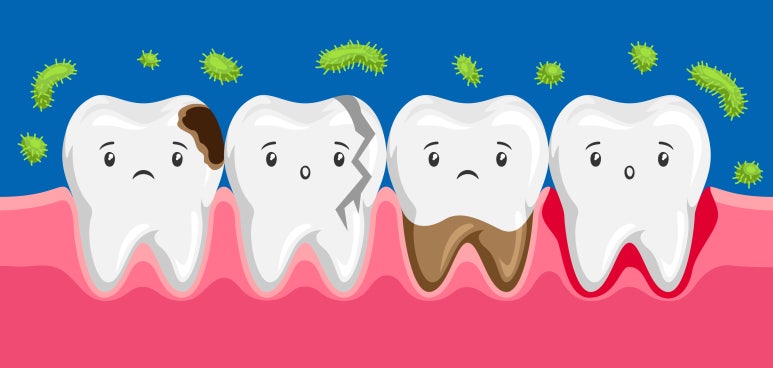
What problems can occur if a tooth fracture (crack) is left untreated?
The changes that can occur if a cracked tooth is left untreated happen in stages. Rather than thinking, “Something terrible will definitely happen,” it is important to know the possible problems in advance and be prepared.
- The pain may become more frequent and stronger
At first, the pain may only occur with certain foods, but over time it can happen more often and more easily. At some point, it may even throb while you are just resting.
- The nerve may become sensitive, making root canal treatment necessary
If the crack goes deeper and affects the nerve, it may hurt not only with cold but also with hot foods, and pain may appear at night. In that case, root canal treatment may be necessary.
- It may progress into an actual “broken” fracture of the tooth
If fine cracks accumulate, they can lead to chips falling off or the tooth wall splitting, resulting in a fracture. Then the scope of treatment becomes larger, and the likelihood of needing reinforcement treatment increases.
- The problem may spread to the gums as well
If a crack in the tooth becomes deep, stimulation can repeatedly affect the gap, and the gums may become sensitive or inflammation may occur.
The key point is this.
If a crack is caught early, the burden can be reduced; if it is left alone, treatment can become larger.
That is why it is often more advantageous to get checked when things feel “unclear.”
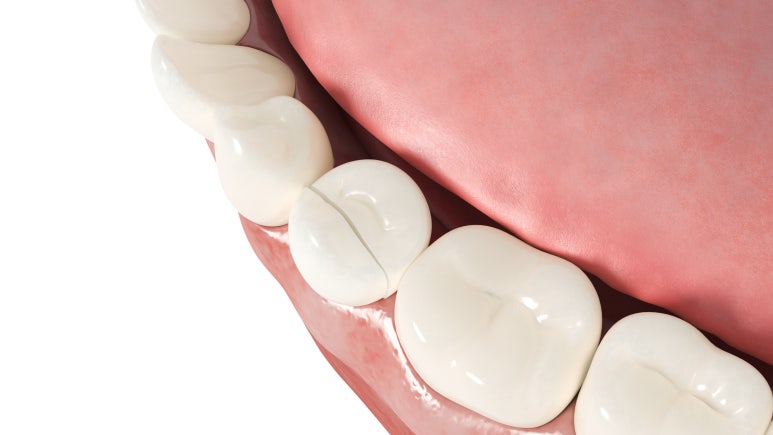
What diagnosis does the dentist make in cases of tooth fracture (crack)?
- They ask in detail about the pain pattern.
-
When does it hurt? (Only when chewing? Only with cold water? At night?)
-
What foods cause pain? (Hard foods? Tough foods?)
-
Is the pain in one tooth, or does it spread widely?
This information is really helpful for diagnosis.
- They check whether a specific point on the tooth hurts.
Even if it is not visible from the outside, pressing on a certain area or chewing may produce a sharp reaction exactly at that point.
- If needed, imaging is used to check the root or surrounding condition.
Imaging alone cannot confirm a crack 100%, but it helps identify and rule out other causes such as inflammation, root problems, or large cavities. It is also an important basis for establishing a treatment plan.
- They also look at the bite and clenching habits.
Cracks are often closely related to force. They check where the force is concentrated and whether bruxism or clenching is suspected, and plan to prevent recurrence as well.
Frequently asked questions (Q&A) and checkpoints about tooth fracture (crack)
Q1. If there is a crack, does it always need treatment?
A. Not necessarily. If the crack is very fine and there are almost no symptoms, it can sometimes be managed with lifestyle adjustments and regular observation only.
However, if pain repeatedly occurs when chewing or becomes stronger over time, treatment should likely be considered.
Q2. When does it become necessary to go all the way to root canal treatment?
A. When the crack has progressed deep inside the tooth and affected the nerve. In particular, if you feel pain even with hot foods or throbbing pain at night, it may be a stage where root canal treatment is needed.
Q3. Is a crown always necessary?
A. It is a relatively common treatment to consider for cracked teeth. The reason is not simply to cover the tooth, but to help hold it together so the crack does not widen further.
Depending on the condition of the tooth, a composite filling may be enough, but if it is a molar that receives a lot of force or if the crack is deep, a crown may be the more stable choice.
Q4. Is there a way to check it at home?
A. There are simple checkpoints.
-
Does it sting only when chewing on one specific tooth?
-
Does the pain differ depending on the direction, even with the same food?
-
Does it hurt more when you bite down and then release?
If you notice these features, you can suspect the possibility of a crack. However, an accurate judgment is difficult, so if the symptoms recur, it is safer to get checked.
Myeonmok-dong Dental Clinic, information from S Leader Dental Hospital
The importance of managing tooth cracks
When a tooth has a crack, the most important thing is not simply to endure the symptoms and move on, but to accurately check how serious the current condition is. Even if there is no special abnormality visible on the outside, if a sharp sensation when chewing repeats or discomfort is felt only in certain situations, there is a possibility that a small crack has already started inside the tooth. Therefore, it is important not to brush off these warning signs lightly.
In particular, cracked teeth can often be managed with relatively simple methods if detected early, but the longer they are left untreated, the deeper the crack can become and the larger the treatment scope may become, such as root canal treatment or a crown. For that reason, timing is especially important.
As such, tooth fractures are often difficult to judge based only on what is visible on the outside, so a more accurate plan requires considering multiple factors together, such as the pattern of pain, the feeling when chewing, and the bite condition.
At S Leader Dental Hospital, Myeonmok-dong Dental Clinic, we comprehensively check the condition of the tooth and provide treatment guidance that avoids unnecessary procedures and focuses on preserving the tooth as much as possible. If discomfort while chewing or sharp symptoms recur, we recommend receiving an accurate examination before it progresses further.




Myeonmok-dong Dental Clinic :: S Leader Dental Hospital