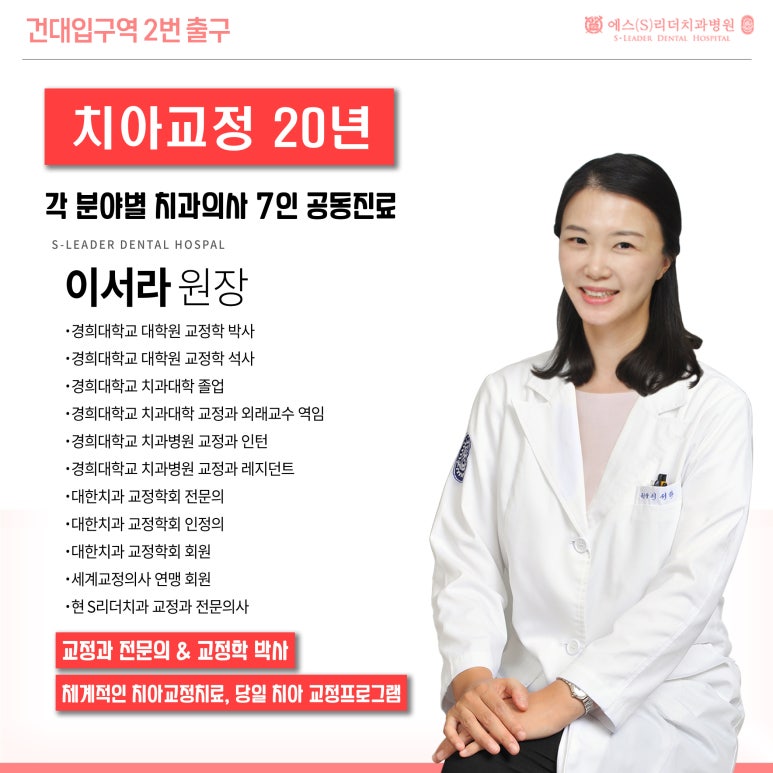
Hello, this is S Leader Dental Hospital, a Seongsu-dong dental clinic, celebrating its 22nd anniversary this year.
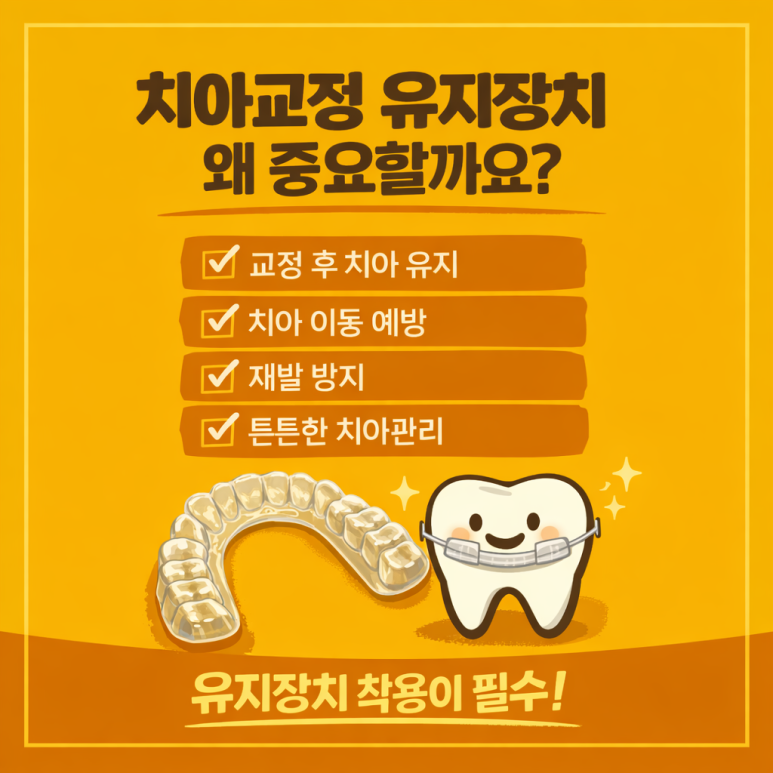
After finishing orthodontic treatment, many people say this:
“Is orthodontics over now?”
At first glance, when you see teeth that have been neatly aligned, it is understandable to feel that way. After enduring the discomfort of wearing appliances for a long time, it is natural to think that everything is finally finished.
However, in actual consultations, many people do not fully realize that management after orthodontic treatment is even more important than the period right after treatment ends. In particular, we often hear the question, “Do I really have to wear a retainer?”
Orthodontic treatment is not just about moving teeth; it is a process that also includes stabilizing the results.
Today, at Seongsu-dong Dental Clinic, S Leader Dental Hospital, we will explain in detail why orthodontic retainers are truly necessary, which many people are curious about.
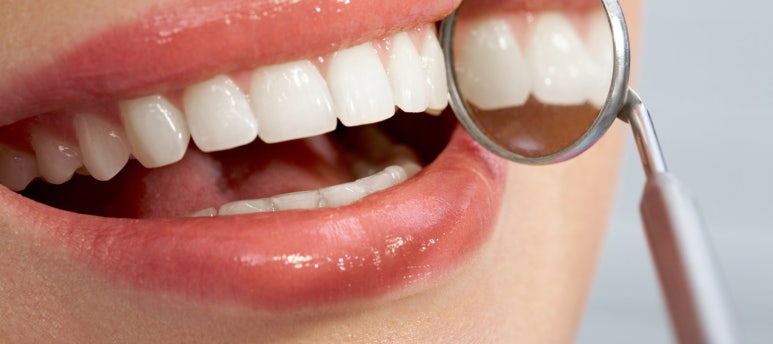 Why do teeth move again after orthodontic treatment?
Teeth may look firmly fixed from the outside, but in reality they are supported by the jawbone and periodontal tissues, so they are more flexible than you might think.
Why do teeth move again after orthodontic treatment?
Teeth may look firmly fixed from the outside, but in reality they are supported by the jawbone and periodontal tissues, so they are more flexible than you might think.
For this reason, when force is applied from the outside, teeth can move, and orthodontic treatment uses this principle to slowly move teeth into place. But the important point is that even after the movement is finished, the teeth are not completely fixed in that position right away.
The gums, bone, and surrounding tissues that support the teeth have not yet fully adapted to the new position. So during this period, the tendency to return to the original position, known as “relapse,” is strong.
In addition, everyday factors such as the position of the tongue, lip pressure, and chewing habits can continuously affect the teeth. As these
small forces repeat, the aligned bite achieved through orthodontic treatment can gradually become distorted.
In other words, it is better to understand that although the visible orthodontic treatment has ended, an “stabilization process” is still underway inside the teeth.
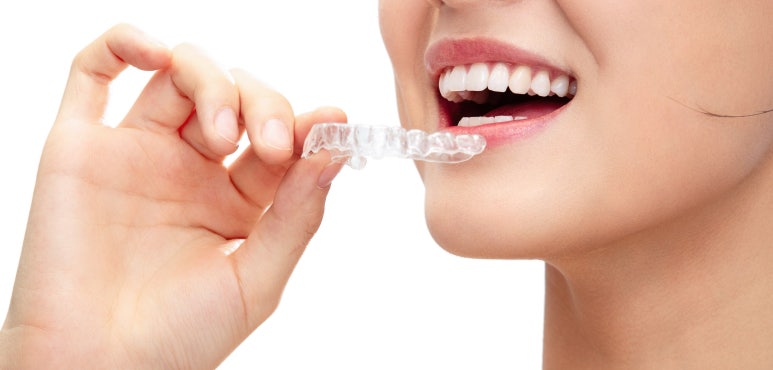 So, what exactly is a retainer?
A retainer is a device that helps prevent teeth that have been moved through orthodontic treatment from shifting again. Put simply, you can think of it as playing the role of “protecting” the tooth alignment that was carefully created.
So, what exactly is a retainer?
A retainer is a device that helps prevent teeth that have been moved through orthodontic treatment from shifting again. Put simply, you can think of it as playing the role of “protecting” the tooth alignment that was carefully created.
Many people think of retainers as an extra, separate step, but in reality it is more accurate to see them as the final stage of orthodontic treatment. Even after the braces or other orthodontic appliances are removed, treatment is not over; it continues into the retention phase.
If you do not wear the retainer properly during this period, the results achieved through orthodontics may gradually collapse. On the other hand, if you wear the retainer consistently, the teeth and surrounding tissues can settle stably into their new position.
Ultimately, a retainer is not merely an auxiliary device, but a key element that completes the orthodontic results.
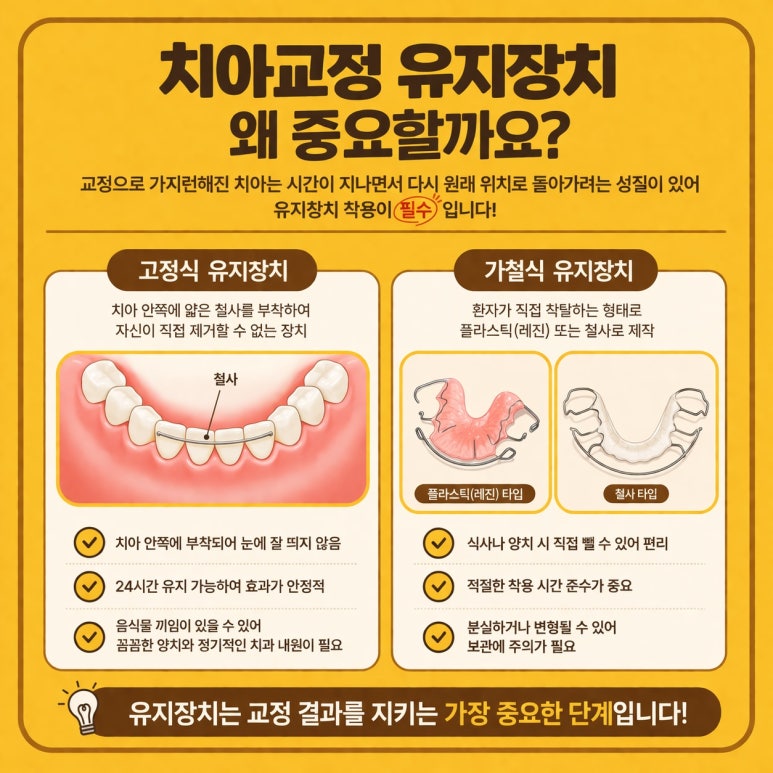 Different types of retainers?? Here is a simple summary.
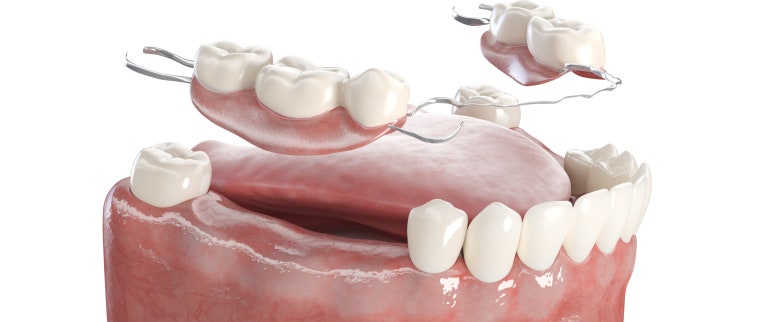
Retainers can largely be divided into two types: fixed and removable.
Different types of retainers?? Here is a simple summary.
Retainers can largely be divided into two types: fixed and removable.
A fixed retainer uses a thin wire attached to the inside of the teeth, so it is not easily visible from the outside and continuously
helps hold the teeth in place. Since it does not need to be worn or removed separately, it has the advantage of being relatively easy to manage.
In contrast, a removable retainer is a type that can be taken in and out as needed. In the beginning, it is worn for most of the day, and then the wearing
time is gradually reduced. A key feature is that it can be used flexibly according to the individual’s lifestyle.
Depending on the patient’s tooth condition and orthodontic results, one method may be chosen, or in some cases both may be used together for a more stable retention effect.
✔ Problems that occur if you do not wear a retainer ✔
The most common problem when a retainer is not worn properly is that the teeth become crooked again.
At first, it starts with subtle changes, but over time the alignment can become noticeably different. In particular, even small movements of the front teeth can create a big aesthetic change, so they are felt more sensitively.
In some cases, the teeth may partially return to their pre-orthodontic condition, and this can lead to a situation where re-treatment is needed. Re-treatment requires time and money again, and it can also increase psychological 부담.
Ultimately, you must remember that if you neglect the retainer, the orthodontic results can collapse.
 How long should a retainer be worn?
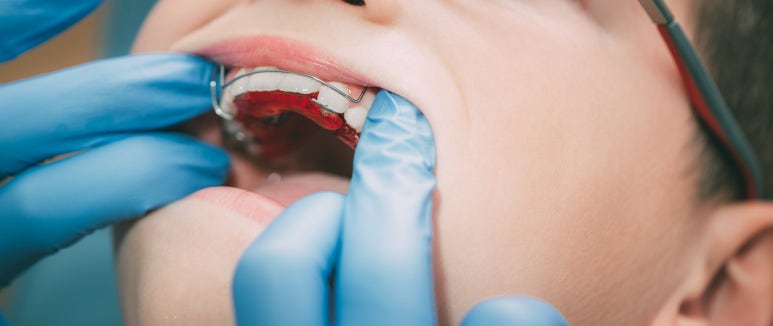
The wearing period for a retainer can vary depending on the individual’s dental condition, the difficulty of the orthodontic treatment, and lifestyle habits.
How long should a retainer be worn?
The wearing period for a retainer can vary depending on the individual’s dental condition, the difficulty of the orthodontic treatment, and lifestyle habits.
Generally, right after orthodontic treatment ends, it is recommended to spend most of the day wearing the retainer. As the teeth and surrounding tissues gradually stabilize, the wearing time is reduced.
After a certain period, some people switch to wearing it only while sleeping, but because teeth can move slightly throughout life,
long-term management may be necessary.
Therefore, the exact wearing period and method should be carried out according to the medical staff’s guidance, taking the individual’s condition into account.
✔ How to care for a retainer ✔
Caring for a retainer is just as important as wearing it.
Removable retainers should be cleaned thoroughly after meals, and it is hygienic to store them in a dedicated case. For fixed retainers, the spaces between the teeth and the inner side must be carefully cleaned.
Also, if the retainer becomes distorted or damaged, it is necessary to visit the clinic immediately for an examination. This is because leaving even a small problem unattended can affect tooth alignment.
Regular checkups to confirm the retention status are also a very important part of care.
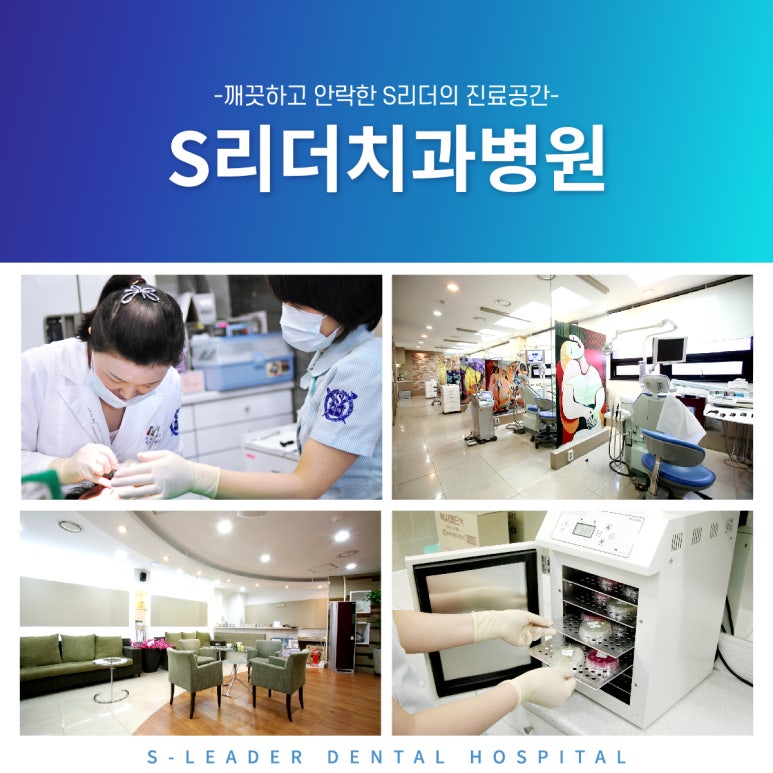 Seongsu-dong Dental Clinic, S Leader Dental Hospital,
Care that takes responsibility until the end of orthodontic treatment
Orthodontic treatment is not simply about making teeth straight; it is a process that also includes how stably the results are
maintained.
Seongsu-dong Dental Clinic, S Leader Dental Hospital,
Care that takes responsibility until the end of orthodontic treatment
Orthodontic treatment is not simply about making teeth straight; it is a process that also includes how stably the results are
maintained.
Retainers are not optional but essential, and they are the most important device for protecting orthodontic results. Only when consistent
wear and proper care are supported can the completeness of orthodontic treatment truly be improved.
At Seongsu-dong Dental Clinic, S Leader Dental Hospital, we provide systematic guidance even after orthodontic treatment for retention management, and we help maintain stable results through customized care plans suited to each patient’s condition.
One more point I would like to emphasize is that a retainer is not a device you stop using because it is inconvenient; it is the minimum level of care needed to preserve your current orthodontic results for a long time.
The difference between managing it as a brief inconvenience and ending up in a situation where re-treatment is needed often comes down to this retention stage.
If you want to maintain your orthodontic results for a long time and in a stable way, please take another look at your retainer-wearing habits now.
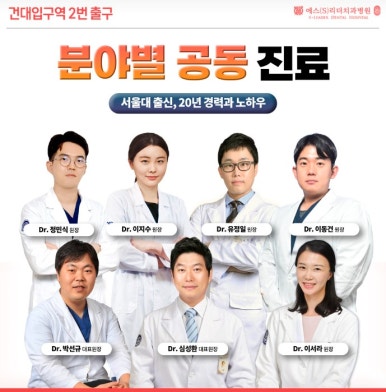


 Seongsu-dong Dental Clinic :: S Leader Dental Hospital