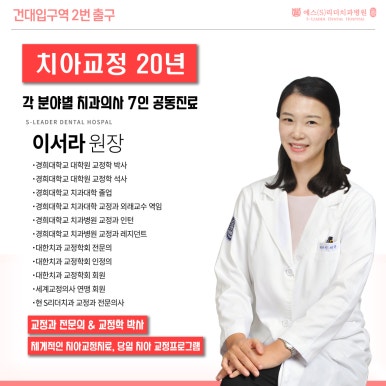
Hello, we are S Leader Dental Hospital, a Konkuk University area orthodontic clinic celebrating its 22nd anniversary this year.
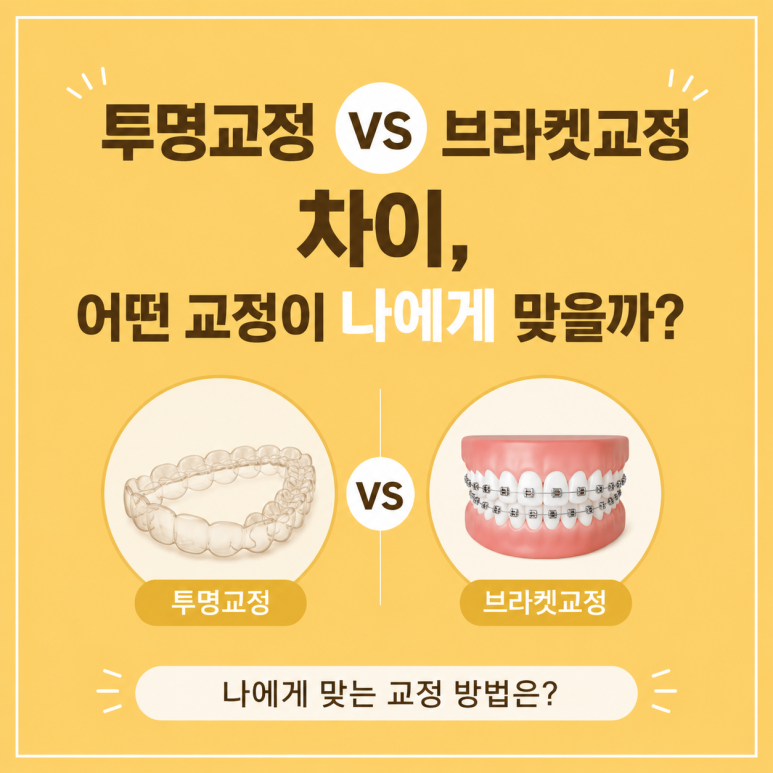
When you start thinking about orthodontic treatment, the first thing you compare is the type of orthodontic appliance.
In particular, interest in clear aligners, which are not easily visible, has recently increased, and we often hear things like, “I want to straighten my teeth without it showing,” or “Brackets feel burdensome because of work and social life.” On the other hand, people who are recommended bracket orthodontics may also wonder,
“Why can’t I get clear aligners?” or “Are brackets more effective?”
In fact, many of the people who come in for consultations have already spent a lot of time searching online and reading reviews. But once they start looking at the information, they often become even more confused. That’s because some places say clear aligners are more convenient, while others say bracket orthodontics is more precise. As a result, many people find it difficult to choose based only on whether the treatment is “less visible” or “faster.”
Have you ever experienced something like this?
You want orthodontic treatment, but you worry that the appliance will stand out too much, or you wanted clear aligners but were told they are not suitable for your teeth, leaving you even more concerned. In particular, orthodontic treatment is not something that ends quickly; it can last one to two years or longer, so the method you choose at the beginning can affect your satisfaction with the entire treatment process.
So today, at S Leader Dental Hospital, a Konkuk University area orthodontic clinic, we’ll take a detailed look at the differences between clear aligners and bracket orthodontics, the advantages and features of each, and which option may be better suited to you.
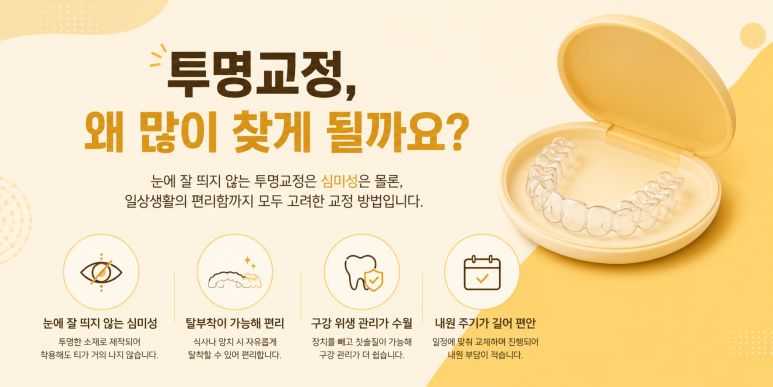
Why are clear aligners so popular?
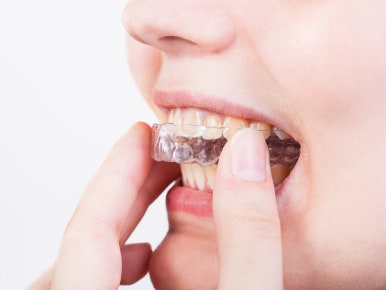
Clear aligners, as the name suggests, are a method of moving teeth using transparent appliances.
The most widely known type involves gradually moving the teeth by replacing a series of thin, transparent plastic trays step by step. Because the appliance is not easily noticeable when worn, it is especially popular among office workers, college students, and people in service jobs.
People with jobs that involve meeting others frequently, or those with frequent photo shoots, presentations, or meetings, often ask about clear aligners because they do not want it to be obvious that they are undergoing orthodontic treatment. The fact that the appliance can be removed and reinserted is also mentioned as one of its advantages.
Because it can be removed briefly during meals, there is relatively less inconvenience from food getting stuck, and oral hygiene is generally easier to manage.
Also, when people first think of bracket orthodontics, they may feel uncomfortable because they picture visible metal appliances. Clear aligners can help reduce that psychological 부담. In particular, aesthetic concerns are often an important factor in adult orthodontics, so preference for them has naturally increased.
However, what is important here is that “clear aligners = orthodontics that work for everyone” is not the case.
If a large amount of tooth movement is needed or major bite correction is required, or if the protrusion is severe, bracket orthodontics may be more appropriate.
In other words, rather than deciding simply because they are less visible, you need to consider both your current dental condition and your treatment goals.
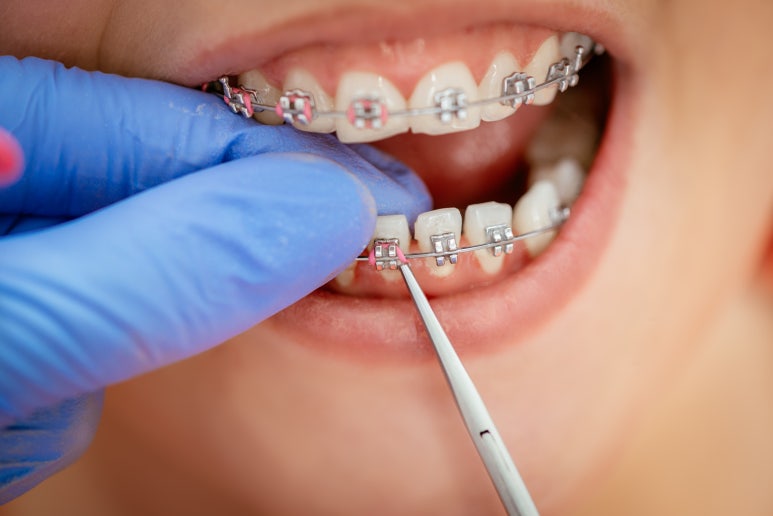
Why are bracket orthodontics still chosen so often?
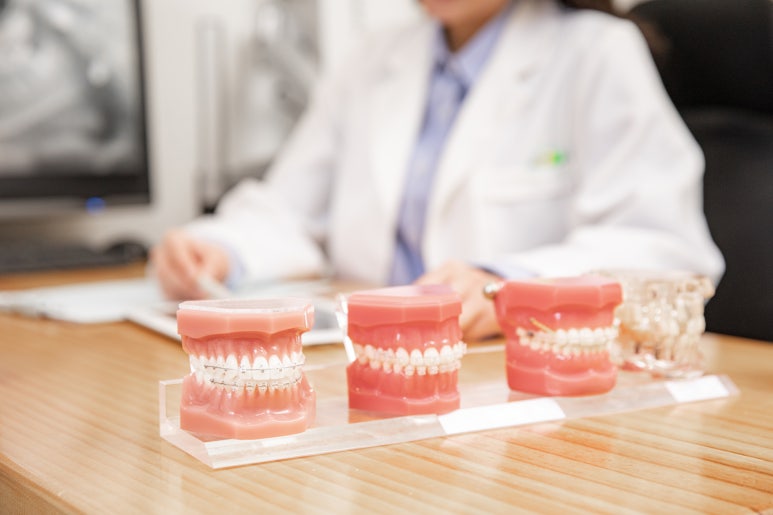
Bracket orthodontics is the most representative orthodontic method, in which appliances are attached to the tooth surface and teeth are moved using the force of wires. Some people think of it as an older method, but in reality it is still one of the most commonly used orthodontic treatments today.
The reason is that it allows for more precise control over tooth movement.
In particular, when there is severe crowding, protrusive teeth, extraction-based orthodontics, or bite problems that require significant movement, bracket orthodontics can help carry out the treatment plan more stably.
It is also highly useful in cases where complex orthodontic correction is needed, because it allows each tooth’s movement to be controlled in detail. When treatment needs to consider not only aligning the teeth but also changes in the upper and lower bite or the overall appearance of the mouth, bracket orthodontics is often the more advantageous option.
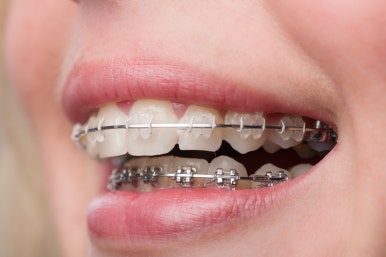
Of course, there can be some burden because the appliance is visible. However, these days a variety of less noticeable options, such as ceramic brackets, are also widely used, and the aesthetic burden has become lighter than before.
And many people find that after starting orthodontic treatment, they focus more on the results than on the appliance itself. Even those who initially say, “I don’t like that it shows,” often later say, “It’s better than I expected,” or “I can see my teeth becoming straighter quickly.”
What is the biggest difference between clear aligners and bracket orthodontics?
Many people think the difference is simply whether they are visible or not, but in reality, the treatment methods themselves are different.
With clear aligners, it is very important that the patient consistently wears the appliance themselves.
Typically, wearing them for more than 20 hours a day is recommended, and if the wearing time is insufficient, the teeth may not move as planned. In other words, patient compliance often affects the treatment results.
By contrast, bracket orthodontics uses fixed appliances, so the patient cannot remove them or adjust wearing time. Because the planned force is applied continuously, the treatment has the advantage of progressing more stably.
The range of applications can also vary depending on the condition of the teeth. Mild alignment issues or relatively simple cases may be sufficiently treated with clear aligners, but if there is severe tooth rotation or a need for large movement after extraction, bracket orthodontics may be more efficient.
Treatment duration varies greatly from person to person, so it is difficult to say simply that one orthodontic method is faster. Rather, choosing the method that fits the current condition and treatment plan may be more important for the overall treatment process.
Which orthodontic method is better for me?
The answer is not determined by the type of appliance alone.
What matters is your current dental condition, lifestyle, and treatment goals.
For example, if you meet people often and your profession places great importance on appearance, clear aligners may be more satisfying.
Conversely, if the amount of tooth movement is large and more precise adjustment is needed, bracket orthodontics may be more suitable.
Lifestyle habits are also important.
Because clear aligners require you to wear them properly on your own, careful management is essential. If you frequently remove them or if your wearing time is inconsistent, the treatment plan may be disrupted. On the other hand, bracket orthodontics uses fixed appliances, so consistent management can be relatively more stable.
What is important in this process is not simply choosing a trendy orthodontic method, but finding the one that suits your teeth.
Rather than deciding based only on reviews from people around you or social media, it is important to determine the direction after fully checking your current bite, degree of protrusion, tooth alignment, and other factors.
S Leader Dental Hospital, a Konkuk University area orthodontic clinic
We think together about the orthodontic direction that is right for you.
Orthodontic treatment is not simply a matter of attaching appliances; it is a process that must also consider future tooth alignment, bite, and changes in facial impression.
That is why the treatment satisfaction and adjustment process can vary depending on which orthodontic method is chosen at the beginning.
At S Leader Dental Hospital, a Konkuk University area orthodontic clinic, rather than recommending only one specific orthodontic method, we consider the patient’s current dental condition, lifestyle, and desired direction to guide them toward a more suitable treatment plan.
In particular, clear aligners and bracket orthodontics each have different advantages and ranges of application, so after carefully checking the current condition, it is important to thoughtfully examine which method can lead to a more stable and satisfying result.
If you are considering orthodontic treatment, we recommend not deciding based only on “less visible orthodontics” or “popular orthodontics,” but rather receiving enough consultation to find the direction that truly suits your dental condition.



Konkuk University area orthodontic clinic :: S Leader Dental Hospital