Hello, we are S Leader Dental Hospital, a Gui-dong dental clinic celebrating its 22nd anniversary this year.
During orthodontic treatment, you may hear about “orthodontic screws.” When people hear that a small screw will be placed in the gums, many feel worried at first. However, orthodontic screws are one of the auxiliary devices used to move teeth more stably and precisely.
In actual consultations, many people ask questions such as, “Do I really need it?”, “Does it hurt a lot?”, and “Will my braces treatment finish faster?” In particular, adult orthodontic treatment often requires careful control over changes in the profile and even the direction of tooth movement, so
there are many cases where screws are used together.
Orthodontics is not simply a treatment to align teeth evenly; it is a process that also considers bite and balance of forces. That is why, when it is difficult to achieve the desired movement with regular orthodontic appliances alone, screws may be used to guide tooth movement more efficiently and stably.
Today, at S Leader Dental Hospital in Gui-dong, we will look at why screws are used during orthodontic treatment, what role they play, and the pain and care aspects that many people are curious about.
✔️ 3-line summary
-
Orthodontic screws are temporary anchorage devices used to move teeth more stably.
-
They are often used in cases that require precise tooth movement, such as protrusive-mouth correction or extraction-based orthodontics.
-
They are not required in every orthodontic case, and whether they are needed may vary depending on the current tooth condition and direction of movement.
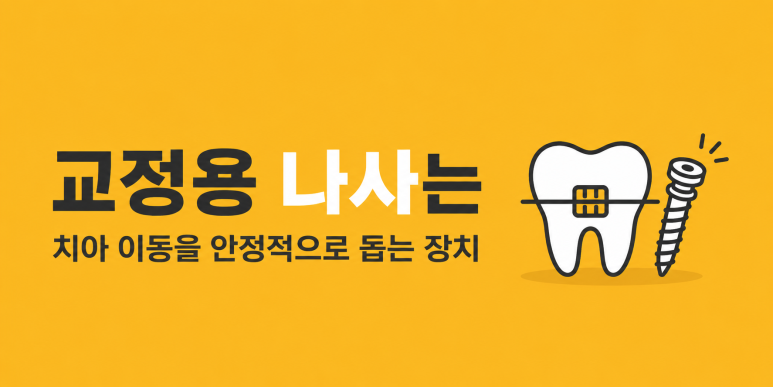 Orthodontic screws help teeth move in a stable way.
Orthodontic screws are temporary anchorage devices used to move teeth more stably. They are often perceived as frightening because of the expression “putting in a screw,” but in reality, they are closer to a small auxiliary device used to control the direction of tooth movement more precisely.
Their size is also smaller than you might expect, and their purpose is completely different from that of implants. If implants are a treatment kept in place for a long time to replace tooth function, orthodontic screws are temporary devices used for a certain period to help move teeth. So, once orthodontic treatment is completed, they are usually removed and do not remain permanently.
In orthodontic treatment, continuous force is applied to move teeth in the desired direction. However, when force is applied to move one tooth, other teeth also tend to move in response. In simple terms, even if you want to move the front teeth backward, if the anchor point shifts, the back teeth may be pulled forward.
The screw used in this case creates a fixed anchor point that does not move, helping teeth move more stably.
In particular, in protrusive-mouth correction or extraction-based orthodontics, where the front teeth need to be moved backward, this anchorage can affect the treatment outcome, so screws are often used together.
 More precise tooth movement may be needed in the later stages of orthodontic treatment.
Orthodontic screws are not used only in severe orthodontic cases; in many cases, they are used to make the final result more precise.
When orthodontic treatment begins, it may seem as though simply attaching the appliance is the end of it, but the actual treatment process is much more detailed. In the early stage, the focus is on aligning crooked teeth, but after the teeth have been arranged to some extent, the process moves on to more precise adjustments of the bite, profile, and tooth angles.
This is often when people hear about using screws. In particular, if the front teeth need to be moved slightly further back, or if the direction of movement of a specific tooth needs to be controlled more precisely, regular appliances may have limitations.
For example, in protrusive-mouth correction, simply having the teeth aligned and actually having the mouth look more set back can be different. From the patient’s perspective, it may feel like “my mouth doesn’t seem to have moved back as much as I expected,” and in such cases, screws may be used to move the teeth backward more stably and help create profile changes.
Also, even if the alignment has been mostly corrected, screws may be used when the upper and lower bite balance is not fully matched or when only a specific tooth needs to move a little more. So, orthodontic screws are better understood not simply as a device used only for “severe orthodontic cases,” but as an auxiliary device that helps improve the completeness of the result.
Here is a common misunderstanding about orthodontic screws.
Orthodontic screws are also a device that people often misunderstand. In actual consultations, many patients come in worried because of incorrectly known information.
-
Using screws does not automatically mean the orthodontic case is severe.
-
They are not devices used for every orthodontic patient.
-
They are not devices that stay in place for life like regular implants.
-
Having a screw placed does not necessarily make the orthodontic treatment period much shorter.
-
On the other hand, using screws does not mean the orthodontic treatment has failed.
What matters is whether the plan matches the current tooth condition, direction of movement, and bite structure. Even if it looks like the same protrusive-mouth case,
some people can proceed without screws, while in other cases using screws may ultimately lead to a more stable result.
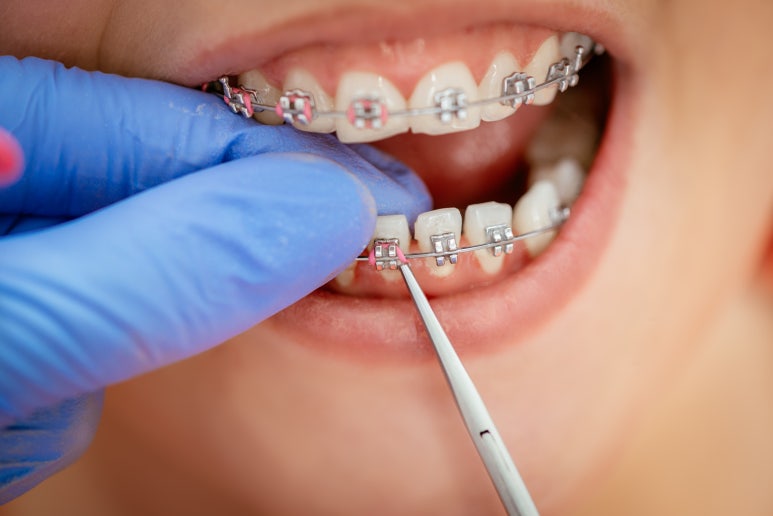 Orthodontic screws may help make tooth movement more efficient.
Orthodontic screws can be used as a device that helps teeth move more efficiently.
Many people wonder whether using screws makes orthodontic treatment faster. To be clear, the treatment period is not necessarily shortened in every case. However, they can certainly help the tooth movement process proceed more efficiently.
Ultimately, orthodontic treatment is the process of moving teeth to the desired position in a stable way. But if force is dispersed or teeth move in an undesired direction, the position may need to be corrected again. If these situations accumulate, the overall treatment period may become longer.
On the other hand, using screws can help set the movement direction more accurately and reduce unnecessary movement. In particular, adult orthodontics often involves slower tooth movement than orthodontics during growth, or cases where the bone is denser, so stable anchorage is often more important.
Difference between regular orthodontics and orthodontics using screws
| Regular orthodontics | Orthodontics using screws |
|---|
| More affected by elastic cooperation | More stable anchorage can be secured |
| Movement direction may be limited | More precise movement control is possible |
| Adjacent teeth may move together | Helps move the target tooth more centrally |
| Limitations may exist in profile changes | May be used to improve protrusive-mouth cases |
In particular, when the front teeth need to be moved back sufficiently, such as in protrusive-mouth correction or extraction-based orthodontics, more stable anchorage can become important. In some cases, regular orthodontics alone is enough, but depending on the situation, screws are also used together to move the teeth more precisely in the desired direction.
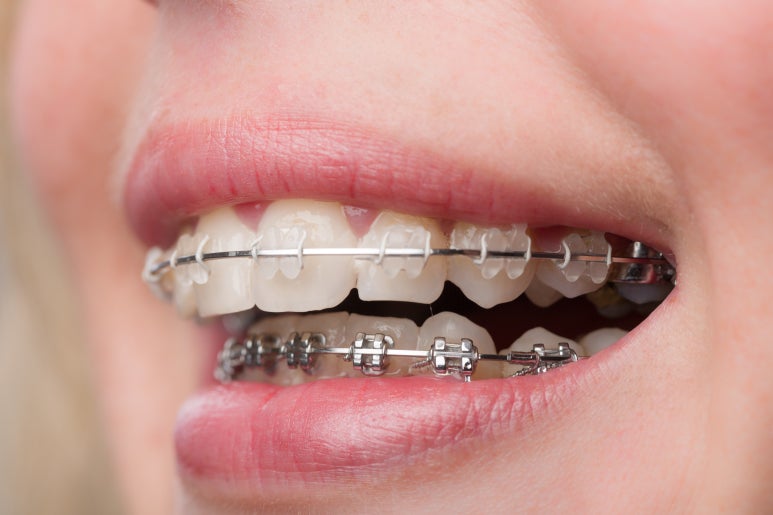 Orthodontic screw placement is often completed in a relatively short time.
When people hear about orthodontic screws, the first concern is usually pain. The idea of placing a screw in the gums naturally makes people think it will be scary and painful. However, the actual procedure is often completed in a short time,
and since it is usually done under local anesthesia, there is rarely significant pain during the procedure.
Of course, there are individual differences. People who are very tense may feel pressure or discomfort more strongly, and for a day or two after placement, the area may feel sore or awkward when chewing. However, for most people, the discomfort gradually becomes easier to get used to over time.
Some patients even say that the pressure when the appliance was first attached or the pain at the beginning of orthodontic treatment was more uncomfortable. Since screws themselves are small and the procedure time is relatively short, many people say it was better than they expected.
However, care after placement is important. Food can easily get trapped around the screw, and if maintenance is neglected, the gums may swell or
inflammation may occur, so more careful hygiene than usual is needed. In particular, during orthodontic treatment, regular toothbrushes alone may not be enough for detailed care, so using interdental brushes or a water flosser can be helpful.
Also, in very rare cases, the screw may loosen or fall out. But in such cases, rather than becoming overly worried, it is important to check the current condition accurately, and if necessary, treatment may continue through repositioning or reinsertion.
 Whether orthodontic screws are needed depends on the current tooth condition.
Orthodontic screws are not a device required for every patient.
Whether they are used depends on the current tooth condition, degree of protrusion, bite structure, whether extraction is involved, and the direction of movement. In some cases, the desired result can be achieved sufficiently with regular orthodontic appliances and elastic bands alone, while in others, screws are needed for more stable and precise movement.
In particular, these days many people judge their orthodontic direction based only on social media reviews or online information, but in reality, it is often necessary to consider not only tooth alignment but also the condition of the jawbone, the bite structure, and even the face shape. Even if it looks like the same protrusive-mouth case,
some people can proceed without screws, while in other cases using screws may ultimately lead to a more stable result.
So, the important thing is not simply deciding whether it is “necessary” or “not necessary,” but accurately checking which method is more appropriate for the current condition of your teeth.
Orthodontic screw FAQ
Q. Does an orthodontic screw hurt a lot?
A. In most cases, it is performed under local anesthesia, and the procedure time is relatively short. Although there are individual differences, many people say it was better than they expected.
Q. Are orthodontic screws kept in forever?
A. No. They are temporary devices used to help move teeth during the orthodontic process, and in most cases they are removed after treatment.
Q. Does using a screw shorten the orthodontic treatment period?
A. It does not shorten the period in every case, but it may help tooth movement proceed more efficiently.
Q. Can the screw come loose or fall out?
A. In rare cases, it may loosen or fall out, but depending on the condition, treatment may continue through reinsertion.
Q. Do all orthodontic patients use screws?
A. No. Whether they are needed varies depending on the tooth condition, direction of movement, and treatment plan.
 Gui-dong dental clinic, S Leader Dental Hospital
considers even the detailed movements during orthodontic treatment.
Orthodontic treatment is not simply a treatment that ends with attaching appliances to the teeth. While treatment is in progress, it is important to continuously check which direction the teeth are moving, whether the current speed is appropriate, and whether additional auxiliary devices are needed, and to make detailed adjustments accordingly.
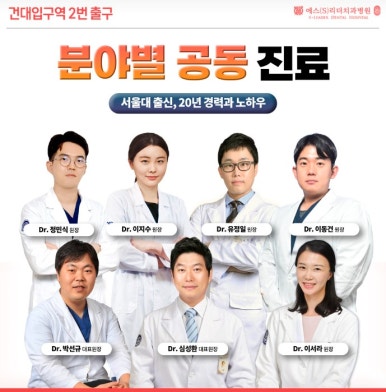
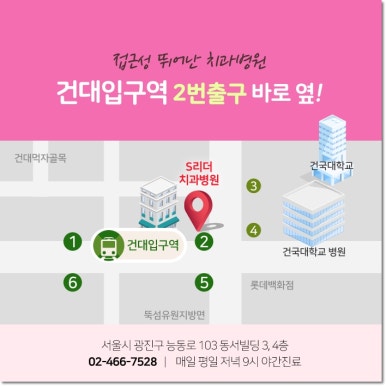
S Leader Dental Hospital in Gui-dong, near Konkuk University Entrance Station, provides treatment centered on orthodontics, implants, and aesthetic dentistry, while considering not only each patient’s tooth alignment and bite condition, but also their profile and facial balance. In addition, when screw use is needed during orthodontic treatment, we do not simply recommend the device; we explain in sufficient detail why it is needed and what changes can be expected before proceeding with treatment.
Many people feel worried as soon as they hear the word orthodontic screw, but in reality, it is one of the devices used to help achieve more stable and precise tooth movement. What matters is not simply whether it is used, but whether the treatment plan is proceeding in a way that matches the current condition of your teeth. If you are considering screw use during orthodontic treatment, we recommend checking your current condition accurately through a thorough diagnosis and consultation.

 Gui-dong Dental Clinic :: S (S) Leader Dental Hospital