Hello, we are S Leader Dental Hospital, a Guwi-dong dental clinic that is celebrating its 22nd anniversary this year.
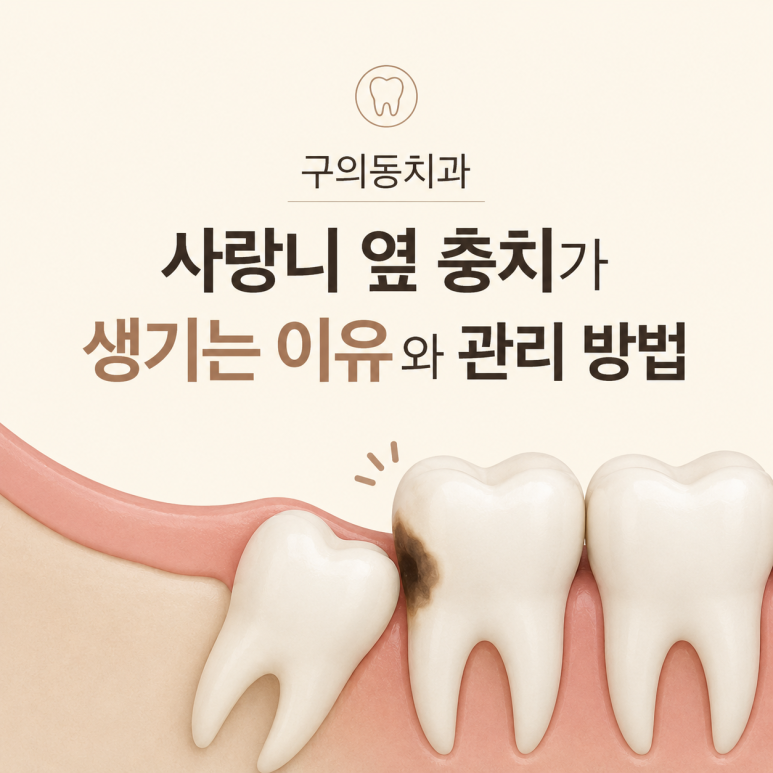
Wisdom teeth are teeth that many people worry about at least once. In particular, some people hesitate and think, “My wisdom tooth seems a little uncomfortable, but do I really need to have it removed?” or “It doesn’t hurt yet, so isn’t it fine?” and end up visiting the dentist only after some time has passed. In actual dental practice, however, we often see patients who come in not because of the wisdom tooth itself, but because of a “cavity next to the wisdom tooth.”
In particular, some people keep feeling food stuck in the back of the molars or that the toothbrush does not reach well when brushing, but since there is no significant pain, they continue as usual until sudden severe pain develops and treatment becomes necessary. The problem is that cavities next to wisdom teeth are often discovered late. This is because they are located at the very back of the mouth, making them hard to see with the naked eye, and early on they often have no special symptoms.
What requires even more caution is that a cavity next to a wisdom tooth does not affect only the wisdom tooth itself; it can also affect the normal molar right in front of it. In some cases, this can lead to a situation where even a previously healthy molar needs treatment, so early examination and management can be important.
Today, at S Leader Dental Hospital, a Guwi-dong dental clinic, we will take a detailed look at why cavities next to wisdom teeth occur, in what cases they are more likely to develop, what problems can arise if they are left untreated, and how to manage them.
 Why do cavities next to wisdom teeth develop so easily?
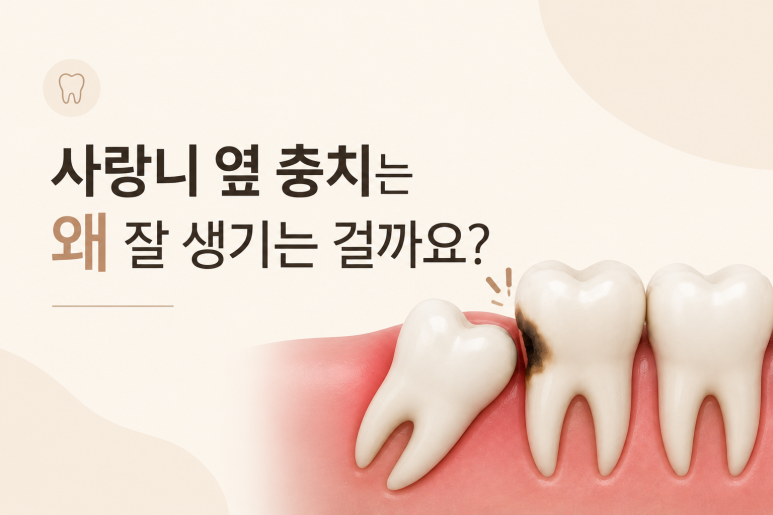
Wisdom teeth are teeth that erupt at the very back of the mouth. However, due to a lack of space or problems with the direction of eruption, they often cannot come in normally.
Why do cavities next to wisdom teeth develop so easily?
Wisdom teeth are teeth that erupt at the very back of the mouth. However, due to a lack of space or problems with the direction of eruption, they often cannot come in normally.
Common forms include the following:
In these cases, food can easily get stuck between the wisdom tooth and the molar in front. The problem is that this area is located so far back that brushing is not easy. As the toothbrush cannot properly reach the area, food debris and plaque repeatedly build up, creating an environment where bacteria can easily multiply.
In particular, when a wisdom tooth is lying at an angle, cavities often develop not on the wisdom tooth itself, but on the back surface of the molar directly in front of it. Because this area is not easily visible even in a mirror during daily life, it is not uncommon for the cavity to be discovered only after it has progressed.
 Can a cavity develop even if the wisdom tooth does not hurt?
Many people think, “If the wisdom tooth doesn’t hurt, then it must be fine.” But wisdom tooth-related problems often progress without pain more often than expected.
Can a cavity develop even if the wisdom tooth does not hurt?
Many people think, “If the wisdom tooth doesn’t hurt, then it must be fine.” But wisdom tooth-related problems often progress without pain more often than expected.
In particular, early cavities often progress without noticeable pain, and because the area around the wisdom tooth is difficult to check due to its location, it can also be hard to notice on your own.
If the following symptoms occur repeatedly, it may be worth getting checked:
-
A frequent feeling of food getting stuck behind the molars
-
A lingering feeling that the mouth is not clean even after brushing
-
Recurrent bad breath
-
Repeated swelling of the gums around the wisdom tooth
-
Discomfort in the back molar when chewing
-
A cold-sensitive feeling in the back molar when eating cold foods
Because inflammation and cavities often progress together around wisdom teeth, it is important not to simply dismiss it as “my gums must be swollen because I’m tired.”
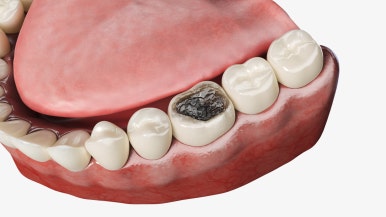 Why are cavities next to wisdom teeth dangerous??
What is even more problematic than the cavity in the wisdom tooth itself is that it can affect the normal molar in front of it.
Why are cavities next to wisdom teeth dangerous??
What is even more problematic than the cavity in the wisdom tooth itself is that it can affect the normal molar in front of it.
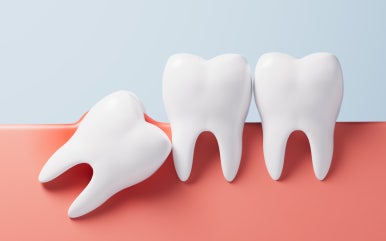
Wisdom teeth often do not play a major functional role, but the molar in front of the wisdom tooth is a tooth that plays an important role in actual chewing. However, if a cavity develops in the area where it contacts the wisdom tooth, the back surface of the normal molar can also decay.
The problem is that when cavities in this area are discovered, they are often already deep. This is because the location makes them hard to check and early detection is not easy.
If the cavity becomes severe, it can lead to the following situations:
-
Need for root canal treatment
-
Large-scale prosthetic treatment
-
Accompanying gum inflammation
-
Damage to the surrounding alveolar bone
-
In severe cases, possible extraction
In other words, what starts as “just a wisdom tooth problem” can end up requiring treatment for an important molar as well.
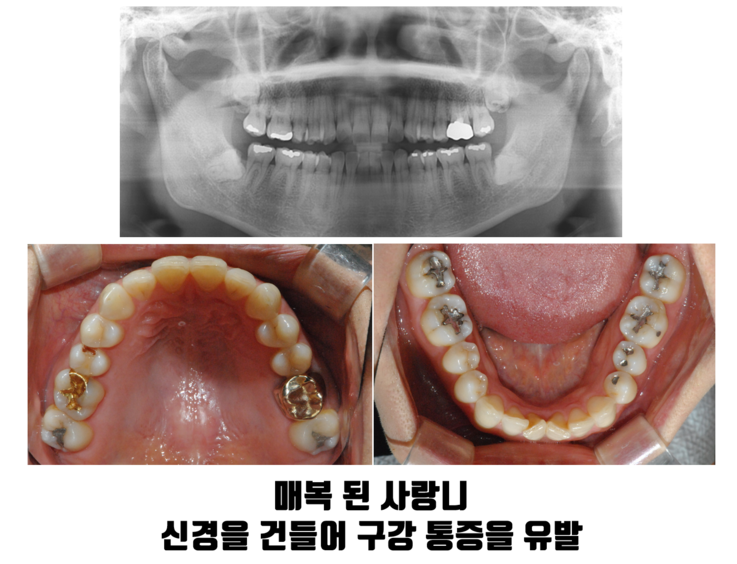
Partially impacted wisdom teeth require extra caution
Among wisdom teeth, partially impacted wisdom teeth can have an even higher risk of cavities and inflammation.
A partially impacted wisdom tooth means that part of the tooth is buried under the gum. In this case, a gap forms between the wisdom tooth and the gum, allowing food debris and bacteria to build up easily.
In particular, when part of the gum covers the area, bacteria can multiply easily and inflammation can occur repeatedly. This is sometimes called pericoronitis, and it can lead to swelling and pain around the wisdom tooth or discomfort when opening the mouth.
The problem is that when such inflammation repeats, it can affect not only the area itself but also the surrounding tissues. Therefore, when checking wisdom teeth, it can be important not only to see whether they have erupted, but also to evaluate the direction in which they are growing.
How are cavities next to wisdom teeth treated?
The treatment plan may vary depending on the extent of the cavity and the condition of the wisdom tooth.
If the cavity is not extensive, it may be managed with cavity treatment followed by ongoing care. However, if the position of the wisdom tooth itself is repeatedly causing problems, extraction is often considered as well.
In particular, if the wisdom tooth is affecting the molar in front of it, treating only the cavity may not be enough. If the wisdom tooth is left in place, the same problem may recur.
Also, if the cavity has already progressed deeply, root canal treatment or additional prosthetic treatment may be necessary. That is why it is important to check not only whether there is pain at the moment, but also the extent of the cavity and the condition of the surrounding teeth.
Care around the wisdom tooth is important too
The area around a wisdom tooth is structurally difficult to manage. That is why daily care habits can also be important.
In particular, it is important to take thorough care so that the toothbrush reaches all the way to the very back, and using interdental brushes or oral irrigators can also be helpful.
It is also important to check the direction of the wisdom tooth and whether there is any surrounding cavity through regular examinations. Since wisdom tooth cavities often cause little to no self-noticeable symptoms in the early stage, regular checkups can help with early detection.
 Guwi-dong Dental Clinic, S Leader Dental Hospital
We carefully examine even the teeth around wisdom teeth.
Wisdom teeth are often thought of simply as teeth that are removed when they start hurting later. However, in reality, there are many cases where they affect the normal molar directly in front of them more than the wisdom tooth itself. In particular, cavities next to wisdom teeth are hard to see with the eye because of their location, and early symptoms are often not very noticeable, so they are frequently discovered late.
Guwi-dong Dental Clinic, S Leader Dental Hospital
We carefully examine even the teeth around wisdom teeth.
Wisdom teeth are often thought of simply as teeth that are removed when they start hurting later. However, in reality, there are many cases where they affect the normal molar directly in front of them more than the wisdom tooth itself. In particular, cavities next to wisdom teeth are hard to see with the eye because of their location, and early symptoms are often not very noticeable, so they are frequently discovered late.
The problem is that by the time they are discovered, the cavity may already be deep enough that not only the wisdom tooth but also the molar in front of it needs treatment. That is why, rather than looking only at whether there is pain, it can be important to check both the direction of the wisdom tooth and the condition of the surrounding teeth.
At S Leader Dental Hospital, a Guwi-dong dental clinic, when treating wisdom teeth, we do not simply decide whether extraction is needed. Instead, we carefully assess the current eruption direction of the wisdom tooth, the condition of the surrounding molars, whether cavities are progressing, and the possibility of gum inflammation.
In particular, since every person’s wisdom tooth position and shape are different, it can be important not to simply check whether it is impacted or not, but also to consider how it contacts the surrounding teeth, whether the structure causes food to get stuck repeatedly, and whether the risk of future cavities is high.
Also, because cavities around wisdom teeth are often discovered later than ordinary cavities, this is an area where regular checkups are important. In many cases, patients come in late and are found to already have cavities that have progressed into the normal molar in front of the wisdom tooth, so checking the condition early can help preserve natural teeth for a longer time.
At S Leader Dental Hospital, a Guwi-dong dental clinic, we look at not only the current pain but also long-term oral health when discussing treatment directions. If the back of the wisdom tooth keeps feeling uncomfortable or food keeps getting stuck there, it may be helpful to have the current condition checked accurately.




 Guwi-dong Dental Clinic :: S (S) Leader Dental Hospital