Hello, this is S Leader Dental Hospital, a Sagajeong Station dental clinic celebrating its 22nd anniversary this year.
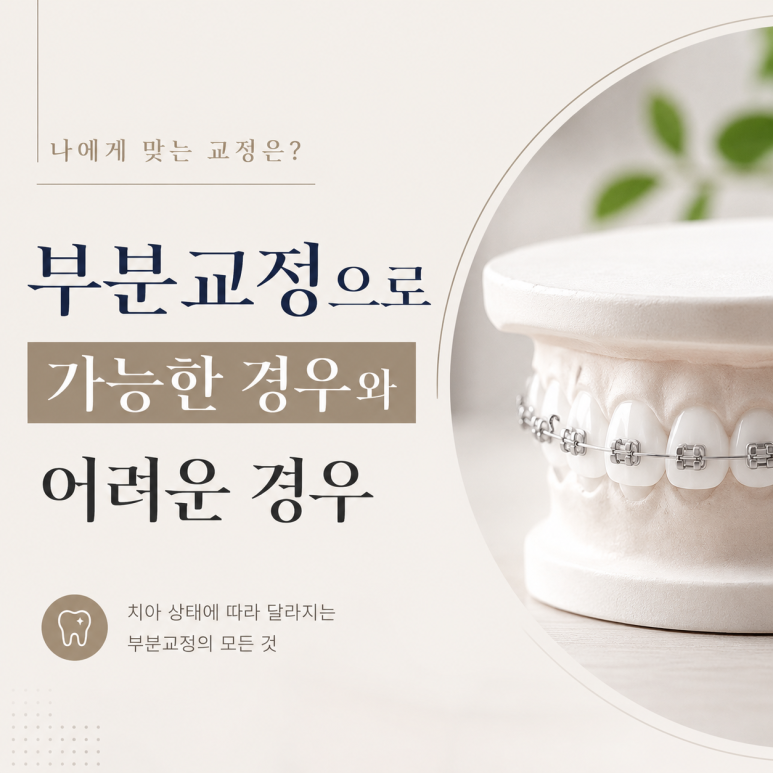
Have you ever noticed that one or two of your front teeth look slightly overlapped whenever you look in the mirror, or felt particularly self-conscious about your tooth alignment when smiling? When the teeth do not appear severely crooked overall but a specific area stands out, many people wonder, “Do I really need orthodontic treatment for something this minor?”
However, when they think about orthodontic treatment, many people worry that the treatment period may be long and find it difficult to start because of the burden of wearing orthodontic appliances for an extended time. Adults, in particular, often need to undergo treatment while managing work and daily life, so they frequently become interested in “partial orthodontic treatment,” which may seem relatively less burdensome.
During consultations, we often hear questions such as, “I just want to straighten my front teeth a little,” and “Is partial orthodontic treatment possible instead of full orthodontic treatment?” However, partial orthodontic treatment is not suitable for everyone simply because only the desired area is moved. Depending not only on tooth alignment but also on the way the upper and lower teeth meet, the degree of space deficiency, and the extent of protrusion,
partial orthodontic treatment may be possible in some cases, while full orthodontic treatment may be more appropriate in others.
Most importantly, rather than making a decision simply because the treatment “appears to take less time,” it is important to first determine whether partial orthodontic treatment can lead to a stable result given your current dental condition.
Today, S Leader Dental Hospital, a Sagajeong Station dental clinic, will take a detailed look at when partial orthodontic treatment is possible, when it may be difficult, and what should be checked before treatment.
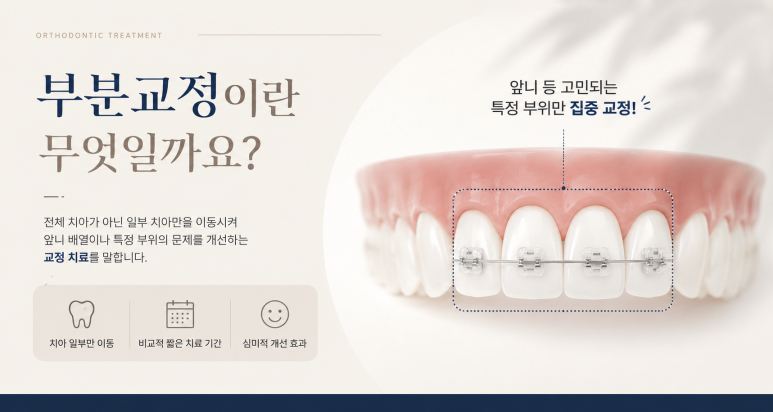
What Is Partial Orthodontic Treatment?
Partial orthodontic treatment refers to orthodontic treatment that moves only some specific teeth rather than all of the teeth. It is generally considered when someone wants to make the alignment of the front teeth a little straighter, and tooth movement is carried out within a relatively limited range.
Many people consider partial orthodontic treatment to improve localized alignment problems, such as slightly overlapping or spaced front teeth or one or two teeth that are tilted in the wrong direction. Since the range of movement is more limited than with full orthodontic treatment, people may also be interested because the treatment period and burden of wearing appliances can feel relatively lower.
However, rather than thinking of partial orthodontic treatment simply as “a treatment that moves a few front teeth,” it is important to determine what is possible within the current bite and overall balance. This is because what appears to be a simple front-tooth issue may also be affected by insufficient space or a bite problem.
Therefore, partial orthodontic treatment should not be viewed merely as orthodontic treatment that finishes quickly. It may be important to first sufficiently confirm whether it is the right treatment approach for the current dental condition.
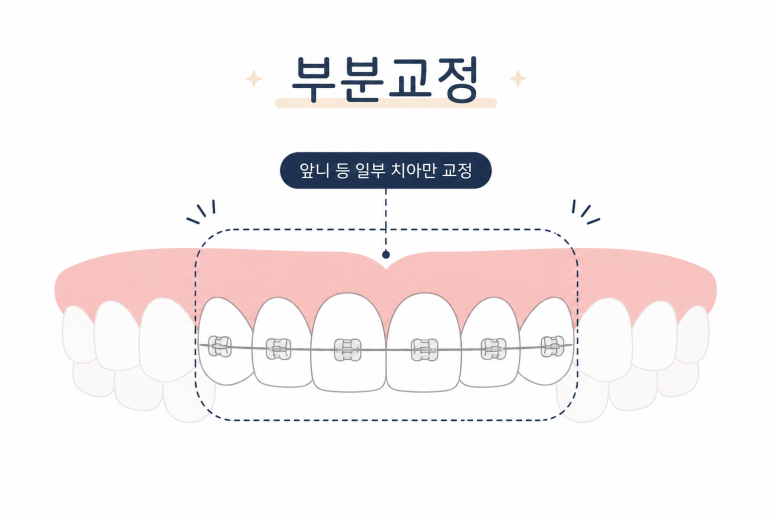
Typical Cases Where Partial Orthodontic Treatment May Be Possible
- When the front teeth are slightly overlapped
This is one of the most typical situations in which partial orthodontic treatment is considered.
When the lower front teeth are slightly crooked or only one or two teeth appear overlapped, improvement may be possible through limited tooth movement alone. If there are no significant problems with the overall dentition or bite, treatment may be carried out within a relatively limited range.
- When there is a slight gap between the teeth
Partial orthodontic treatment may also be considered when there is a small gap between the front teeth.
When the gap between the front teeth is noticeable when smiling or a space has developed in a specific area, improvement may be pursued through partial alignment adjustment.
- When part of the alignment has changed after previous orthodontic treatment
Partial orthodontic treatment may also be considered when only some teeth have shifted again after previous orthodontic treatment because of inadequate retainer care or the passage of time.
When the overall bite remains relatively stable but changes have occurred in only some of the front teeth, limited orthodontic treatment may be possible after evaluating the current condition.
- When space adjustment is needed before prosthetic treatment
Partial orthodontic treatment may also be used to secure space before implant or prosthetic treatment.
When prosthetic treatment cannot be performed immediately because of tooth alignment or the available space, limited tooth movement may be used to create a more stable treatment environment.
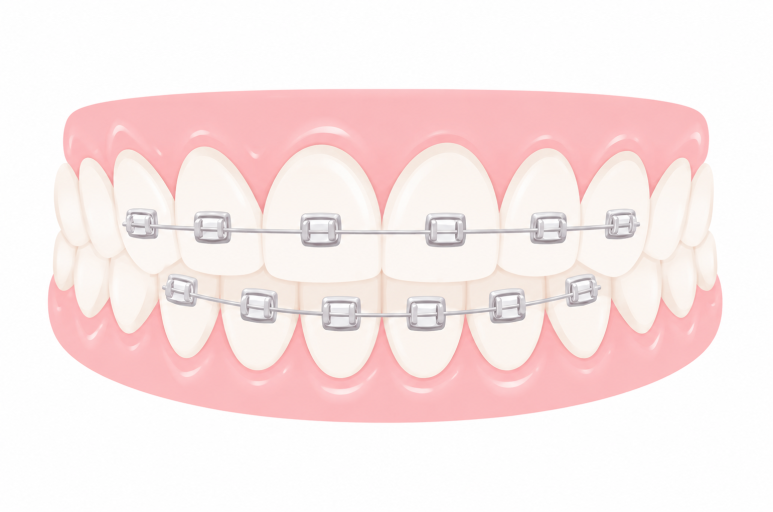
[Cases That May Be Difficult to Treat with Partial Orthodontics Alone]
Many people think of partial orthodontic treatment as “simple orthodontic treatment that finishes quickly,” but in practice, the applicable range may vary depending on the current condition.
In particular, when the issue affects the overall bite and jaw balance rather than being a simple alignment problem, partial orthodontic treatment alone may have limitations.
- When there is significant protrusion
When the mouth appears noticeably protruded or improvement of the lip profile is needed, a situation requiring overall tooth movement may be present.
In such cases, it may be difficult to achieve the desired change by moving only some of the front teeth. Proceeding with partial orthodontic treatment unnecessarily may instead affect bite balance.
- When there is severe crowding and insufficient space
When the teeth overlap significantly or there is not enough space for the teeth themselves, partial orthodontic treatment alone may not be sufficient.
In particular, if an attempt is made to force only some teeth into alignment when there is substantial lack of space, the balance of the dentition may become unstable, so a more careful diagnosis may be needed.
- When there is a significant bite problem
When there is a problem with the way the upper and lower teeth meet, it may be difficult to expect functional improvement through partial orthodontic treatment alone.
Especially when chewing function and jaw movement are also affected, it may be important to consider overall bite balance rather than adjusting only the appearance of the teeth.
- When changes to the facial shape are also desired
Because partial orthodontic treatment focuses on limited tooth movement, it may be difficult to expect significant changes to the facial shape or lip profile.
Therefore, partial orthodontic treatment may be possible when the goal is simply to improve alignment. However, when improvement of protrusion or changes to the side profile are also desired, full orthodontic treatment may be a more suitable approach.
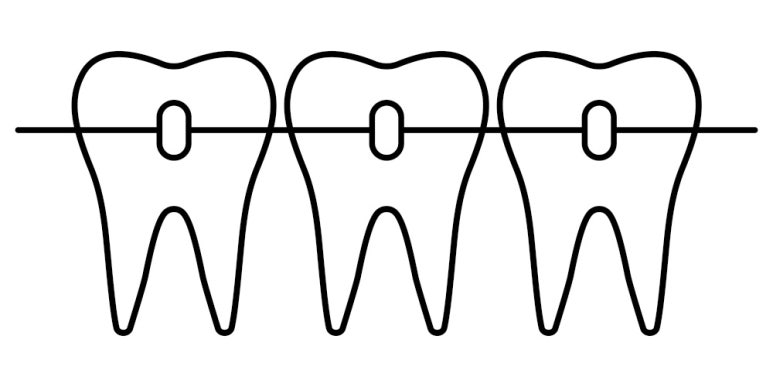
Does Partial Orthodontic Treatment Always Take Less Time?
Partial orthodontic treatment does not necessarily finish very quickly in every case.
Although the range of movement is smaller than with full orthodontic treatment and may therefore be less burdensome, the treatment period can vary depending on the current dental condition and the extent of movement required.
Even when a case appears simple, the direction of tooth movement and the process of adjusting the bite may be important. Therefore, rather than deciding based only on the statement that treatment will “finish in a few months,” it is important to accurately evaluate the current condition.
Rather than focusing only on completing treatment quickly, it may be important to consider whether the approach will allow the alignment and bite to remain stable after treatment. Teeth should not merely look straight; the way the upper and lower teeth meet and chewing function must also be considered.
In addition, tooth movement speed, gum condition, and the degree of space deficiency vary from person to person. As a result, even with the same type of partial orthodontic treatment, the treatment process may differ. In some cases, treatment may require slightly more time than expected, and retainer management may also be important.
For this reason, it may be important to understand partial orthodontic treatment not simply as “orthodontic treatment that finishes quickly,” but as orthodontic treatment performed within a relatively limited range suited to the current condition.
[What Must Be Checked Before Partial Orthodontic Treatment]
If you are considering partial orthodontic treatment, it is important to examine not only the alignment of the front teeth but also the current bite, the degree of space deficiency, and the condition of the gums.
Although the issue may appear to be a simple front-tooth problem, it may actually be connected to the overall bite. A thorough examination may therefore be necessary to accurately understand the current condition.
Because partial orthodontic treatment has a limited range of application, it is also important to fully understand how much improvement is possible in the current condition before starting. In some cases, full orthodontic treatment may lead to a more stable result than partial orthodontic treatment.
Therefore, rather than considering only the treatment period or cost, it may be important to confirm through a thorough consultation whether the treatment approach is appropriate for the current condition.
S Leader Dental Hospital, a Sagajeong Station dental clinic,
The Right Orthodontic Approach for the Current Condition Is Important.
Many people are interested in partial orthodontic treatment because it appears to be relatively less burdensome. In practice, however, whether it is suitable may vary depending on the current tooth alignment and bite. Therefore, rather than looking only at whether “partial orthodontic treatment is possible,” it may be important to sufficiently determine which treatment approach can lead to a more stable result in the current condition.
At S Leader Dental Hospital, a Sagajeong Station dental clinic, we strive to recommend an orthodontic approach suited to each patient by considering not only the alignment of the front teeth but also the current bite, dental balance, and lip profile.
Orthodontic treatment is not only about achieving a result that looks straight. Stable retention after treatment may also be important. Through thorough consultations and detailed diagnostic examinations, we strive to develop treatment plans in a more natural and stable direction.
In particular, since the possible range and limitations of partial orthodontic treatment may vary depending on the current condition, it may be important to consider long-term bite stability and the possibility of maintaining the result rather than focusing only on completing treatment quickly.
At S Leader Dental Hospital, a Sagajeong Station dental clinic, we carefully consider an approach that can continue treatment stably while reducing the burden as much as possible, after sufficiently reviewing each patient’s current dental condition, lifestyle, and desired changes. If you are wondering whether partial orthodontic treatment may be suitable for you, we recommend having your current dental condition accurately evaluated and receiving a thorough consultation about the treatment approach that is right for you.
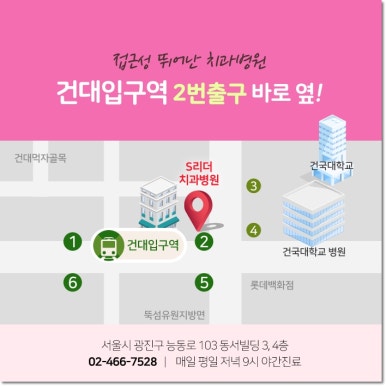


Sagajeong Station Dental Clinic :: S Leader Dental Hospital.