Hello. This year marks the 22nd anniversary of the establishment of S Leader Dental Hospital, located at Konkuk Univ. Station.

Although the reasons for losing teeth vary from person to person, the point at which people begin considering implants tends to occur more often in certain age groups.
In fact, at dental clinics, we frequently hear questions such as, “I should have done it sooner,” or “Is it possible at my age?”
In particular, even when the treatment is the same implant treatment, the treatment approach may differ among people in their 40s, 50s, and 60s because their dental condition, amount of jawbone, overall health, and lifestyle habits can vary. Therefore, rather than judging based on age alone, it is important to consider both the current condition of the mouth and how long the implants can be used in a healthy condition going forward.
Today, S Leader Dental Hospital at Konkuk Univ. Station will take a detailed look at how implant treatment differs by age group and what aspects require particular attention at each stage.
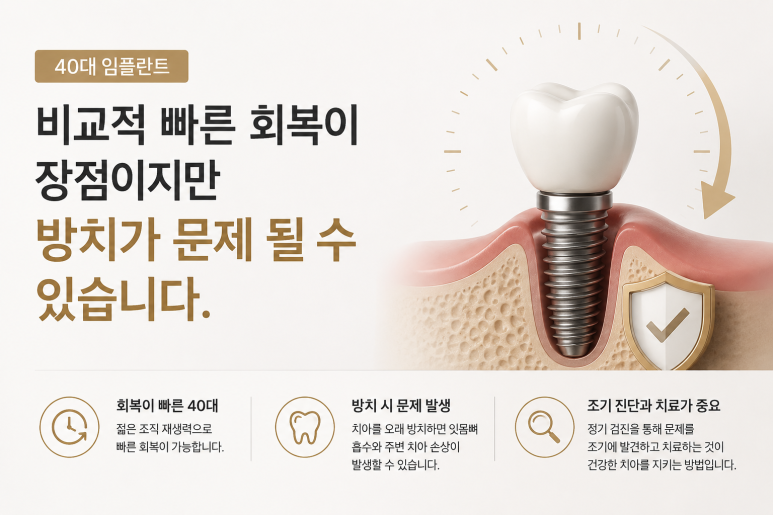
40s Implants: Relatively Fast Recovery Is an Advantage, but Delaying Treatment Can Become a Problem
Many people in their 40s still retain most of their natural teeth, but this is also a period when implant consultations may begin to increase sooner than expected. In particular, tooth extraction may become necessary because of long-standing cavities, tooth fractures after root canal treatment, gum disease, the effects of wisdom teeth, or stress-related teeth grinding.
The main characteristic of this period is that the jawbone is often relatively stable and recovery tends to be favorable. In fact, there are many cases in which only a limited bone graft or relatively simple implant placement is needed, which may shorten the treatment period.
However, the problem arises when people leave an empty space for a long time, thinking, “One tooth should be okay.” Since people in their 40s are often at the height of their careers and social lives, they may postpone treatment. However, leaving a tooth missing for an extended period can cause neighboring teeth to gradually tilt or the opposing tooth to move downward. The longer this continues, the more likely it may become that the jawbone will decrease.
In their 40s, many people also have drinking, smoking, or irregular lifestyle habits that can affect gum health. Even when there appears to be no major problem on the surface, gum inflammation may gradually progress, making it important to check the current condition through a detailed examination.
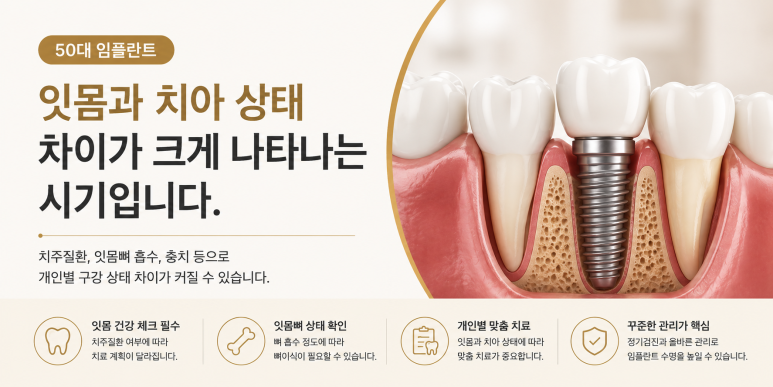
50s Implants: This Is a Period When Differences in Gum and Dental Conditions Become More Pronounced
Implant treatment tends to increase substantially in the 50s. As long-standing cavities and accumulated gum disease take their toll, people may lose several teeth or require retreatment of existing prosthetic restorations.
During this period, differences in individual oral conditions tend to become more pronounced. Some people maintain healthy natural teeth, while others may experience jawbone loss or progressive tooth looseness. For this reason, it is important to carefully evaluate periodontal health and jawbone condition when considering implants in the 50s. Depending on the situation, gum treatment or bone grafting may also be necessary.
Management of chronic conditions such as diabetes and high blood pressure is another important factor. Because recovery speed and the possibility of inflammation may vary depending on how well blood sugar and blood pressure are controlled, a more careful treatment plan may be needed.
After the age of 50, restoring function so that the teeth can be used comfortably for a long time, along with ongoing maintenance, becomes more important than simply filling the space left by a missing tooth. In fact, the length of time implants can be used may vary considerably depending on care after placement, making regular checkups and consistent maintenance very important.
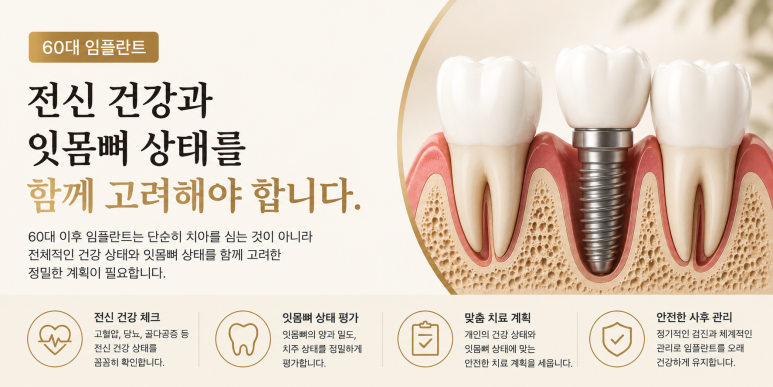
60s Implants: Overall Health and Jawbone Condition Must Be Considered Together
After the age of 60, implants are often more directly connected to quality of life than to appearance alone. Many people consider implants because eating has become difficult due to an inability to chew properly, or because they are uncomfortable using dentures.
At this stage, situations requiring several teeth to be treated at the same time are also relatively common. In particular, when gum disease has progressed over a long period or teeth have been missing for an extended time, jawbone resorption may have advanced considerably.
Therefore, when considering implants in the 60s, it is very important to carefully check not only whether placement is possible but also the amount and density of the remaining bone. Depending on the situation, additional treatment such as bone grafting or sinus lift surgery may be performed.
Overall health is also an important factor. Whether a person has high blood pressure or diabetes, or takes medication for osteoporosis, may affect the treatment plan, so sufficient consultation about current medications and medical history is necessary.
However, one common misconception is that “people cannot get implants when they are older.” In reality, current health and the ability to maintain proper care are more important than age itself. If the gums are stable and overall health is being well managed, implant treatment may still be possible in a stable manner for many people over 60.

What Matters More Than Age Is Your “Current Condition”
Implant treatment is not simply a treatment that should be performed at a particular age. It should be planned by considering the current condition of the teeth and gums, lifestyle habits, overall health, and other factors together. Even among people in the same age group, the necessary treatment approach may differ depending on the condition of the jawbone and periodontal health.
For people in their 40s, relatively quick recovery and a long-term usage plan are important. In the 50s, gum health and functional recovery are considered together. After the age of 60, it may be important to examine overall health and jawbone condition more carefully.
Ultimately, however, what matters most is not age itself but how accurately the current oral condition is diagnosed and how systematically it is managed. Since the length of time implants can be used may vary greatly depending on care after placement, regular checkups and consistent maintenance are also very important.
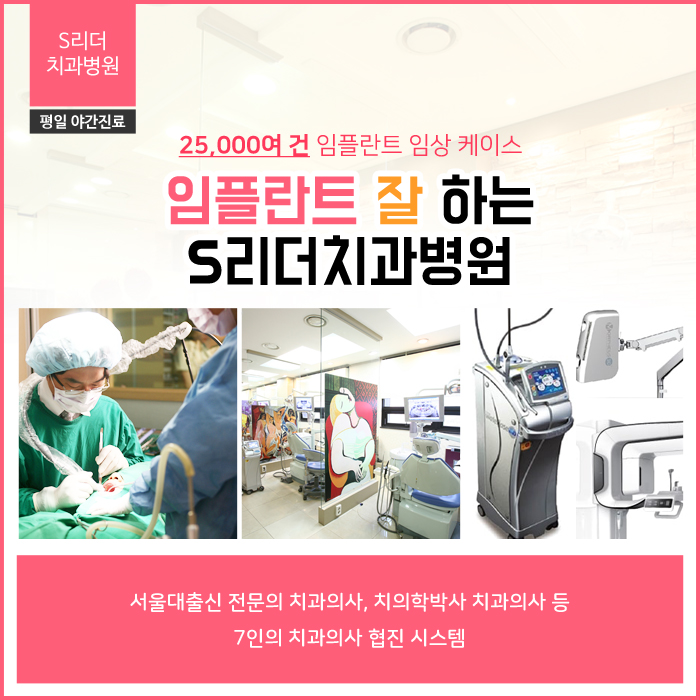
Implants at Konkuk Univ. Station with S Leader Dental Hospital
Understanding the Importance of Implant Care by Age Group
Implant treatment is not simply a procedure for filling an empty space left by a missing tooth. It can affect future eating habits, oral health, and everyday comfort. Therefore, rather than comparing only prices or treatment periods, it is important to accurately check the current condition of the gums and bone and consider whether care afterward can continue in a systematic manner.
In particular, people in their 40s, 50s, and 60s may differ in oral condition, lifestyle patterns, and overall health. For this reason, diagnosis and planning tailored to the individual are needed rather than a uniform approach. Since leaving teeth missing for a long time may cause the jawbone to gradually decrease and may even affect the alignment of neighboring teeth, if you experience discomfort, we recommend checking your current condition first rather than postponing treatment for too long.`
At S Leader Dental Hospital at Konkuk Univ. Station, we carefully evaluate gum condition, the amount of bone, bite alignment, and other factors based on 3D detailed diagnostics before implant treatment, and provide treatment guidance tailored to each patient. We also help ensure that regular checkups and maintenance continue systematically after placement, working with patients to help them maintain their implants in a stable condition for longer.
If you are considering when to receive implant treatment or are wondering what treatment would be appropriate for your current dental condition, rather than worrying alone, we recommend accurately checking your current condition through sufficient consultation and examination.


Implants at Konkuk Univ. Station :: S Leader Dental Hospital