Hello, this is S Leader Dental Hospital, a Gwangjin-gu dental clinic celebrating its 22nd anniversary this year.
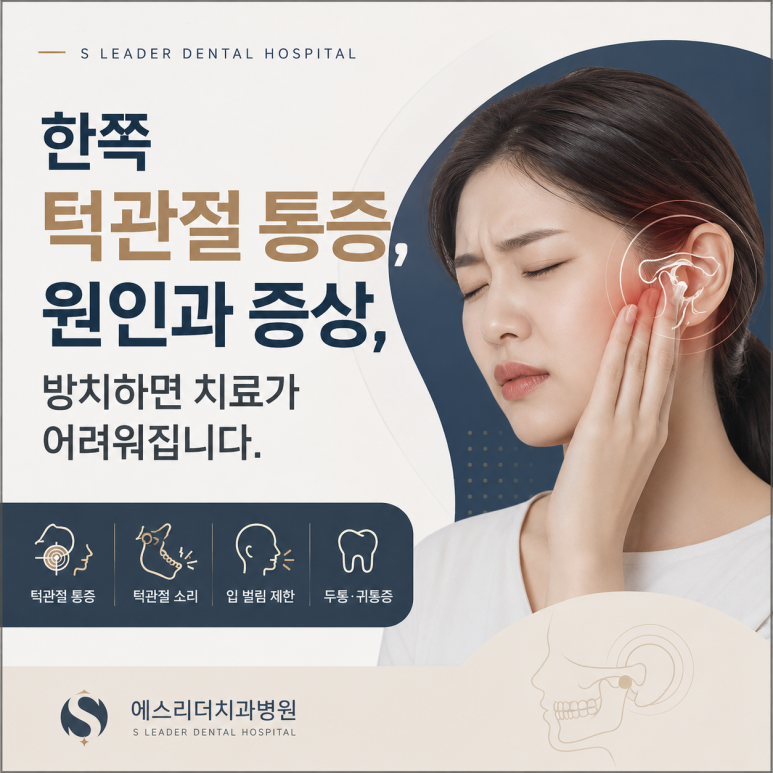
Have you ever heard a “click” in your jaw when opening your mouth or felt discomfort on one side of your jaw while chewing?
At first, many people assume it is simply due to fatigue and do not think much of it. In fact, temporomandibular joint disorders often begin with minor discomfort rather than sudden, severe pain.
However, temporomandibular joint disorders can affect daily life over time as pain gradually worsens or the mouth becomes difficult to open. In particular, when pain repeatedly occurs in one temporomandibular joint, it is important to identify the exact cause and receive appropriate treatment.
Today, S Leader Dental Hospital, a Gwangjin-gu dental clinic, will explain in detail the causes, typical symptoms, and treatment methods for temporomandibular joint disorders.
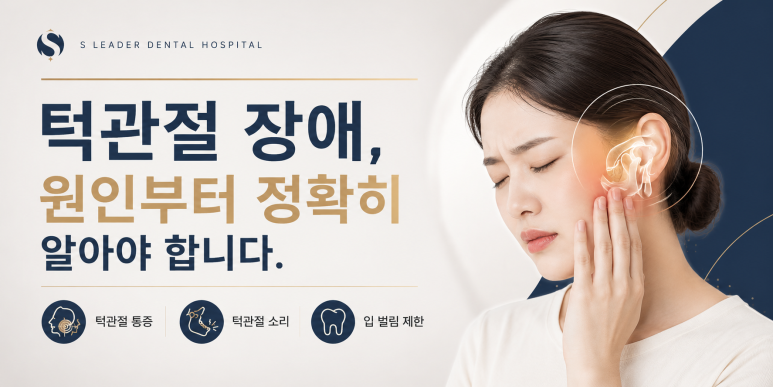
You need to accurately understand the causes of temporomandibular joint disorders first.
The temporomandibular joint connects the lower jaw to the skull and is responsible for various movements, including chewing, speaking, and yawning.
It is one of the most frequently used joints in the body, and muscles, ligaments, and disc structures are located around the temporomandibular joint.
A problem in any one of these areas can lead to a temporomandibular joint disorder.
Many people think that temporomandibular joint pain is simply a problem involving the jaw. In reality, however, various factors—including lifestyle habits, stress, and the condition of the bite—often work together.
Therefore, it is more important than anything else to accurately identify the cause rather than simply reducing the pain.
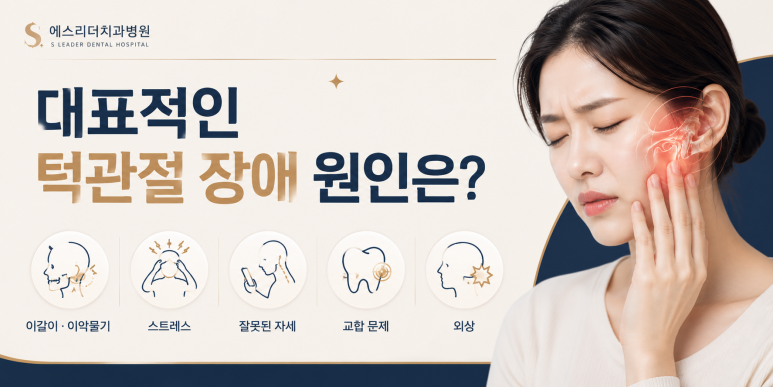
What are the common causes of temporomandibular joint disorders?
Clenching or grinding your teeth
This is one of the most common causes of temporomandibular joint disorders.
If you unconsciously grind your teeth while sleeping or habitually clench them tightly when you are tense, continuous strain is placed on the temporomandibular joints and surrounding muscles.
When this habit is repeated, the internal structures of the joint can become strained, causing pain, sounds, or limited mouth opening.
Stress
This is an aspect that many people overlook. When you are stressed, the muscles around the jaw become tense, and you may frequently clench your teeth without realizing it.
The likelihood of developing a temporomandibular joint disorder may be higher, especially for office workers and students preparing for examinations who remain tense for long periods.
Poor posture
Repeatedly looking at a smartphone for long periods or holding your head forward can disrupt the balance of the muscles around the neck and jaw. This can place abnormal forces on the temporomandibular joint and cause pain.
Problems with the bite
The temporomandibular joints can also be strained when the upper and lower teeth do not meet properly. An uneven bite can cause abnormal jaw movement and may lead to a temporomandibular joint disorder over the long term.
Trauma
A temporomandibular joint injury can occur when the jaw receives a direct impact from a fall or accident. In some cases, problems may also appear as repeated minor injuries accumulate, even without a severe impact.

What temporomandibular joint symptoms should not be left untreated?
A temporomandibular joint disorder is not simply a condition in which the jaw hurts.
If early symptoms are left untreated, they may gradually develop into various other symptoms.
Common symptoms include:
-
Clicking or popping sounds when opening the mouth.
-
Pain on one side of the jaw when chewing.
-
Discomfort when yawning.
-
Frequent stiffness or aching in the jaw.
-
Tired jaw muscles in the morning.
-
Pain in front of the ear.
-
Frequent headaches.
-
Stiffness in the neck and shoulders as well.
At first, there may only be sounds, but the condition can gradually progress to pain or difficulty opening the mouth.
Particular caution is needed if the range of mouth opening becomes smaller or a catching sensation in the jaw occurs repeatedly.

If you have these symptoms, visit a dental clinic for temporomandibular joint pain.
Many people endure temporomandibular joint symptoms without seeking care.
However, if you have any of the following symptoms, it is advisable to get an examination.
- Recurrent pain on one side of the jaw
If the pain improves temporarily and then returns, there may be an ongoing problem inside the joint.
- Difficulty opening your mouth wide
If you cannot open your mouth wide enough to fit approximately three fingers, there may be a functional problem.
- Jaw sounds that are becoming more severe
In many cases, sounds occur at first, followed by pain as time passes.
- Persistent discomfort when chewing
If chewing in a particular direction is uncomfortable or your jaw becomes tired easily, an accurate diagnosis is needed.
- Headaches or neck pain occurring at the same time
Because temporomandibular joint disorders can also affect the surrounding muscles, they may lead to headaches or pain in the neck and shoulders.

What are the main treatment methods for temporomandibular joint disorders?
Treatment methods may vary depending on the cause.
Lifestyle improvements
This is the most basic form of treatment. Reduce tough or hard foods and improve habits such as resting your chin on your hand or clenching your teeth.
Medication
When inflammation or pain is severe, medication may be used together with other treatment to help relieve symptoms.
Splint therapy
For people who grind or clench their teeth while sleeping, a device may be used to reduce the strain on the temporomandibular joints.
Bite adjustment and dental treatment
When there is a problem with the way the teeth meet, the bite can be analyzed and the necessary treatment can be provided.
It is important to select an appropriate treatment method according to the patient’s condition.

At Gwangjin-gu Dental Clinic, S Leader Dental Hospital
Why an accurate diagnosis is important
Temporomandibular joint disorders are often thought of simply as symptoms of jaw pain. In reality, however, they frequently occur as the condition of the bite, the temporomandibular joints, and the surrounding muscles affect one another. Therefore, not all pain has the same cause, and the causes and patterns of symptoms can vary from patient to patient.
In particular, recurring pain in one temporomandibular joint, sounds when opening the mouth, or difficulty opening the mouth are often dismissed as simple fatigue or temporary discomfort. However, if these symptoms continue for a long time, the strain placed on the temporomandibular joints may accumulate, potentially lengthening the treatment period or worsening the symptoms.
Most importantly, it is necessary to determine accurately whether the current symptoms are caused by muscle tension, an uneven bite, or a problem with the internal structures of the temporomandibular joint. Identifying the cause accurately makes it possible to establish a treatment plan suited to the patient, reduce unnecessary treatment, and provide more efficient management.
At Gwangjin-gu Dental Clinic, S Leader Dental Hospital, we carefully analyze the cause of each patient’s symptoms by examining the condition of the temporomandibular joints together with the bite. In addition to improving current discomfort, we also provide detailed guidance on lifestyle habits and management methods to help prevent excessive strain on the temporomandibular joints in the future.
If you hear a sound in your jaw when opening your mouth or experience recurring pain in one temporomandibular joint, it is advisable to receive an accurate examination rather than simply putting it off.






Gwangjin-gu Dental Clinic :: S Leader Dental Hospital.