Hello, this is S Leader Dental Hospital, a Seongsu-dong implant clinic celebrating its 22nd anniversary this year.
When a tooth is lost, people often focus at first only on the inconvenience when chewing food or the empty-looking space.
In particular, when a single molar is missing, some people postpone treatment because they can chew on the opposite side.
However, teeth do not exist independently. They maintain the overall alignment of the teeth by fitting together and supporting one another.
If a missing tooth is left untreated for a long time, the surrounding teeth may tilt toward the empty space, or the opposing tooth may move downward or upward. Chewing only on one side may also place excessive stress on the remaining teeth.
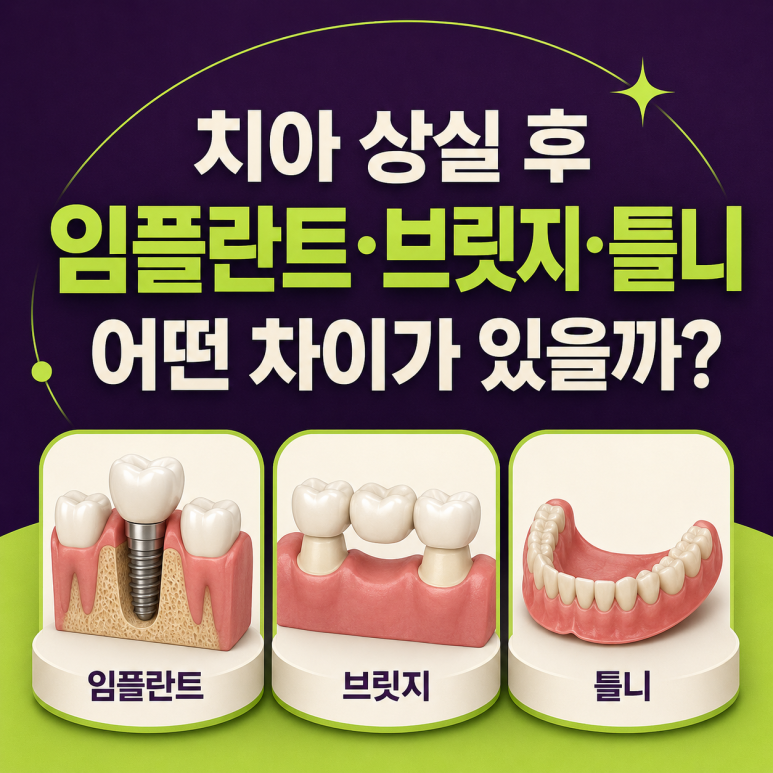
The main methods for restoring an empty space are implants, bridges, and dentures.
All three have the same purpose of replacing the function of a missing tooth, but they differ in how they are supported, the treatment process, how they feel when used,
and how they are maintained.
Today, for those considering implants in Seongsu-dong, we will take an easy-to-understand look at the features, advantages and disadvantages, and selection criteria for implants, bridges, and dentures.
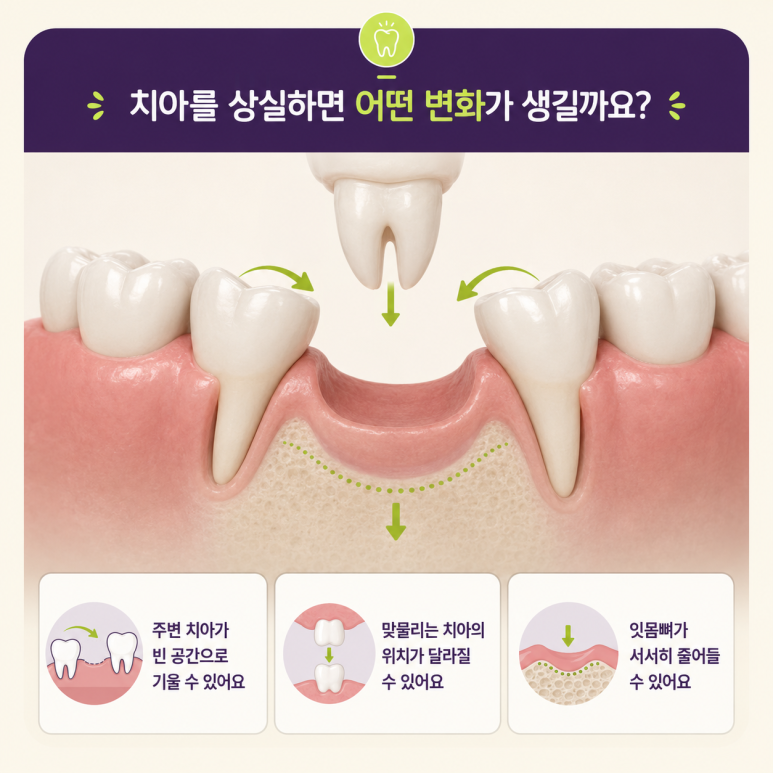
What changes can occur after tooth loss?
- The surrounding teeth may move toward the empty space.
-
Teeth maintain their current positions by touching one another.
-
When a tooth in the middle is lost, the teeth on either side may gradually tilt toward the empty space. New gaps may form between the teeth, making it easier for food debris and plaque to become trapped.
- The opposing tooth may move.
-
The upper and lower teeth maintain their positions by fitting together.
-
When the tooth that used to meet its opposing tooth disappears, the tooth on the other side may move down or up toward the empty space. This can alter the existing bite and make future prosthetic treatment more complicated.
- Chewing forces may become concentrated on one side.
-
If you avoid the area of the missing tooth and chew only on one side, excessive stress may become concentrated on certain teeth.
-
This may also affect the risk of wear or fracture of the remaining teeth, so restoring chewing function at an appropriate time is important.
- The jawbone may gradually decrease.
-
The roots of natural teeth transmit the forces generated during chewing to the jawbone.
-
When a tooth is lost and this stimulation decreases, the jawbone in that area may gradually be resorbed.
-
If an implant is planned after considerable time has passed, additional procedures such as bone grafting or a sinus lift may be necessary to supplement insufficient bone.
What is an implant?
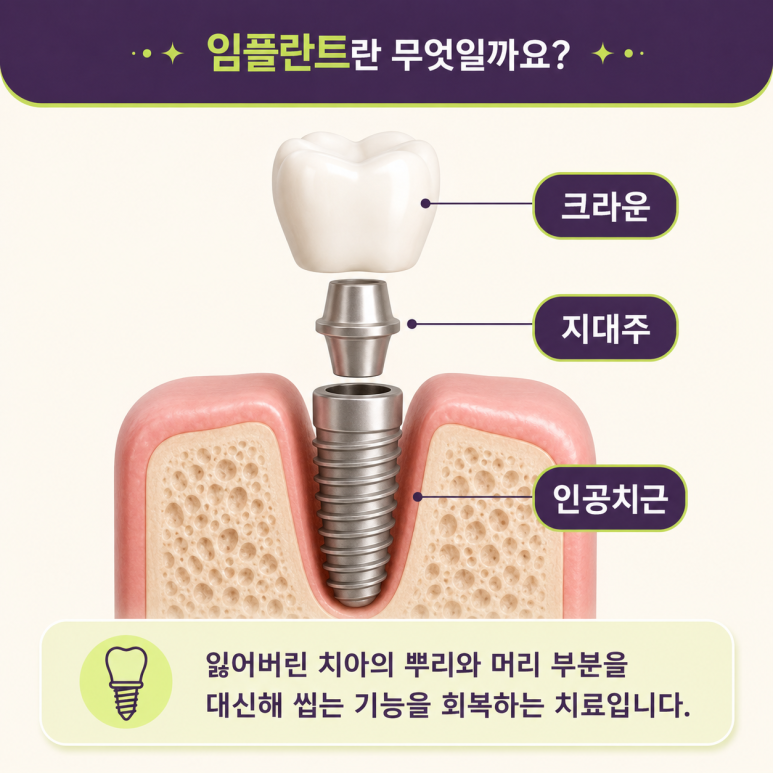
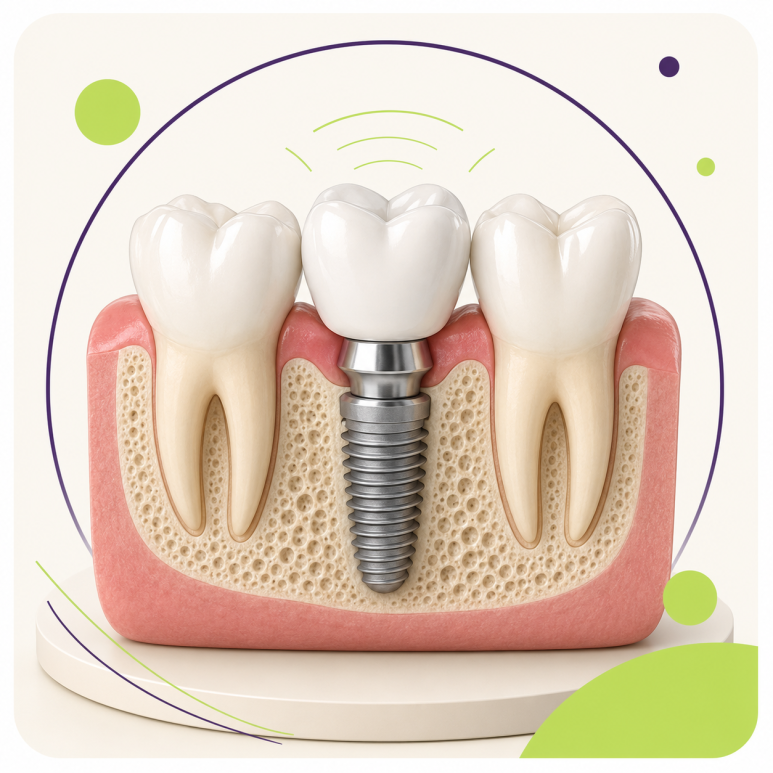
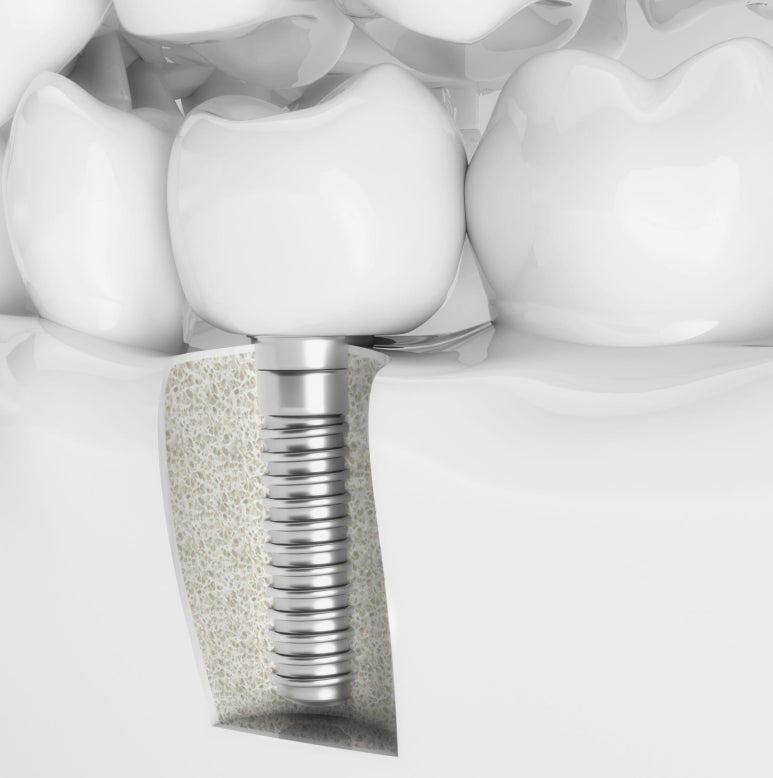
An implant is a treatment in which an artificial tooth root is placed in the jawbone at the site of a missing tooth, followed by the attachment of a connecting component and an artificial tooth.
It generally consists of the following three parts:
-
The implant placed in the jawbone
-
The abutment that connects the implant and the artificial tooth
-
The crown that is visible externally and serves the function of chewing food
If one tooth is missing, a single implant may be considered. If several teeth are missing, multiple implants or an implant-supported bridge may be considered.
If all the teeth are missing, fixed prostheses supported by implants or implant-retained dentures may also be considered.
What are the advantages of implants?
The surrounding teeth do not need to be removed or shaped
-
An implant is placed independently at the site of the missing tooth.
-
Therefore, if the teeth on either side are healthy, they do not need to be shaped to serve as supports, as they would with a bridge.
They can be used as a fixed restoration
-
Because an implant is fixed in the jawbone, the user does not need to remove and reinsert it personally.
-
Once the implant has securely integrated with the jawbone and the prosthesis has been completed, food can be chewed in a relatively stable condition.
They can be used for various ranges of tooth loss
-
Depending on the condition, implants can be used not only when one tooth is missing but also when several or all teeth are missing.
-
Losing several teeth does not necessarily mean that an implant must be placed for every missing tooth. Implants can be placed in the necessary locations, followed by the fabrication of a connected prosthesis.
They do not place a direct burden on the surrounding teeth
-
With a bridge, the teeth on either side share the forces applied to the artificial tooth in the middle.
-
In contrast, an implant is independently fixed in the jawbone and does not use the surrounding natural teeth as supports.
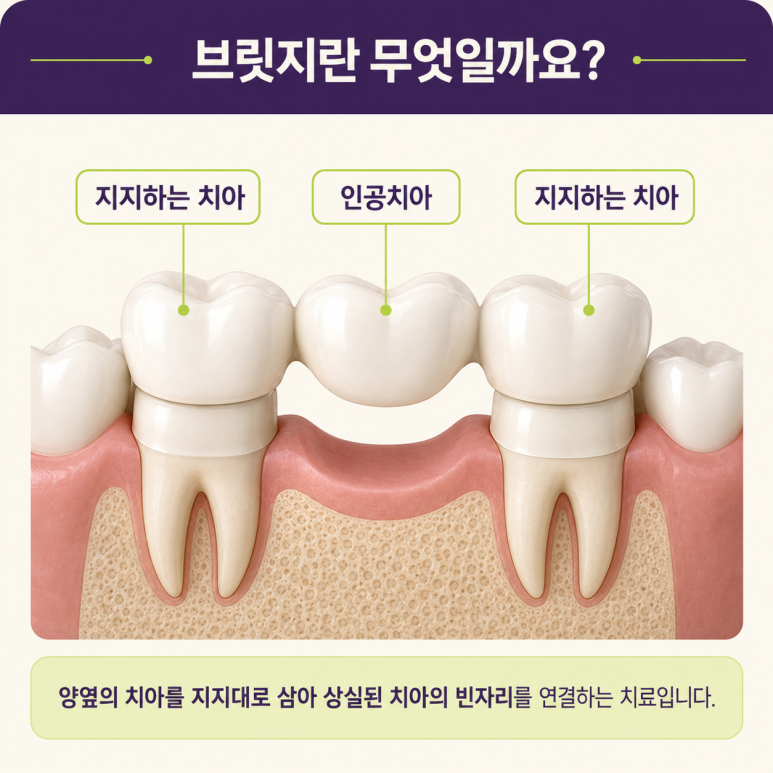
What is a bridge?
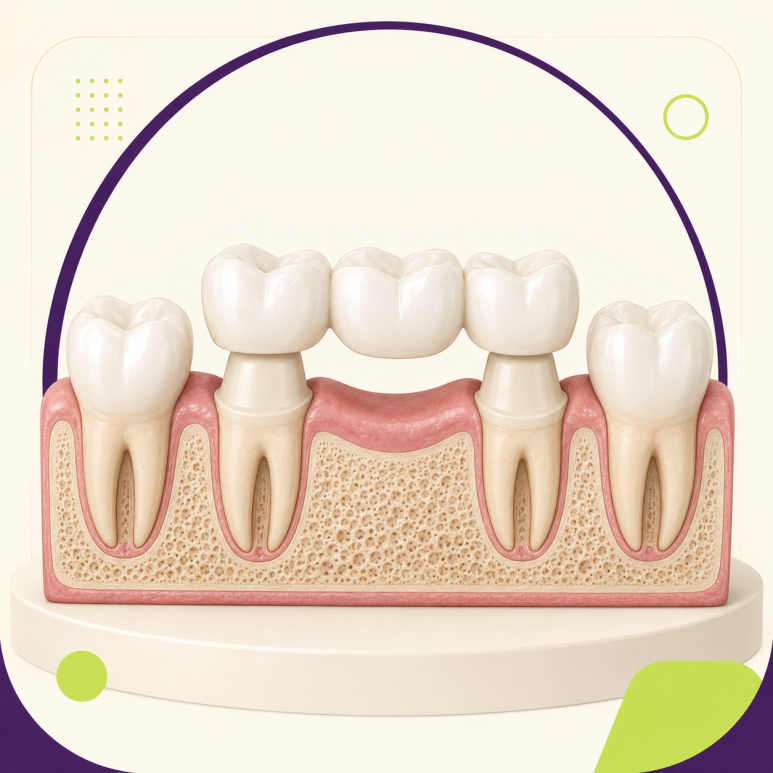
A bridge is a fixed prosthetic treatment that uses the teeth on either side of a missing tooth as supports and connects an artificial tooth in the middle.
It is called a bridge because it connects the space between teeth like a bridge.
A conventional bridge is made by shaping the teeth on both sides, placing crowns over them, and connecting an artificial tooth in the middle.
Unlike dentures, it is fixed in the mouth, so the patient does not remove it personally.
What are the advantages of bridges?
Implant placement surgery is not required
-
A bridge is not a treatment involving the placement of an artificial tooth root in the jawbone.
-
It may be considered as an alternative when the burden of surgery is significant or implant surgery is difficult due to the patient’s general health.
The treatment period may be relatively short
-
Unlike implants, there is no need to wait for the artificial tooth root to integrate with the jawbone.
-
Depending on the condition of the teeth and gums, the prosthesis may be completed within a relatively short period.
It can be used as a fixed restoration
-
Because a bridge is fixed in the mouth, it does not need to be removed and reinserted each time.
-
After adapting to the treatment, it can be used for everyday meals and conversation.
It may be considered when the surrounding teeth also require prosthetic treatment
-
If the teeth on either side of the missing tooth already have extensive cavities or require crowns after root canal treatment, a bridge may be considered.
-
When the surrounding teeth also need treatment, restoring them with one connected prosthesis may be appropriate.
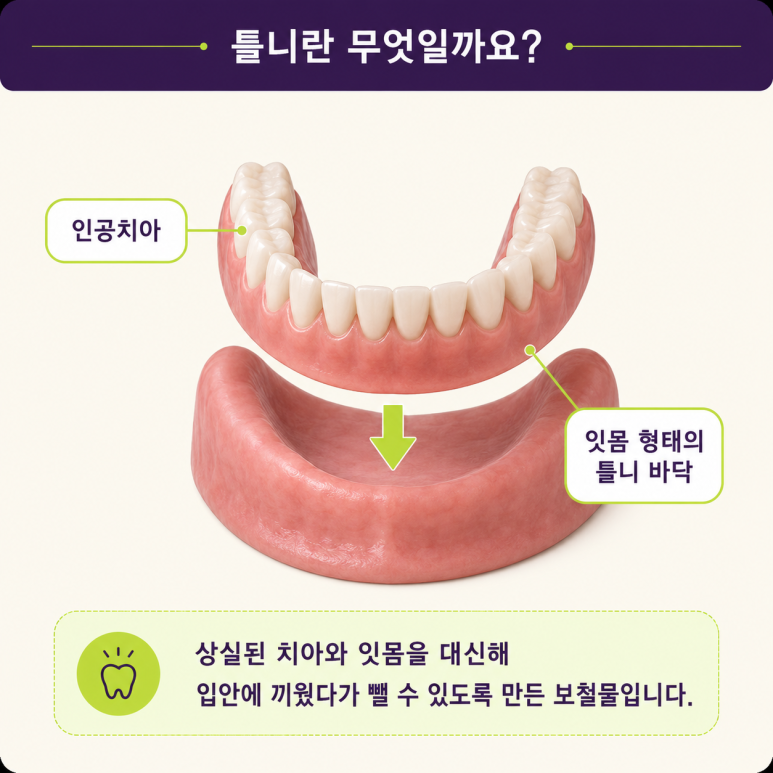
What is a denture?
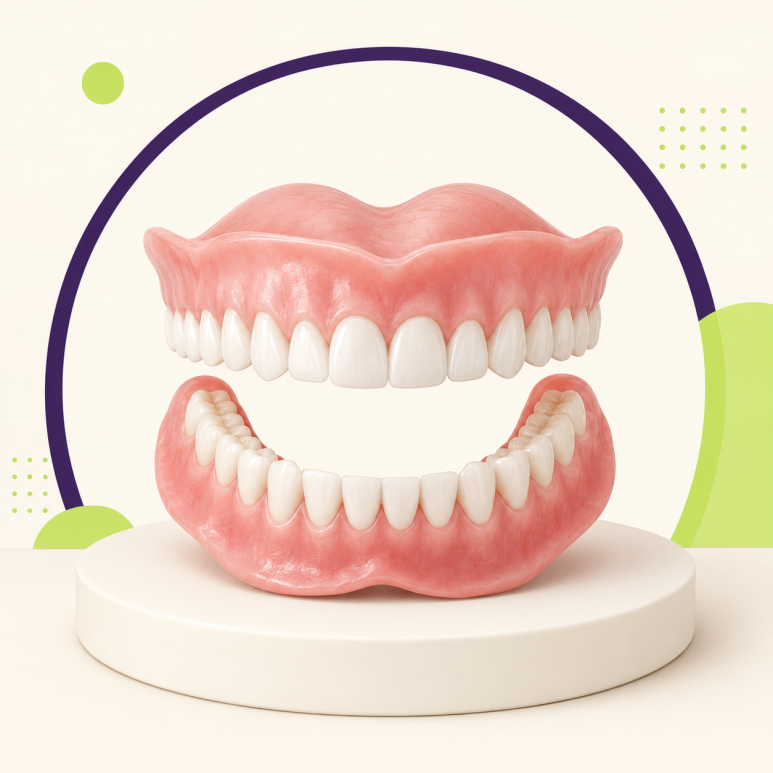
A denture is a removable prosthesis used when several or all teeth are missing, with support from the gums and the remaining teeth.
If some teeth remain, a partial denture may be considered. If all the teeth in one jaw are missing, a complete denture may be considered.
Unlike implants or bridges, dentures must be inserted and removed by the user for cleaning.
What are the advantages of dentures?
Several teeth can be restored at once.
-
Even when several teeth are missing or tooth loss extends over a wide area, the shape of the teeth can be restored with one appliance.
-
Even when all teeth are missing, complete dentures can partially restore appearance and chewing function.
They can generally be made without surgery.
The initial treatment burden may be relatively low.
-
When many teeth are missing, a broad area can be restored at a relatively lower cost than treating each missing tooth with an implant.
-
However, the cost may vary depending on the type and materials of the denture and whether additional treatment is required.
They can be adjusted and repaired.
-
If the gums are compressed or a specific area becomes painful while using dentures, they can be adjusted at a dental clinic.
-
If the denture becomes loose because the shape of the gums has changed, the inner surface can be supplemented or the denture can be remade depending on the condition.
How do implants, bridges, and dentures compare at a glance?
| Category | Implants | Bridges | Dentures |
|---|
| Support method | Artificial tooth root placed in the jawbone | Natural teeth on both sides | Gums and remaining teeth |
| Use | Fixed | Fixed | Removable |
| Removal of surrounding teeth | Generally not required | May be required for conventional bridges | Crown-shaped removal is generally not required, but support attachments may be needed |
| Surgery | Placement surgery required | Generally no surgery | Generally no surgery |
| Treatment period | May be longer due to the recovery period | May be relatively short | Fabrication and adaptation period required |
| Feel when used | Relatively stable | Relatively comfortable because it is fixed | Movement and a foreign-body sensation may occur |
| Applicable range | From one tooth to all teeth | Mainly limited areas of tooth loss | Several or all missing teeth |
| Maintenance | Brushing, flossing, interdental brushes, and regular checkups | Separate cleaning under the bridge | Remove and clean; care for the gums |
| Main considerations | Jawbone and general health | Health of the supporting teeth | Ability to adapt and maintain |
As shown in the table, implants and bridges are fixed restorations, while dentures are removable prostheses that the user inserts and removes personally.
Implants do not require the surrounding teeth to be shaped, but surgery and a recovery period are necessary. Bridges can be completed relatively quickly
but use the surrounding teeth as supports. Dentures can restore several teeth at once, but adaptation and cleaning are required.
Therefore, the appropriate method should be selected by considering the number and location of the missing teeth, the condition of the surrounding teeth and jawbone, and other factors as a whole.
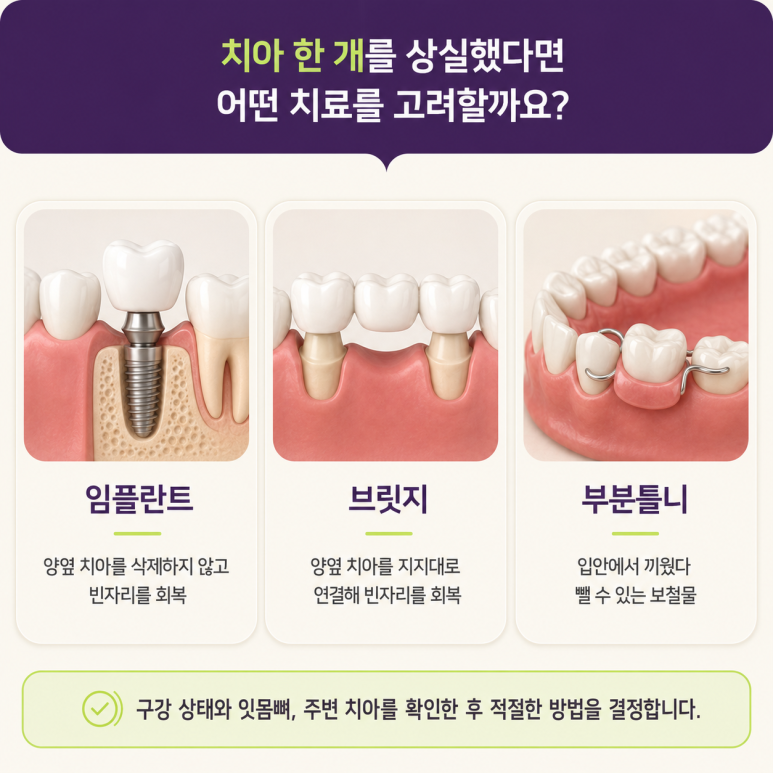
What treatment should be considered if one tooth is missing?
If one tooth is missing and the teeth on both sides are healthy, an implant that does not require shaping the surrounding teeth may be considered first.
Because an implant is placed independently at the location of the missing tooth, it does not use healthy surrounding teeth as supports.
Conversely, if the teeth on both sides are already severely damaged and require crown treatment, or if implant surgery is difficult and the treatment period needs to be
shortened, a bridge may be more appropriate.
Therefore, when one tooth is missing, the surrounding teeth should also be examined rather than automatically choosing an implant or immediately choosing a bridge simply because surgery feels burdensome.
How should you choose if several teeth are missing?
Fixed prosthesis using implants
-
Losing several teeth does not necessarily mean that an implant must be placed for every missing tooth.
-
An implant-supported bridge may be considered by placing several implants in the necessary locations and fabricating a connected prosthesis over them.
-
Although it can be used as a fixed restoration, the extent of surgery, jawbone condition, treatment period, and cost should all be considered.
Partial dentures
-
Partial dentures may be considered when teeth are missing over a wide area or when there are no teeth at the back to support a bridge.
-
They receive support from the remaining teeth and gums and can restore several teeth at once without surgery.
Implant-retained dentures
-
Another option is to place a small number of implants to improve the retention of a denture.
-
This may be an alternative when conventional dentures frequently move or come out and cause discomfort. However, both the areas around the implants and the dentures must be managed consistently.
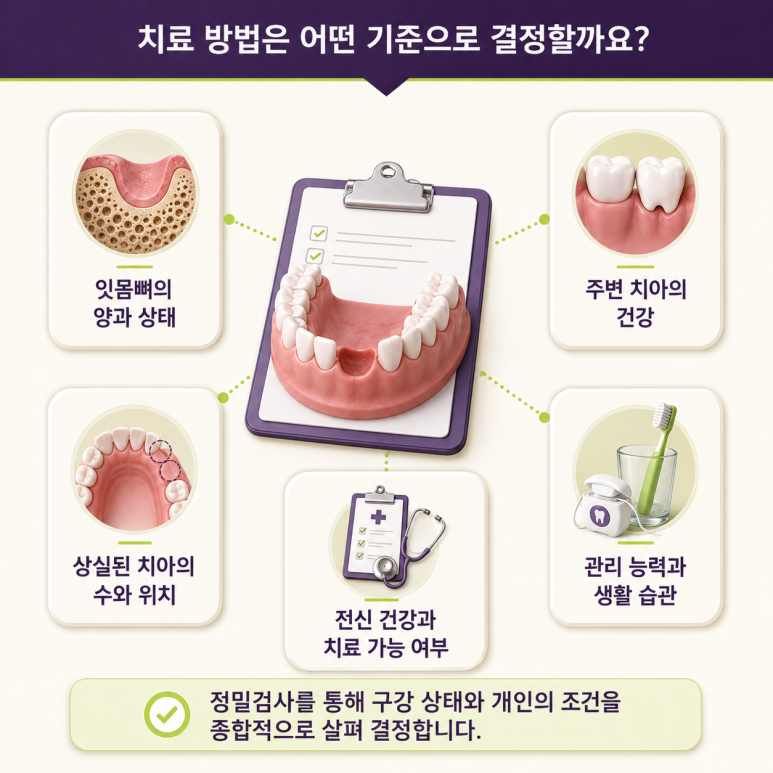
What criteria determine the treatment method?
Number and location of the missing teeth
-
The treatment method varies depending on whether the missing tooth is a front tooth or a molar, and whether one tooth or several consecutive teeth are missing.
-
For front teeth, appearance, pronunciation, and the gum line are important. For molars, a structure capable of withstanding strong chewing forces is important.
Health of the surrounding teeth
-
If the teeth on both sides are healthy, implants may be more advantageous than bridges, which require the teeth to be shaped, from the perspective of preserving tooth structure.
-
Conversely, if the surrounding teeth have extensive cavities or fractures and require crown treatment, a bridge may be appropriate.
Condition of the jawbone and gums
-
To plan an implant, sufficient jawbone to support the artificial tooth root is needed.
-
If the bone is insufficient, bone grafting may be considered. In the upper molar area, the distance between the sinus and the jawbone must also be checked.
-
If periodontal disease is present, gum inflammation may need to be managed first before implant or bridge treatment.
General medical conditions and medications
-
General conditions such as diabetes, high blood pressure, and osteoporosis, as well as medications being taken, may affect surgery and recovery.
-
Having a medical condition does not necessarily mean that implants are impossible, but the current level of control and the types of medications must be checked.
Treatment period and surgical burden
-
Bridges or dentures may be considered if a short treatment period is desired or surgery is a significant concern.
-
Implants may be considered if the patient wants to preserve the surrounding teeth and restore function independently, even if treatment takes somewhat longer.
Ability to maintain oral hygiene and lifestyle habits
-
Although implants and bridges are fixed, the spaces between the teeth and the areas under the prostheses must be cleaned thoroughly.
-
Dentures should be removed and cleaned every day, and the condition of the gums should be checked. The patient’s oral-care habits, hand mobility, and whether assistance from a caregiver is available may also affect the treatment choice.
Choosing a treatment after tooth loss,
Compare your options carefully at S Leader Dental Hospital in Seongsu-dong
Implants, bridges, and dentures all restore the function of missing teeth, but each has different characteristics.
Implants can restore function independently without shaping the surrounding teeth, but placement surgery and a recovery period are required.
Bridges can be used as fixed restorations within a relatively short period, but they require the surrounding teeth to serve as supports.
Dentures can restore several teeth without surgery, but removal, cleaning, and an adaptation process are required.
Therefore, rather than deciding based only on other people’s treatment experiences or cost, the following factors should also be considered together.
-
Number and location of the missing teeth
-
Health of the surrounding teeth
-
Height and width of the jawbone
-
Presence or absence of gum disease
-
General medical conditions and medications
-
Whether surgery is possible and the treatment period
-
The patient’s ability to maintain oral hygiene and lifestyle habits
At S Leader Dental Hospital in Seongsu-dong, we conduct comprehensive examinations based on detailed oral checkups and radiographic examinations, evaluating not only the missing teeth but also the surrounding teeth, jawbone, and bite.
Based on these findings, we provide a thorough comparison and explanation of the treatment options—implants, bridges, and dentures—to identify the direction most appropriate for the patient’s current oral condition.
If you are considering implants in Seongsu-dong but are unsure which treatment to choose, rather than deciding on a specific treatment in advance, we recommend receiving a thorough consultation covering the advantages and disadvantages of each treatment as well as care after treatment.



Seongsu-dong Implants :: S Leader Dental Hospital.