Hello. This is S Leader Dental Hospital, Sejong University Dental Clinic, which is celebrating its 22nd anniversary this year.
Wisdom teeth are generally the last teeth to erupt, most commonly in the late teens or early twenties. However, not all wisdom teeth erupt normally. When there is insufficient space in the jawbone or the wisdom tooth is positioned abnormally, it may be found partially or completely buried in the gums or jawbone as an “impacted wisdom tooth.”
Impacted wisdom teeth often cause no noticeable pain, making it easy to think, “It doesn’t hurt, so it should be fine to leave it alone.” In fact, they are often discovered incidentally when X-rays are taken during a health examination or dental checkup.
However, the absence of symptoms does not always mean that the tooth is healthy. Impacted wisdom teeth can affect the surrounding teeth and gums from a location that is not visible, and over time they may cause various problems, including inflammation, tooth decay, and gum disease.
Of course, not every impacted wisdom tooth necessarily needs to be extracted. The important thing is to accurately assess the tooth’s current position and direction, as well as the condition of the surrounding tissues, before deciding whether treatment is needed.
Today, S Leader Dental Hospital, Sejong University Dental Clinic, will explain in detail what impacted wisdom teeth are, what problems may occur if they are left untreated, and when extraction may need to be considered.

What Is an Impacted Wisdom Tooth?
An impacted wisdom tooth is a wisdom tooth that has not erupted normally and remains buried in the gums or jawbone.
The main causes are insufficient space for the wisdom tooth to erupt or the tooth growing at an angle and becoming blocked by the tooth in front of it.
Some wisdom teeth stop after emerging only slightly from the gums, while others remain completely buried within the jawbone.
Impacted wisdom teeth can generally be classified into the following types:
-
Partially impacted, with only part of the tooth emerging from the gums
-
Soft-tissue impacted, with most of the tooth buried beneath the gums
-
Completely impacted, with the tooth fully buried in the jawbone
-
Horizontally impacted, lying down or growing at an angle toward the adjacent tooth
Lower wisdom teeth are especially often found to be impacted because there is frequently less space for them than for upper wisdom teeth.

What Problems Can Occur If an Impacted Wisdom Tooth Is Left Untreated?
Even when there are no symptoms, leaving an impacted wisdom tooth untreated for a long time may lead to various problems.
- Recurrent gum inflammation may occur.
The area around a wisdom tooth is difficult for a toothbrush to reach, so food particles and bacteria can easily remain there.
In particular, when only part of a wisdom tooth has erupted, the gums often cover part of the tooth. If bacteria enter through this gap, inflammation may occur repeatedly.
Symptoms may include swollen gums, pain when chewing, difficulty opening the mouth, and worsening bad breath.
- The molar in front of it may also develop tooth decay.
A horizontally impacted wisdom tooth is often located very close to the molar in front of it.
Food can easily become trapped between these teeth, but toothbrushes and dental floss may not reach the area properly, allowing bacteria to remain there for a long time.
If this environment persists, tooth decay may develop not only in the wisdom tooth but also in the molar immediately in front of it.
- It may lead to gum disease.
Repeated inflammation around an impacted wisdom tooth can weaken the gum tissue and may progress to periodontal disease.
When inflammation becomes severe, it may affect not only the gums but also the surrounding alveolar bone. If left untreated for a long time, the extent of treatment required may increase.
- It may damage adjacent teeth.
An impacted wisdom tooth growing at an angle can continuously push against or exert pressure on the tooth in front of it.
Although tooth alignment does not change in every case, a wisdom tooth may affect the root or surrounding tissues of an adjacent tooth, making regular imaging examinations necessary.
Changes such as root resorption are particularly difficult to notice in the early stages, so they are often identified through X-rays or CT scans.
- Lesions such as cysts may develop.
Although rare, a cyst may develop around an impacted wisdom tooth.
There are often no noticeable symptoms in the early stages, but if the lesion grows, it may affect the surrounding bone or tissues. Therefore, regular checkups are important for monitoring the condition.
If There Are No Symptoms, Does the Tooth Still Need to Be Extracted?
The presence of an impacted wisdom tooth does not necessarily mean that extraction is required.
If the wisdom tooth is completely impacted, does not affect the surrounding teeth or gums, and there are no particular problems such as inflammation or tooth decay, the condition may be monitored through regular checkups.
On the other hand, extraction may be considered in the following cases:
-
Gum inflammation occurs repeatedly
-
Tooth decay has developed in the molar in front of it
-
Pain frequently occurs around the wisdom tooth
-
Damage to the teeth or gums has been identified
-
A lesion such as a cyst is suspected
In other words, an impacted wisdom tooth should not automatically be extracted simply because it is impacted. It is important to accurately assess its current condition before deciding whether treatment is needed.
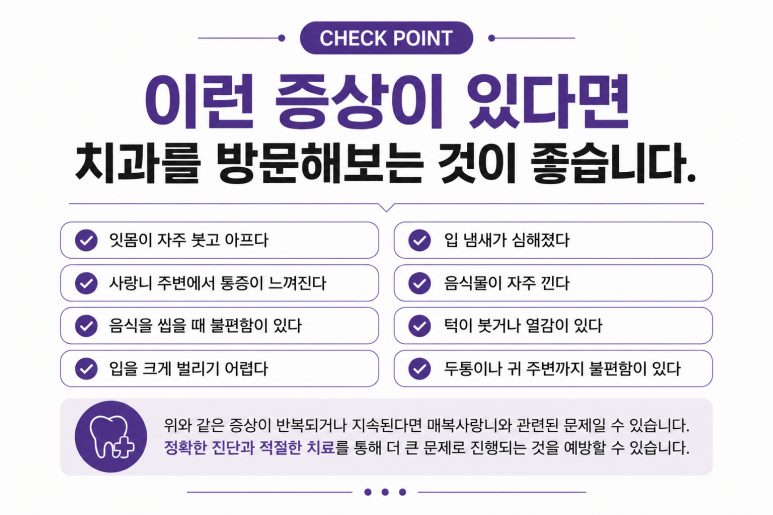
If You Have These Symptoms, It Is a Good Idea to Visit a Dentist
The following symptoms may be related to an impacted wisdom tooth, so it is advisable to receive a dental examination:
-
The gums swell frequently.
-
Pain is felt around the wisdom tooth.
-
Chewing food is uncomfortable.
-
It is difficult to open the mouth wide.
-
Bad breath has become worse.
-
Food frequently becomes trapped.
-
The jaw is swollen or feels warm.
Although these symptoms do not all mean that extraction is necessary, it is important to identify the exact cause and determine the appropriate time for treatment.

Gunja-dong Dental Clinic, Impacted Wisdom Teeth
Accurate Diagnosis Is Most Important
An impacted wisdom tooth cannot necessarily be considered safe simply because it causes no symptoms. The problems that may develop in the future differ from person to person depending on the wisdom tooth’s position and direction, as well as the condition of the surrounding teeth and gums. Therefore, rather than visiting a dentist only after pain develops, it is helpful to check the current condition through regular examinations and plan treatment at the appropriate time when necessary to maintain oral health.
In addition, managing an impacted wisdom tooth involves more than simply deciding whether to “extract it or not.” It is important to comprehensively evaluate the tooth’s shape and degree of impaction, its distance from nearby nerves, and its relationship with adjacent teeth. Based on this assessment, creating an appropriate treatment plan for each patient can lead to safer treatment with consideration for the expected outcome.
At S Leader Dental Hospital, Gunja-dong Dental Clinic and Gwangjin-gu Dental Clinic, we use detailed examinations such as 3D CT scans to carefully assess the position and direction of impacted wisdom teeth and the condition of the surrounding tissues. We then provide treatment plans suited to each patient’s oral condition. If you are experiencing pain due to an impacted wisdom tooth or are wondering whether extraction is necessary, please seek an accurate diagnosis rather than making the decision on your own.





Gunja-dong Dental Clinic :: S Leader Dental Hospital