Hello, this is S Leader Dental Hospital, a Konkuk orthodontic clinic celebrating its 22nd anniversary this year.
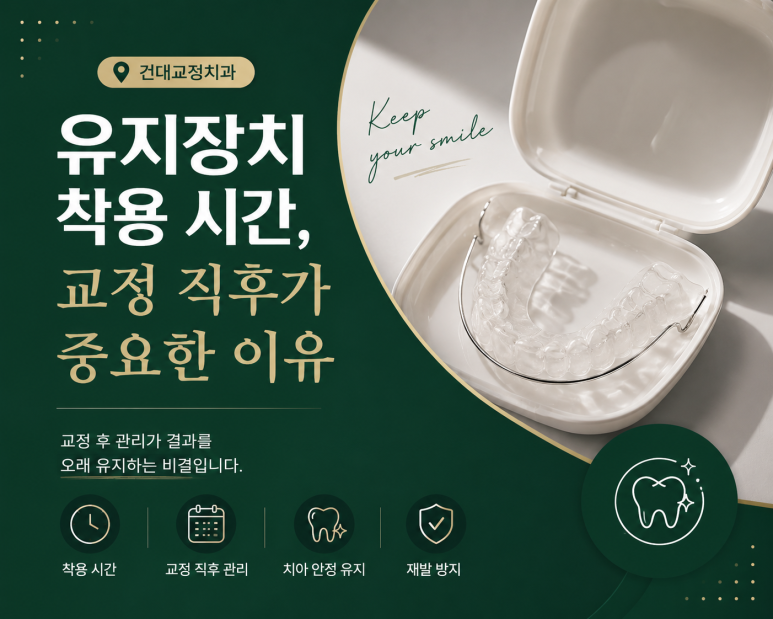
The day when orthodontic appliances are removed after a long course of treatment is a moment many people look forward to. It is easy to think that treatment is completely finished when you see your teeth neatly aligned, but in reality, an important stage begins after orthodontic treatment: maintaining the results.
Immediately after orthodontic appliances are removed, the teeth have not yet fully adapted to their new positions. The teeth that have been moved over a long period, along with the surrounding gums, periodontal ligaments, and alveolar bone, are still undergoing stabilization, so some force may remain that tends to move them back to their original positions.
Retainers are necessary to minimize this natural movement and maintain the results of orthodontic treatment for as long as possible.
However, although many people know that they need to wear a retainer, they often do not know exactly “how many hours a day it should be worn,” “how long it should be used,” or “whether it is okay to skip it for a few days.”
Today, S Leader Dental Hospital, a Konkuk orthodontic clinic, will explain in detail the role of retainers, why the period immediately after orthodontic treatment is especially important, and what changes may occur if retainers are not worn.
What Is a Retainer?
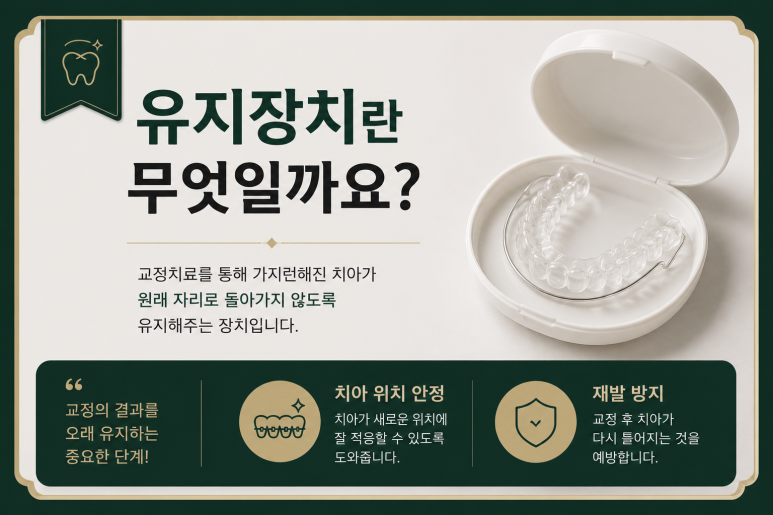
A retainer is an appliance that helps teeth moved through orthodontic treatment remain stably in their current positions.
The goal of orthodontic treatment is not simply to arrange the teeth attractively, but also to maintain that condition for a long time after treatment ends. Therefore, it is best to think of retainers as an extension of orthodontic treatment.
Immediately after orthodontic appliances are removed, the tissues surrounding the teeth have not yet adapted to their new positions. The periodontal ligaments and alveolar bone that support the teeth need time to remodel, so the teeth may retain a tendency to move slightly for a certain period.
At this time, retainers help prevent unnecessary tooth movement and maintain the alignment achieved through orthodontic treatment.
Retainers include fixed retainers attached to the inner surfaces of the teeth and removable retainers that can be put on and taken off. Depending on the patient’s dental condition and treatment plan, one type or both types may be used together.
Why Do Teeth Move Again Even After Orthodontic Treatment Ends?
Many people wonder, “Why are my teeth moving again when my orthodontic treatment is already finished?”
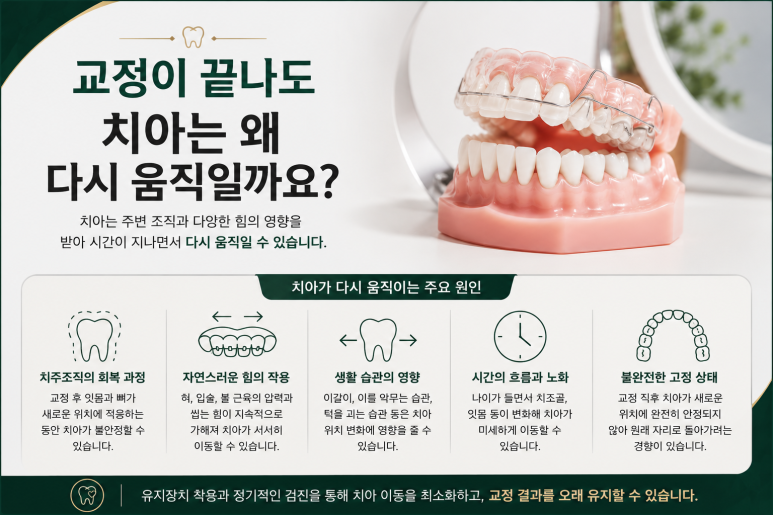
Although teeth appear to be completely fixed in hard bone, they can actually move microscopically through tissue called the periodontal ligament.
Orthodontic treatment is a process of moving teeth using continuous force. As the teeth move, the alveolar bone undergoes repeated resorption and regeneration, changing to accommodate their new positions.
However, these tissue changes do not end immediately just because the orthodontic appliances have been removed.
It takes time for the tissues surrounding the teeth to stabilize completely, and during this period, some force may remain that tends to return the teeth to their original alignment. This is often referred to as relapse or re-alignment, or as tooth movement.
In addition, teeth can move very slightly throughout a person’s life. Chewing habits, pressure from the tongue, the force of the lips and cheek muscles, teeth grinding, and clenching can also affect tooth alignment.
For these reasons, management with retainers remains important even after orthodontic treatment has ended.
Why Is the Period Immediately After Orthodontic Treatment the Most Important?
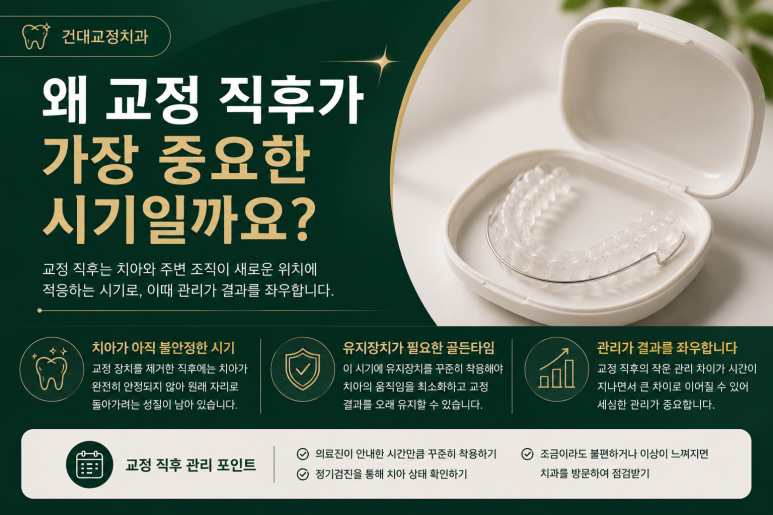
Among the periods when retainers need to be worn, the time immediately after orthodontic appliances are removed is known to be especially important.
During this period, the teeth are still adapting to their new positions. If retainers are not worn regularly, tooth alignment may change more quickly than expected. Changes in the front teeth are particularly noticeable, so some people may feel that their teeth look slightly different from before even after not wearing their retainers for just a few days.
Immediately after orthodontic treatment, not only the teeth but also the gums and alveolar bone are undergoing recovery. Therefore, it is important to follow the wearing schedule provided by your dental professional.
They may feel somewhat uncomfortable or tight at first, but most people gradually adjust over time.
On the other hand, if you repeatedly skip wearing them while thinking, “It should be fine for just one day,” the teeth may begin to move little by little. This may eventually cause the retainer to fit poorly or make it necessary to have a new one made.
Therefore, immediately after orthodontic treatment, it is important to pay consistent attention to maintenance just as you did to the treatment itself.
What Happens If Retainers Are Not Worn Properly?
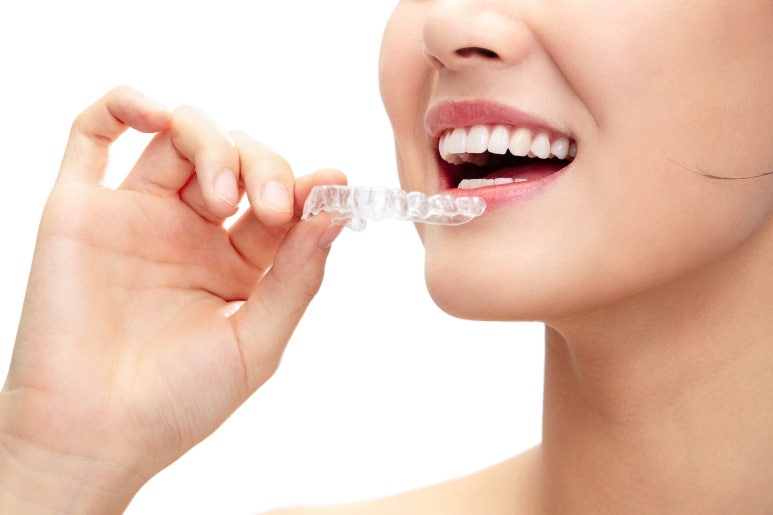
If retainers are worn for less than the recommended amount of time or are not used for an extended period, the alignment of the teeth may change.
At first, there may seem to be no major change, but over time, subtle changes such as spaces developing between the teeth or the front teeth gradually overlapping may appear.
These changes can be difficult to notice at first, but after a certain amount of time, the retainer may no longer fit properly or may not fully seat.
If significant tooth movement has already occurred, retainers alone may not be sufficient, and additional orthodontic treatment may be necessary.
Of course, not everyone’s teeth move to the same extent. Differences may depend on each person’s dental condition, orthodontic method, and lifestyle habits.
However, to maintain the results achieved through orthodontic treatment for a long time, it is most important to consistently follow the wearing instructions provided by your dental professional.
How Many Hours a Day Should Retainers Be Worn?
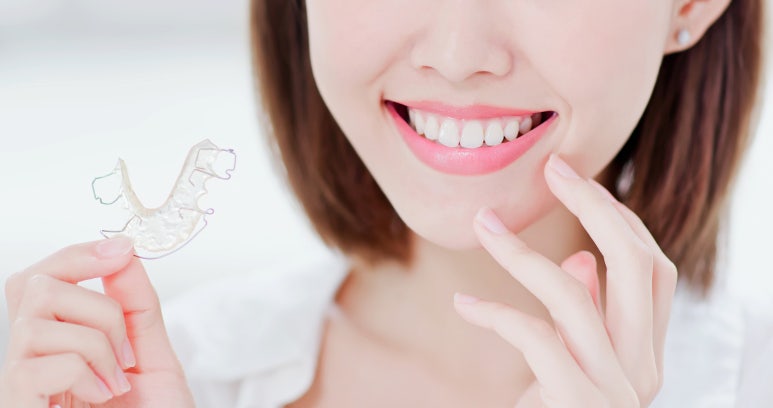
One of the most common questions after orthodontic treatment is, “About how many hours a day should I wear my retainer?”
However, there is no single answer that applies to everyone.
The wearing time may vary depending on the extent of tooth movement, the orthodontic method, whether teeth were extracted, the type of malocclusion, and the current stability of the teeth.
In general, immediately after orthodontic treatment, the teeth have not yet fully adapted to their new positions, so many people are instructed to spend most of the day wearing their retainers.
As time passes and the teeth become stable, the wearing time may be gradually reduced based on the dental professional’s assessment.
However, it is not advisable to suddenly reduce the wearing time on your own or stop wearing the retainers for several days.
Even if there does not appear to be any particular change at first, teeth can move very slightly. When these small changes accumulate, the retainer may no longer fit properly or the alignment may change.
Therefore, it is most important to follow the instructions of your dental professional rather than general information found online.
How Long Should Retainers Be Worn?
“Do I only need to wear them for a few months?”
Many people think this way, but the wearing period for retainers also differs from person to person.
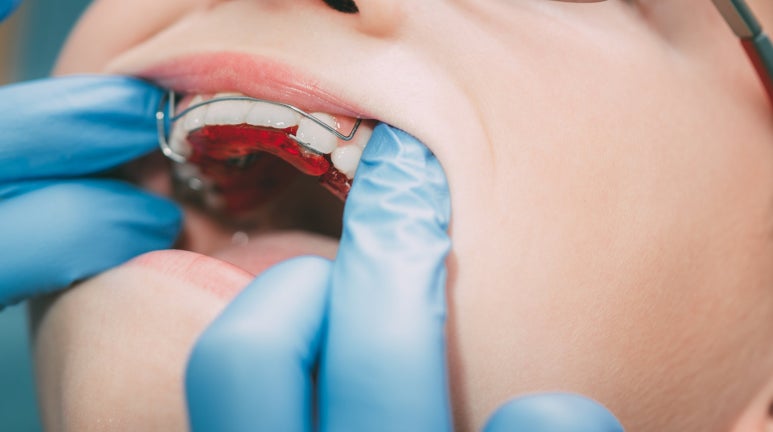
For a certain period after orthodontic treatment, more consistent wear is often necessary. Afterward, the wearing time may be adjusted depending on the condition of the teeth.
However, one thing is clear: the fact that orthodontic treatment has ended does not mean that tooth movement disappears completely.
Throughout life, the position of the teeth may change little by little under various influences, including chewing forces, pressure from the tongue, movement of the lips and cheek muscles, and aging.
For this reason, some people who want to maintain their orthodontic results for a long time continue wearing retainers at night for an extended period.
Because the wearing period varies from patient to patient, rather than assuming that it will definitely end after a certain number of years, it is important to monitor the stability of the teeth through regular checkups and manage them accordingly.
How Should Retainers Be Maintained for Long-Term Use?
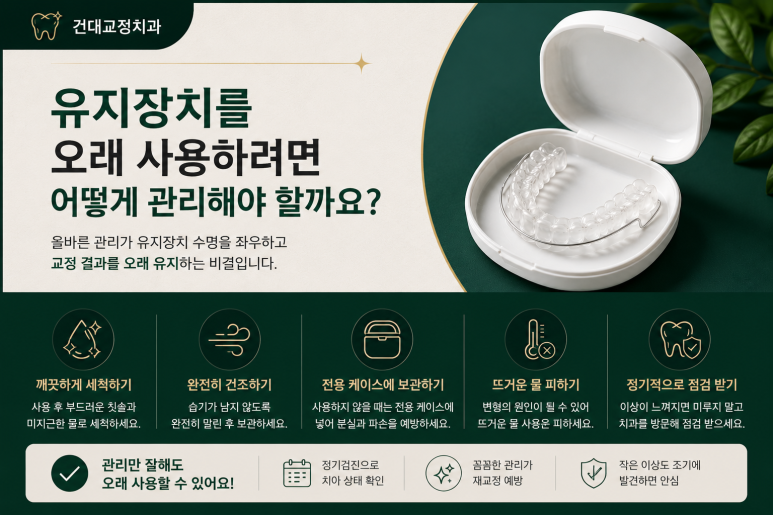
Retainers also require consistent care.
Removable retainers should be taken out during meals, cleaned thoroughly, completely dried, and then stored.
Because hot water may deform the appliance, using lukewarm or cool water is recommended.
It is also a good idea to develop the habit of storing the retainer in its dedicated case when it is not being used.
This is because people accidentally throw retainers away after wrapping them in a tissue more often than you might expect.
If you use a fixed retainer, it is important to clean around the appliance carefully not only by brushing normally but also by using dental floss, an interdental brush, or similar tools.
Food can easily become trapped around the appliance, and plaque can accumulate there. Inadequate care may increase the possibility of cavities or gum disease.
In addition, it may not be appropriate to continue using a retainer that is cracked or bent. If you notice anything unusual, it is advisable to have it examined.
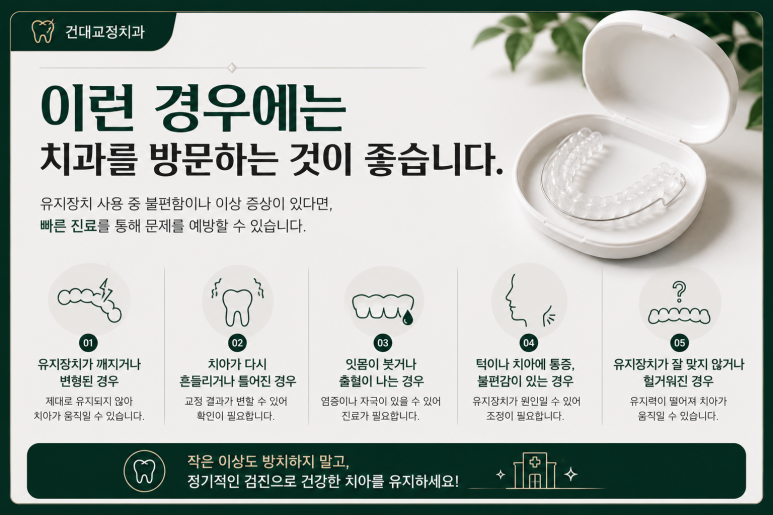
When Should You Visit a Dental Clinic?
Various situations may arise while using retainers.
In the following cases, rather than continuing to wear the retainer forcefully, it is advisable to have your condition checked at a dental clinic.
-
The retainer suddenly no longer fits properly.
-
It hurts more than before when you wear it.
-
The appliance is cracked or deformed.
-
The fixed retainer has come loose.
-
You feel that your tooth alignment has changed.
-
You have been unable to wear the retainer for an extended period.
If these symptoms are left unattended, tooth movement may continue, so having the condition checked as soon as possible can be helpful.
In particular, trying to force a retainer into place after not wearing it for a long time may damage the appliance or place stress on the teeth, so caution is necessary.
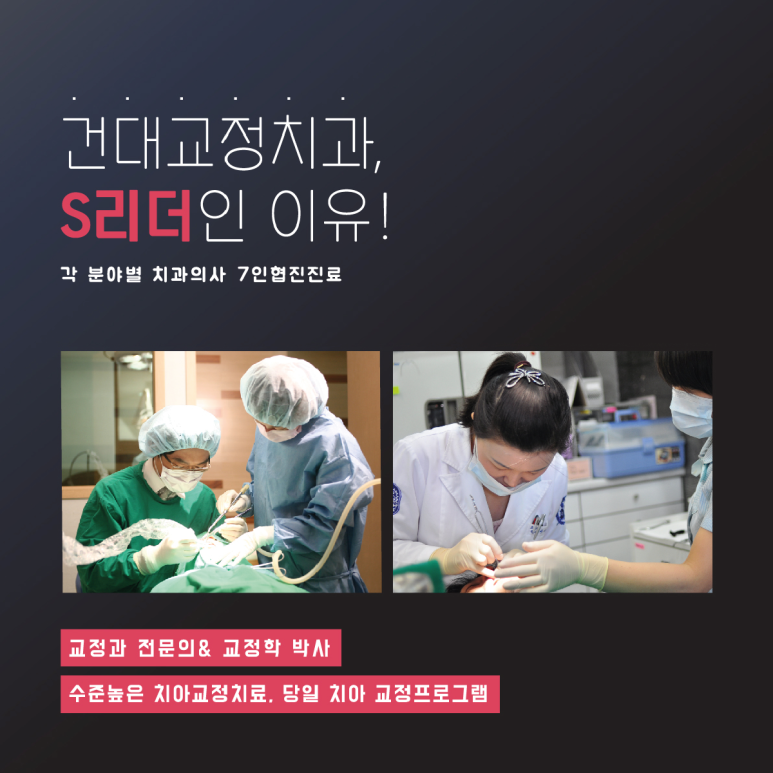
The Importance of Retainer Care Explained by S Leader Dental Hospital, a Konkuk Orthodontic Clinic
Orthodontic treatment is the process of straightening the teeth, but it is no exaggeration to say that maintaining the results over time depends on retainer care.
In particular, the period immediately after orthodontic appliances are removed is an important time when the teeth and surrounding tissues are adapting to their new positions. Developing the habit of wearing retainers regularly is therefore very important.
Even after the teeth have stabilized over time, it is advisable to check the condition of the retainers and any changes in tooth alignment through regular examinations. This is because even small changes can be managed more easily when detected early.
At S Leader Dental Hospital, a Konkuk orthodontic clinic, we regularly check patients’ dental conditions and retainer fit even after orthodontic treatment has ended, and we also provide follow-up care guidance to help maintain stable tooth alignment over the long term.
Orthodontic treatment is not complete on the day the appliances are removed. It is completed when care continues to maintain a healthy, well-aligned set of teeth for a long time afterward.
Rather than considering retainer wear a nuisance, please understand it as an important process for maintaining your orthodontic results over time and continue to take proper care of your teeth.



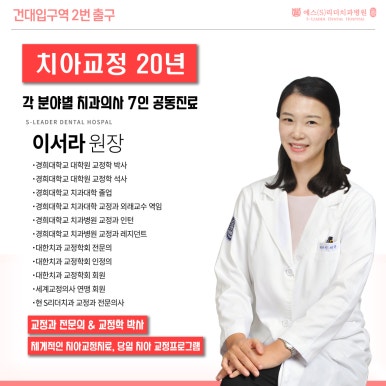
Konkuk Orthodontic Clinic :: S (S) Leader Dental Hospital