Hello, this is S Leader Dental Hospital, a Konkuk University orthodontic clinic celebrating its 22nd anniversary this year.
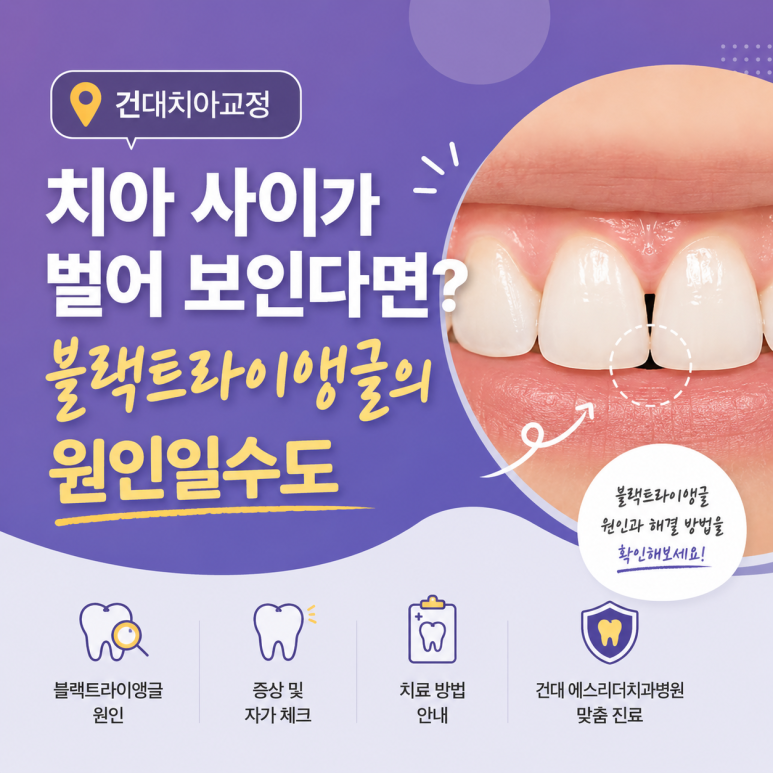
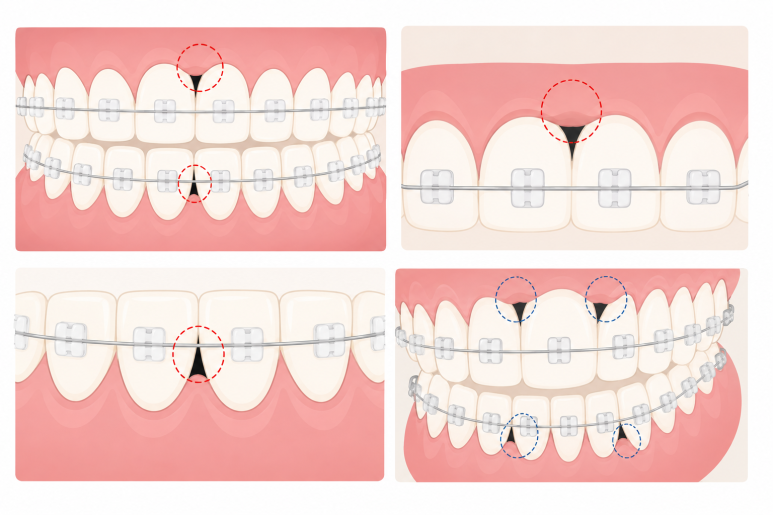
Some people become concerned after looking in the mirror following orthodontic treatment and noticing what appears to be black, triangular spaces between their teeth.
"My orthodontic treatment ended successfully, so why do my teeth look like there are gaps between them?"
"Could my teeth have shifted apart?"
"Could something have gone wrong with my orthodontic treatment?"
The phenomenon in which the spaces between the teeth appear dark after orthodontic treatment is called a black triangle. People seeing it for the first time may mistake it for their teeth spreading apart again, but in reality, it often results from a combination of several factors.
Because black triangles can affect not only appearance but also make food more likely to become trapped and gum care more difficult, it is important to identify the cause accurately.
Today, S Leader Dental Hospital, a Konkuk University orthodontic clinic, will take an in-depth look at why black triangles develop after orthodontic treatment, their symptoms, and treatment methods.
What Is a Black Triangle?
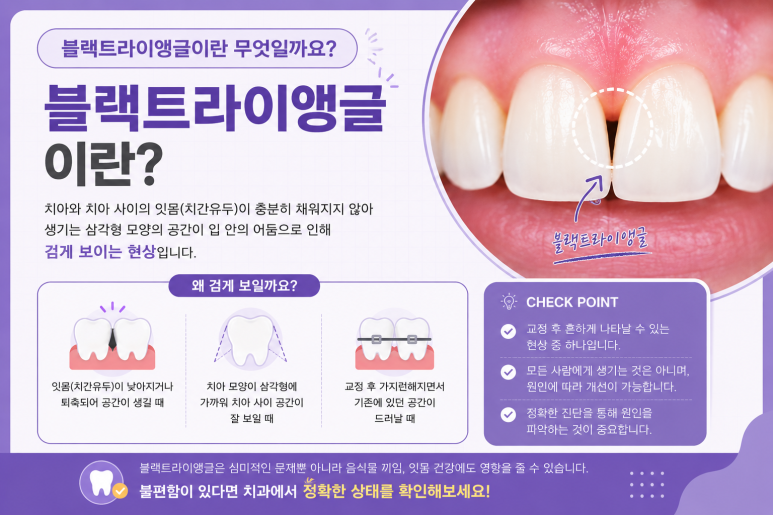
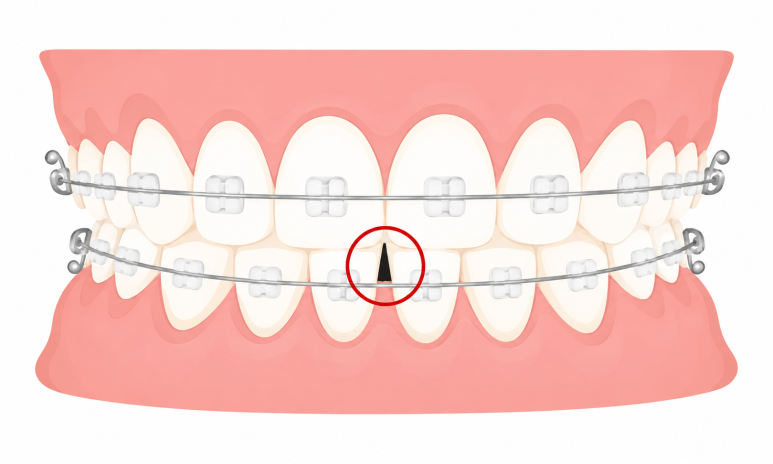
A black triangle refers to a phenomenon in which a triangular space forms and appears dark because the gum between the teeth, known as the interdental papilla, does not fill the area completely.
Even when the actual space is not very large, the darkness inside the mouth can make it look like a black triangle, which is how it got its name.
As the teeth become aligned after orthodontic treatment, spaces that were previously hidden by overlapping teeth may become visible. Black triangles may also develop depending on the condition of the gums and the shape of the teeth.
The important point is that the development of a black triangle does not necessarily mean that the orthodontic treatment was unsuccessful.
It can be one of the natural changes that appears depending on an individual's gum condition, tooth shape, and oral condition before orthodontic treatment.
What Causes Black Triangles After Orthodontic Treatment?
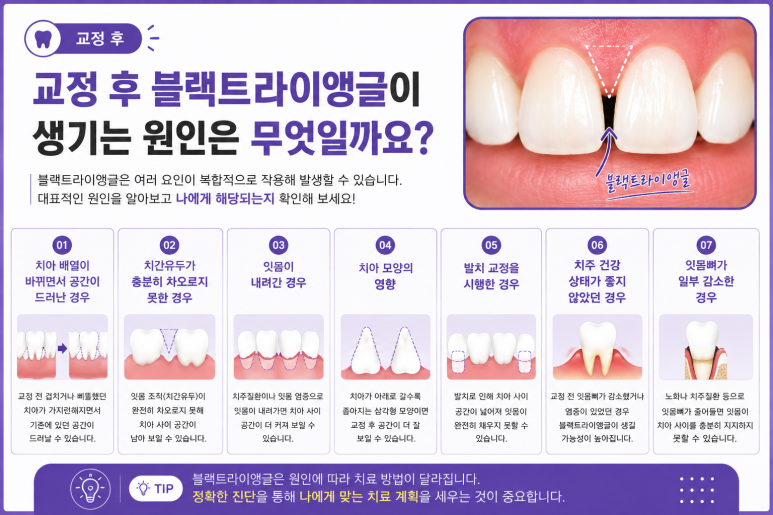
The most common causes include the following.
Spaces Become Visible as the Teeth Are Realigned
Before orthodontic treatment, spaces that were not visible because the teeth were overlapping or crooked may become noticeable once the teeth are straightened. In many cases, this does not mean that a new space was created during treatment; rather, a structure that was already present has become visible.
The Interdental Papilla Does Not Fully Fill the Space
A space may form when the gum tissue that fills the area between the teeth, called the interdental papilla, does not fill it completely.
In adults especially, black triangles may temporarily appear immediately after orthodontic treatment because tissue recovery tends to be slower.
The Gums Have Receded
If periodontal disease or gum inflammation was present, part of the gum may have receded, making the space between the teeth appear larger.
The poorer the gum health, the greater the possibility that black triangles may appear.
The Effect of Tooth Shape
When the teeth are triangular and become narrower toward the bottom rather than having a more rectangular shape, the spaces between them may remain relatively more visible even after the teeth are aligned through orthodontic treatment.
In Which Cases Are Black Triangles More Likely to Develop?
Not every orthodontic patient develops black triangles.
However, they may be somewhat more likely to occur in the following cases.
-
When orthodontic treatment is performed in adulthood
-
When orthodontic treatment involving tooth extraction is performed
-
When periodontal disease was present before orthodontic treatment
-
When a person naturally has thin gums
-
When there were wide spaces between the teeth
-
When the teeth are close to triangular in shape
-
When some of the supporting jawbone has been lost
Adults, in particular, may have gums that do not completely fill the spaces between the teeth after orthodontic treatment because gum tissue has less recovery capacity than it does during the growth period.
In addition, if gum health was poor before orthodontic treatment, black triangles may be more likely to appear.
What Symptoms Can Occur When Black Triangles Develop?
The first change people usually notice is aesthetic.
The spaces between the teeth may look dark when smiling or speaking, which can be particularly noticeable when black triangles occur around the front teeth.
Some people may also notice that food frequently becomes trapped between their teeth or that dental floss passes through unusually easily.
Some patients say that their pronunciation feels slightly different than before, and wider spaces may make brushing or flossing more difficult.
However, it cannot be assumed that all of these symptoms are caused by black triangles, so it is important to identify the cause through an accurate diagnosis.
What Problems Can Occur If Black Triangles Are Left Untreated?
It is easy to think of black triangles as merely an aesthetic issue in which the spaces between the teeth look dark. However, depending on the cause, they may also affect oral health, so it is important to have the condition accurately assessed rather than simply leaving it unaddressed.
The most common discomfort is food becoming trapped between the teeth.
When the spaces between the teeth become wider, food can remain there easily after meals. If it is not removed properly, this may create an environment where plaque can accumulate more readily.
If plaque continues to build up, gum inflammation or bleeding may occur. If proper care is not maintained, it may also lead to gingivitis or periodontal disease.
Repeatedly trapped food can also contribute to bad breath.
Because it is difficult to clean perfectly between the teeth with a toothbrush alone, dental floss or an interdental brush is often needed as well.
The aesthetic stress should not be overlooked either.
When black triangles develop around the front teeth in particular, the dark spaces may be noticeable when smiling or speaking, and many people feel that this has lowered their confidence.
However, having a black triangle does not necessarily mean that treatment is required. Whether treatment is appropriate may vary depending on the size of the space, its cause, and the level of discomfort, so receiving an accurate diagnosis first is important.
Can Black Triangles Be Treated?
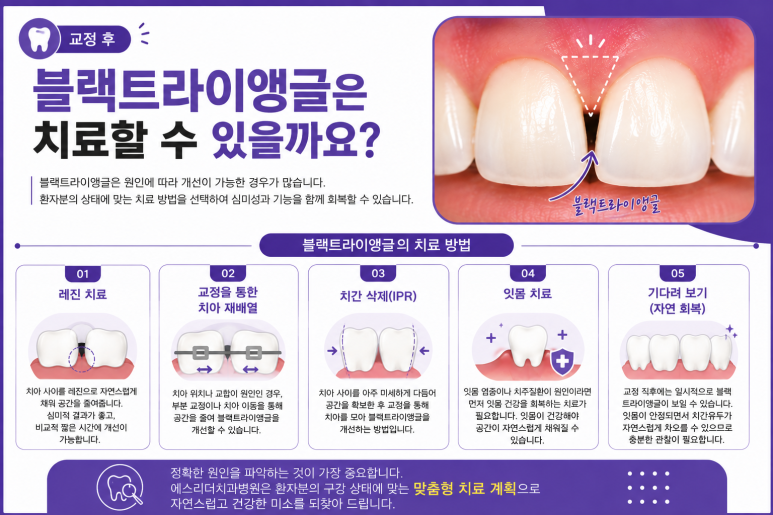
Black triangles can sometimes be improved depending on their cause.
The important thing is not simply to fill the space, but first to determine why the black triangle developed.
Common treatment methods include the following.
Composite Resin Treatment
When the shape of the teeth is triangular, composite resin can be used to naturally refine the areas between the teeth and reduce the spaces. Because a material similar in color to the teeth is used, aesthetic satisfaction is generally high, and improvement may be possible in a relatively short time.
Realignment Through Orthodontic Treatment
When the cause is related to the bite or tooth position, partial retreatment or tooth movement may be used to reduce the space. However, not every black triangle is a candidate for retreatment. Whether treatment is appropriate is determined after considering the current tooth alignment and gum condition as a whole.
Interproximal Reduction
When tooth shape is the cause, the spaces may be reduced by performing interproximal reduction, which involves minimally reshaping the areas between the teeth, followed by orthodontic treatment. This is not a procedure that removes an excessive amount of tooth structure; it is performed safely within the necessary range.
Gum Treatment
If gum inflammation or periodontal disease is the cause, treatment to restore gum health is needed first. This is because a stable gum condition allows a subsequent treatment plan to be established more accurately.

S Leader Dental Hospital, a Konkuk University Orthodontic Clinic
From Identifying the Cause of Black Triangles to Personalized Treatment
Black triangles are often difficult to assess by looking only at the spaces between the teeth.
Because various factors—including tooth shape and alignment, gum condition, the height of the alveolar bone, and the bite relationship—can affect the condition, the cause and treatment method may differ from patient to patient.
At S Leader Dental Hospital, a Konkuk University orthodontic clinic, we carefully identify the cause of black triangles through detailed examinations and establish a personalized treatment plan suited to each patient's oral condition.
Rather than focusing solely on filling the spaces, we consider tooth function and appearance as well as gum health, providing care aimed at achieving a natural and stable result.
Depending on the situation, we comprehensively consider various treatment options, including composite resin treatment, an orthodontic approach, and periodontal treatment. Even after treatment, we provide attentive care to help patients maintain healthy teeth and gums for a long time through proper oral care and regular checkups.
If you are concerned because the spaces between your teeth look dark after orthodontic treatment or because food frequently becomes trapped, instead of worrying on your own, please receive an accurate diagnosis to assess your current condition.






Konkuk University Orthodontics :: S (S) Leader Dental Hospital.