Hello, this is S Leader Dental Hospital, a Songjeong-dong dental clinic celebrating its 22nd anniversary this year.
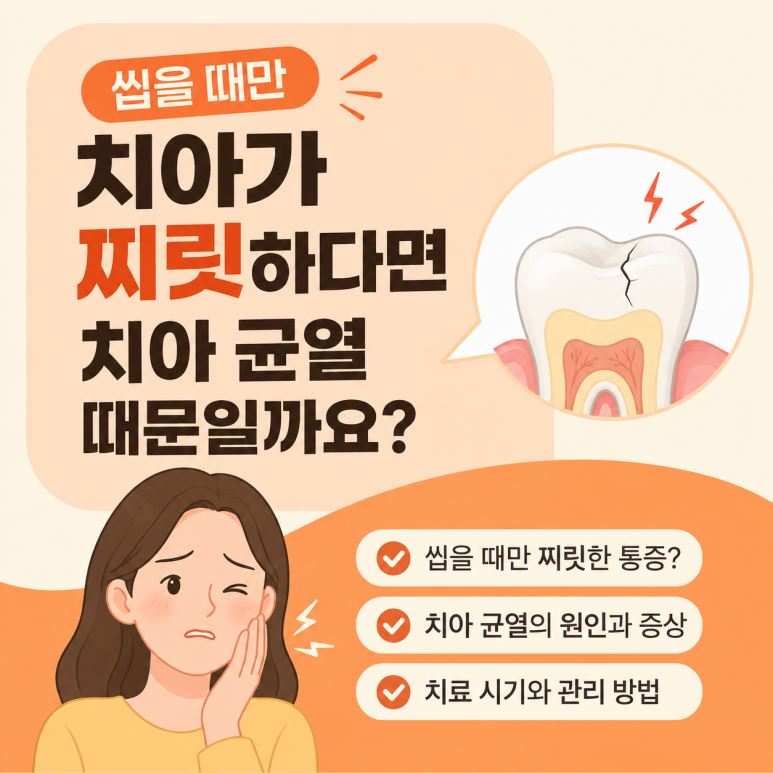
There are times when a specific tooth suddenly feels sharp and painful the moment you chew food, even though it feels perfectly fine normally. Because the pain does not continue, it is easy to initially think that food has become stuck or that excessive force was briefly placed on the tooth.
Especially when the pain disappears quickly, some people choose to monitor it for a few days. However, if the same area repeatedly hurts every time you eat, or if particularly sharp pain occurs when chewing hard foods, a cracked tooth should also be considered as one possible cause.
A cracked tooth refers, literally, to a state in which a fine crack or gap has formed in the tooth. The problem is that, unlike a tooth that has completely broken, it often appears normal on the outside.
Today, S Leader Dental Hospital, a Songjeong-dong dental clinic, will explain step by step why cracks form in teeth and how they are related to pain that occurs when chewing.
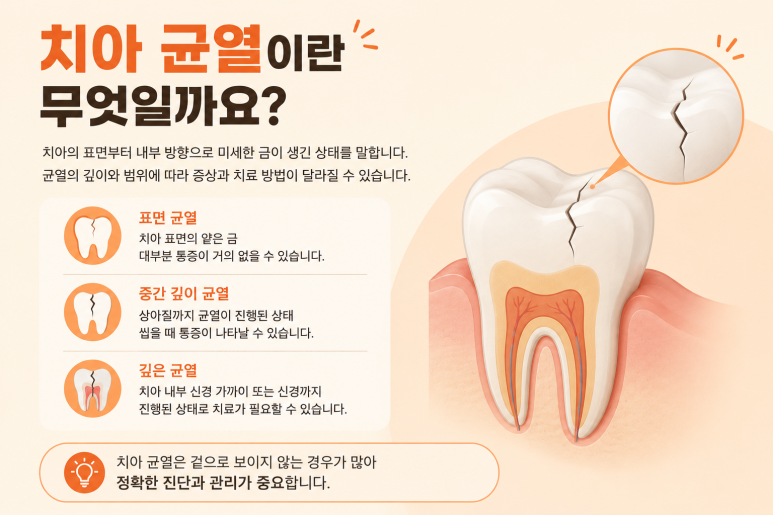
What Is a Cracked Tooth?
A cracked tooth refers to a condition in which a fine crack forms from the tooth’s surface toward the inside.
The condition can vary widely, from a shallow line appearing only on the tooth’s surface to a crack extending deep into the inner part of the tooth. Therefore, not all tooth cracks can be considered the same level of problem.
A tooth may look normal on the outside while actually having a crack extending through its interior. Because of this characteristic, a cracked tooth can be more difficult for patients to notice themselves than tooth decay or an obvious fracture.
It may initially begin as occasional discomfort when chewing food, and one characteristic symptom is sudden pain that occurs only when force is applied to a particular tooth.
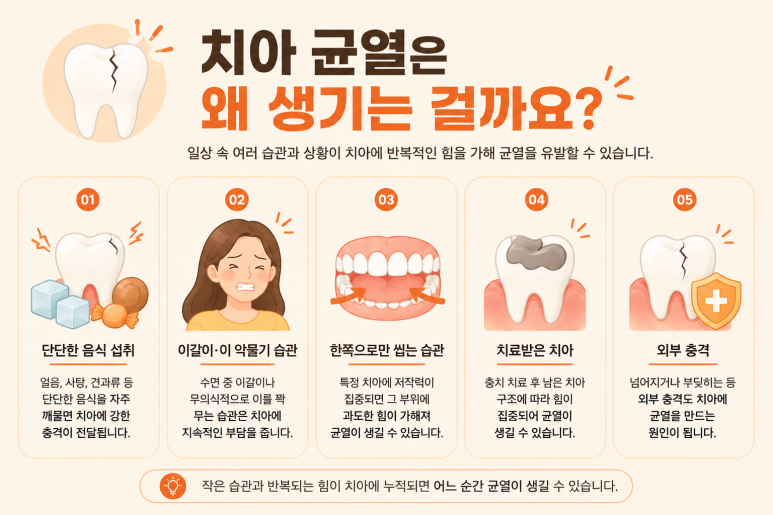
Why Do Teeth Crack?
Teeth withstand countless chewing forces every day. A crack may form from a single strong impact, but fine cracks can also develop as forces repeatedly applied over a long period accumulate.
- Frequently chewing hard foods
The habit of frequently biting down on hard things such as ice, hard candy, nuts, or foods containing bones can suddenly transmit strong force to the teeth.
Especially when unexpectedly biting down forcefully on a hard object, the force may become concentrated in one area, causing the tooth to crack or part of it to break.
- Grinding or clenching your teeth
Grinding your teeth while sleeping or unconsciously clenching them tightly during the day can also place continuous strain on the teeth.
Rather than applying force through a single impact, these habits repeatedly transmit force to the teeth and may contribute to the formation of fine cracks over a long period.
- Chewing only on one side
When you always chew food in the same direction, chewing forces may become concentrated on specific teeth.
If this habit continues for a long time, the teeth on the frequently used side repeatedly receive substantial force, which can lead to strain such as tooth cracks or wear.
- Teeth that have already been treated
When part of a tooth has been removed through treatment such as cavity treatment and the tooth has received restorative treatment such as a composite resin filling or inlay, the way force is transmitted may vary depending on the remaining natural tooth structure and its shape.
In particular, force may become concentrated on the remaining tooth structure when a large portion of the tooth has been restored. It is therefore important to assess the current condition of both the tooth and the restoration.
- External impact
A tooth can also crack because of an accident such as falling or bumping into something, or an impact sustained during exercise.
Even if the tooth has not immediately broken or fallen out, if a specific tooth continues to feel uncomfortable when chewing after an impact, it is necessary to check whether internal damage has occurred.
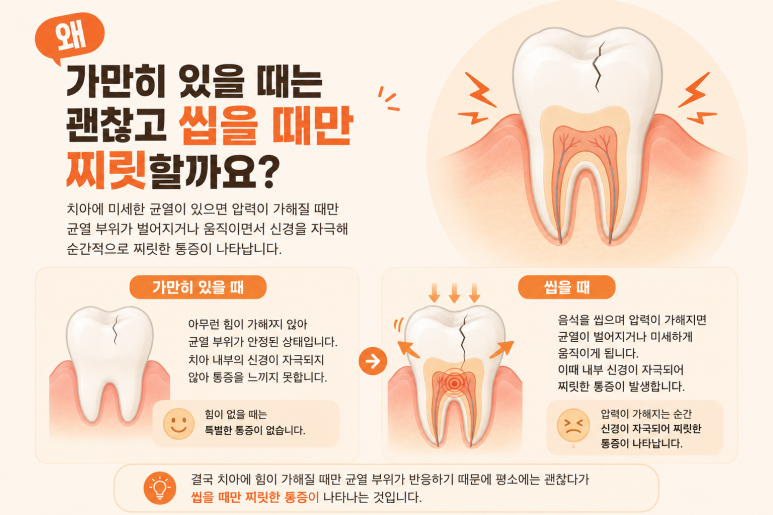
Why Does It Feel Fine at Rest but Sharp Only When Chewing?
One characteristic symptom of a cracked tooth can be pain that occurs momentarily when chewing.
When no force is normally applied, there is little movement in the cracked area, so you may not feel any discomfort.
However, when pressure is placed on the tooth while chewing food, slight movement can occur in the cracked area and stimulate the inside of the tooth.
For this reason, instead of pain that continues throughout the day, sudden sharp or stabbing pain may occur when chewing certain foods.
The pain may also occur only when chewing in a particular direction or eating hard and chewy foods, rather than with every type of food.
Some people feel pain at the moment they release the force after biting down, making them feel that they cannot identify exactly which tooth hurts.
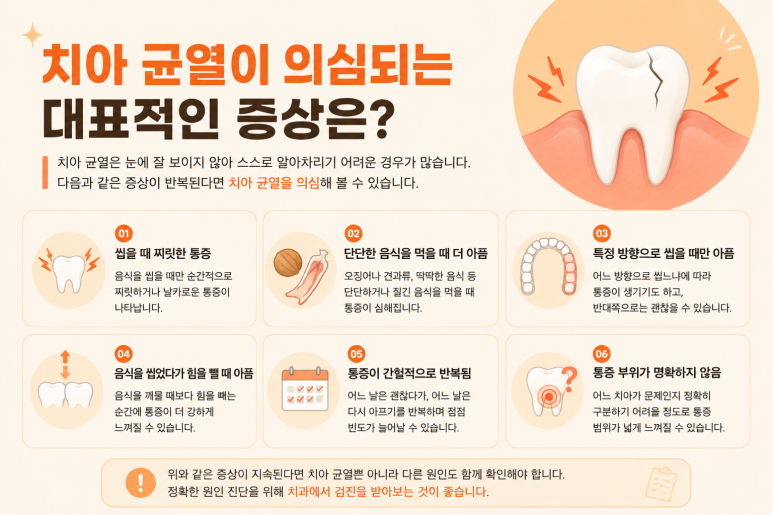
What Are the Typical Symptoms That May Suggest a Cracked Tooth?
The symptoms of a cracked tooth can vary depending on the location and depth of the crack.
Typical symptoms include momentary pain in a specific tooth when chewing food or pronounced pain when chewing something hard.
Pain may occur when chewing food in a particular direction even though everything feels fine normally. A symptom that initially appeared occasionally may also gradually recur more often over time.
If the following symptoms repeatedly occur, it is advisable to have the condition of the tooth checked:
-
The tooth feels fine normally but suddenly hurts when chewing.
-
Pain occurs when eating hard or chewy foods.
-
It hurts only when chewing in a particular direction.
-
There is momentary pain after biting down on food and then releasing the force.
-
It feels fine on some days, but the pain returns on others.
-
Discomfort when chewing is gradually becoming more frequent over time.
However, these symptoms alone cannot confirm a cracked tooth, so it is necessary to distinguish it from other possible causes.
Pain When Chewing Does Not Always Mean a Cracked Tooth.
A sharp sensation in a tooth when chewing can also occur because of tooth decay, gum problems, or an abnormal bite.
Pain when chewing may occur when deep tooth decay is irritating the inside of the tooth or when there is inflammation in the gums or tissues surrounding the tooth.
If a specific tooth has felt uncomfortable when chewing since recently receiving treatment such as a composite resin filling, inlay, or crown, along with the sensation that it contacts first, it may also be necessary to check the bite.
Similar symptoms may occur if an existing restoration or prosthetic appliance has become damaged with age or if a problem has developed between the tooth and the restoration.
Therefore, rather than simply concluding, “It feels sharp when I chew, so the tooth must be cracked,” it is important to examine the tooth and gums, previously treated areas, bite, and other factors together.
How Is a Cracked Tooth Identified?
A cracked tooth is not always as easy to see as an ordinary cavity. In particular, if the crack is very fine or has formed toward the inside of the tooth, it can be difficult to identify simply by looking at the tooth in a mirror.
At a dental clinic, the first step may be to determine when the pain occurs and whether it appears when chewing with a specific tooth.
The condition of the teeth and gums may be examined, and when necessary, a comprehensive evaluation may include X-rays, an assessment of the bite, and tests that apply stimulation to the tooth to observe its response.
The important point is not merely to check whether a crack is visible on the tooth’s surface, but also to assess the location of the pain, the extent of the crack, and the condition of the tissues inside the tooth.
What Happens If a Cracked Tooth Is Left Untreated?
A crack in a tooth does not naturally rejoin over time like a wound on the skin.
If you continue using a cracked tooth, force is repeatedly transmitted to it each time you chew food. During this process, the extent of the crack may change, and the internal tissues of the tooth may also be affected.
Pain that initially occurred briefly only when eating hard foods may gradually become more frequent, or discomfort may begin to occur even during ordinary meals.
Depending on how far the crack progresses, it may affect the nerve inside the tooth and may also lead to a fracture in which part of the tooth breaks off.
Therefore, rather than waiting until the pain becomes severe, it is important to identify the cause when recurring symptoms first appear.
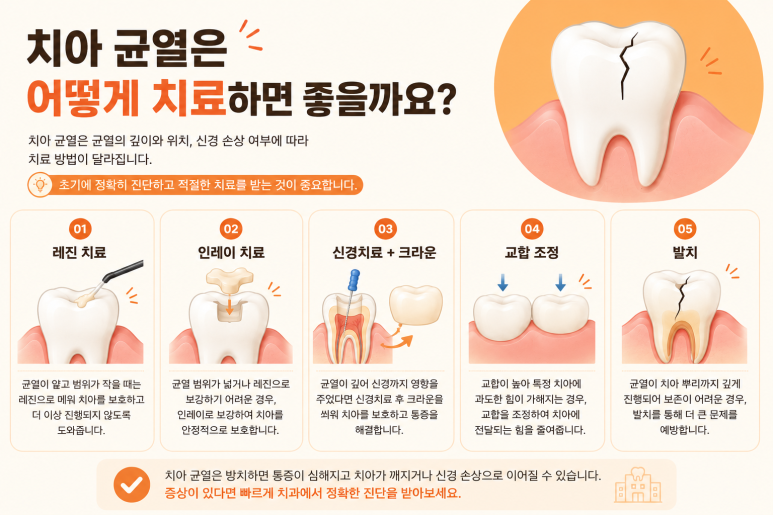
How Should a Cracked Tooth Be Treated?
Treatment for a cracked tooth is not the same in every case.
The treatment approach may vary depending on where the crack has formed, how deeply it extends, and whether it has affected the nerve inside the tooth.
If the crack is relatively shallow and there is no significant problem inside the tooth, treatment to protect the tooth and reduce further damage may be considered.
On the other hand, if the crack is deep and has affected the nerve, root canal treatment may be necessary. Prosthetic treatment such as a crown may then be considered to protect the remaining tooth structure.
If the crack has progressed deeply toward the tooth root and the tooth is difficult to preserve, extraction may also be necessary in some cases.
Therefore, a crown or root canal treatment is not automatically performed simply because a tooth has cracked. It is necessary to determine the appropriate treatment approach after assessing the current condition of the tooth and the extent of the crack.
Repeated Tooth Pain When Chewing,
Have the Cause Checked at S Leader Dental Hospital
A single sharp sensation in a tooth during a meal does not necessarily mean that the tooth is cracked.
However, if the same tooth repeatedly feels sharp every time you chew even though it normally feels fine, or if pain occurs particularly when eating hard foods, it is worth checking whether the tooth has a fine crack.
Cracks in teeth are often difficult to see, and pain may be intermittent in the early stages, making it easy to leave the problem untreated for a long time because “it feels fine now.”
However, it is difficult to judge the condition of a tooth based only on the severity of the pain. The appropriate care and treatment may differ depending on whether the crack is small or extends into the interior of the tooth.
S Leader Dental Hospital, a Songjeong-dong dental clinic, emphasizes that when pain repeatedly occurs while chewing, it is important to investigate the cause by considering not only a cracked tooth but also various possibilities, including cavities, gum condition, existing restorations and prosthetic appliances, and the bite.
If a tooth that was previously fine has started to bother you every time you chew, please have its current condition checked rather than simply enduring it by chewing only on the opposite side.



Songjeong-dong Dental Clinic :: S Leader Dental Hospital