Hello, this is S Leader Dental Hospital, a Gwangjin-gu dental implant clinic celebrating its 22nd anniversary since establishment this year.
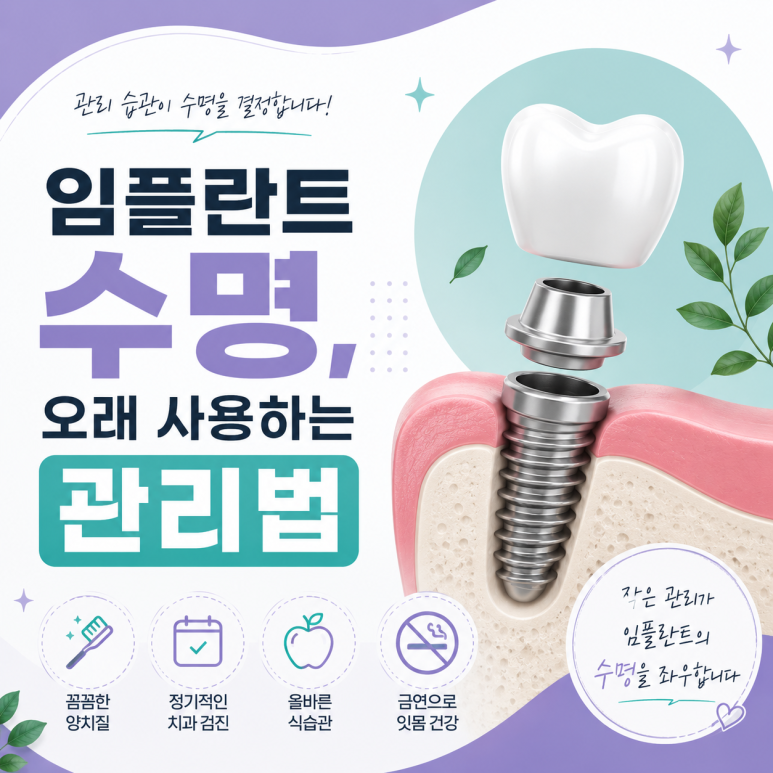
Implants are one treatment option to consider when restoring function and appearance after tooth loss. They allow you to chew food similarly to natural teeth and have the advantage of requiring little alteration to the surrounding teeth, which has made them a relatively familiar dental treatment today.
However, those preparing for implant treatment or who have already undergone treatment may have wondered at least once:
“Can dental implants be used for life once they are placed?”
Implants are designed for long-term use, but they do not remain in place for life without any additional care simply because treatment has been completed. Even among people treated at the same time, the maintenance period can vary depending on their oral condition, lifestyle habits, and whether they receive regular care.
Just as important as the durability of the implant itself is the health of the gums and jawbone supporting it.
Therefore, from the time treatment is completed, how well you care for the implant becomes important.
Today, S Leader Dental Hospital, a Gwangjin-gu dental implant clinic, will take an in-depth look at how long implants generally last and what you should pay attention to in order to use them comfortably and healthily for a long time.
How long do dental implants last?
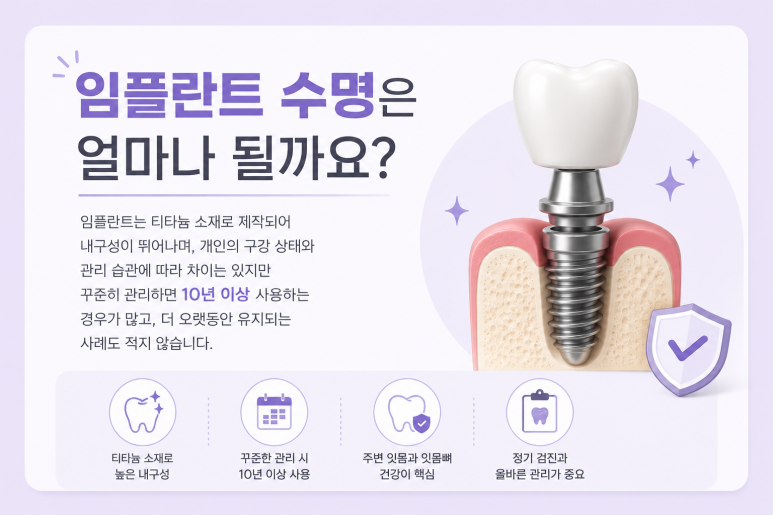
Dental implants generally consist of an artificial tooth root placed in the jawbone and a prosthesis that replaces the shape of the tooth.
The artificial tooth root placed in the jawbone is usually made of titanium. It forms a stable connection with the jawbone and performs a role similar to that of a natural tooth root.
Although the period varies depending on a person’s oral condition and care habits, implants are often used for 10 years or longer when properly maintained, and may last even longer depending on their condition.
However, it is difficult to define the “lifespan” of an implant simply as a certain number of years.
This is because various factors can have an effect, including the implant’s location, the condition of the jawbone, oral hygiene care, chewing force, habits such as teeth grinding or clenching, smoking, and whether regular checkups are received.
In addition, even if there is no problem with the implant itself placed in the jawbone, the prosthesis connected above it may become worn or damaged through long-term use. Therefore, it is necessary to check the condition of both the prosthesis and the implant itself.
Above all, the most important thing is to keep the tissues surrounding the implant healthy.
Implants can also develop gum inflammation.
“Since implants cannot develop cavities, wouldn’t it be okay if my care is a little inadequate?”
Some people may think this way.
It is true that, unlike natural teeth, implants do not develop cavities. However, that does not mean they are completely free from oral diseases.
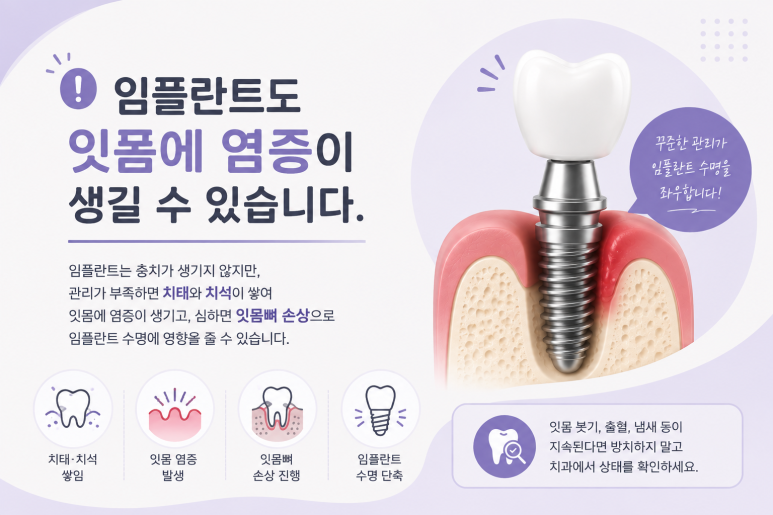
If brushing is not performed properly, plaque and tartar can build up around the implant as well. If this condition continues, inflammation may develop in the surrounding gums, and in severe cases, even the jawbone supporting the implant may be affected.
This is commonly called peri-implantitis.
It may begin with symptoms such as swollen gums or bleeding when brushing, but if inflammation progresses and damages the jawbone, it may become difficult for the implant to remain stable.
Therefore, rather than neglecting care because “implants do not develop cavities,” consistent oral care is needed just as it is for natural teeth.
How to care for implants for long-term use
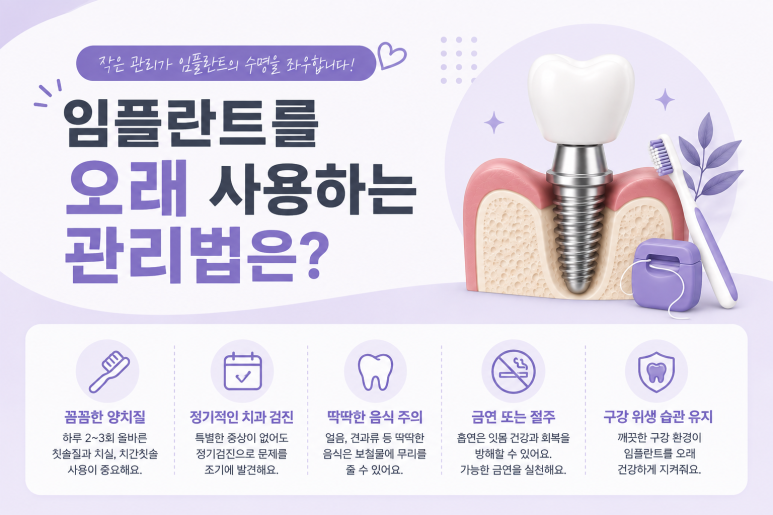
1. Thorough brushing is essential.
The most basic part of implant care is, of course, brushing every day.
After meals, carefully brush away food particles and plaque so they do not remain around the boundary between the implant and the gums. In particular, the area where the prosthesis meets the gums is easy to overlook, so it should be cleaned with extra care.
Brush properly two to three times a day. For the spaces between teeth and around implants that are difficult to clean with a toothbrush alone, it can also be helpful to use oral care products such as dental floss or an interdental brush.
However, using an interdental brush that is excessively thick for the space between your teeth may irritate the gums. It is advisable to check the appropriate size and usage method for you.
2. Regular checkups are recommended even when there is no discomfort.
To use implants for a long time, it is important to visit the dentist regularly and have their condition checked even when there are no particular symptoms.
This makes it possible to check whether tartar is building up around the implant, whether inflammation has developed in the gums, and whether the prosthesis has been damaged or become loose.
In particular, inflammation around an implant may not cause noticeable pain in its early stages.
If you postpone checkups for a long time, thinking, “It’s probably fine because it doesn’t hurt,” a problem may only be discovered after it has progressed.
Therefore, rather than thinking that dental visits end when treatment is completed, it is better to consider regular checkups an extension of implant treatment.
3. Be careful with excessively hard or chewy foods.
Although implants allow you to chew most foods, they are not immune to damage from every type of force.
Repeatedly biting down on ice out of habit or chewing very hard nuts and foods as hard as bones can place stress on the implant prosthesis.
In particular, if you have a habit of chewing only on one side, force may become concentrated in a specific area.
If this habit continues for a long time, the prosthesis may wear down or break, and problems may occur at the connection points. Therefore, it is advisable to use both sides of your teeth in a balanced manner whenever possible.
To use implants for a long time, you need to pay attention not only to oral care but also to your usual chewing habits.
4. Check for teeth grinding or clenching habits.
If you grind your teeth while sleeping or unconsciously clench them during the day, continuous strong force may be transmitted to the implant and prosthesis.
These habits are often difficult to recognize on your own.
If the area around your jaw feels stiff when you wake up or your teeth tend to wear down frequently, it is a good idea to have these issues checked during a dental examination as well.
If necessary, after checking your oral condition and habits, methods to reduce the burden placed on the implant may be considered.
5. It is advisable to reduce smoking as much as possible or quit.
Smoking is one of the lifestyle habits that can affect implant care.
Tobacco can negatively affect the health of gum tissue and the healing process, and may also affect the risk of inflammation developing around the implant.
Quitting smoking is especially important immediately after implant surgery, when the gums and jawbone are recovering.
Even after treatment is complete, if you want to keep your implants healthy for a long time, it is advisable to quit smoking whenever possible.
Implant prostheses also need to be checked.
When people think of implant care, they may easily focus only on the artificial tooth root placed in the jawbone. However, the part used directly when chewing food is the prosthesis above it.
Because the prosthesis is also repeatedly subjected to chewing forces over a long period, it may wear down or break over time, and the connection points may become loose.
Therefore, if chewing feels different from before or food suddenly starts getting stuck frequently, it is better to have the condition checked rather than dismissing it as a minor inconvenience.
Early detection may make it possible to check or adjust only the necessary parts, which is why regular examinations are important.
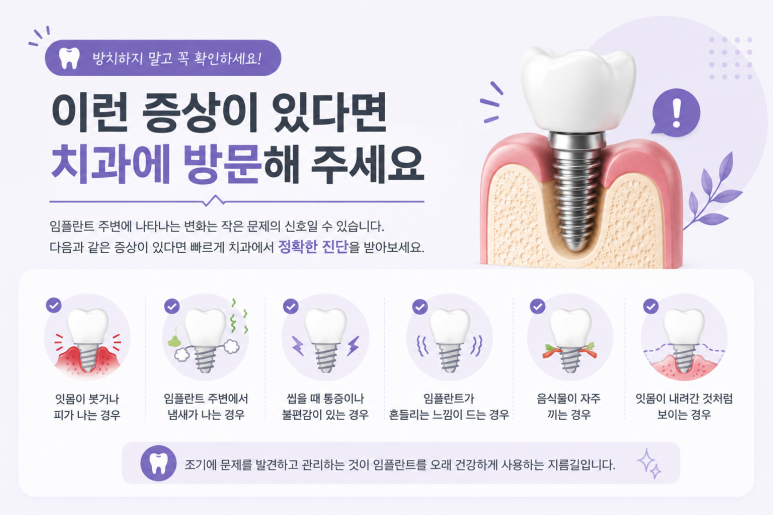
Please visit a dentist if you experience these symptoms.
If you notice changes that differ from usual while using an implant, it is best not to leave them untreated.
In particular, if you experience any of the following symptoms, the condition of the implant and surrounding tissues should be checked.
-
The gums around the implant are swollen or bleed when brushing.
-
You notice an odor or unpleasant taste around the implant.
-
Pain or discomfort occurs when chewing food.
-
Food gets stuck more frequently than before.
-
The prosthesis feels loose or seems to move.
-
The gums around the implant appear to have receded.
These symptoms can occur for various reasons, ranging from simple gum irritation to problems with the prosthesis or inflammation around the implant.
Since it is difficult to determine the exact cause based on symptoms alone, if the discomfort persists, it is advisable to visit a dentist and have your current condition checked.
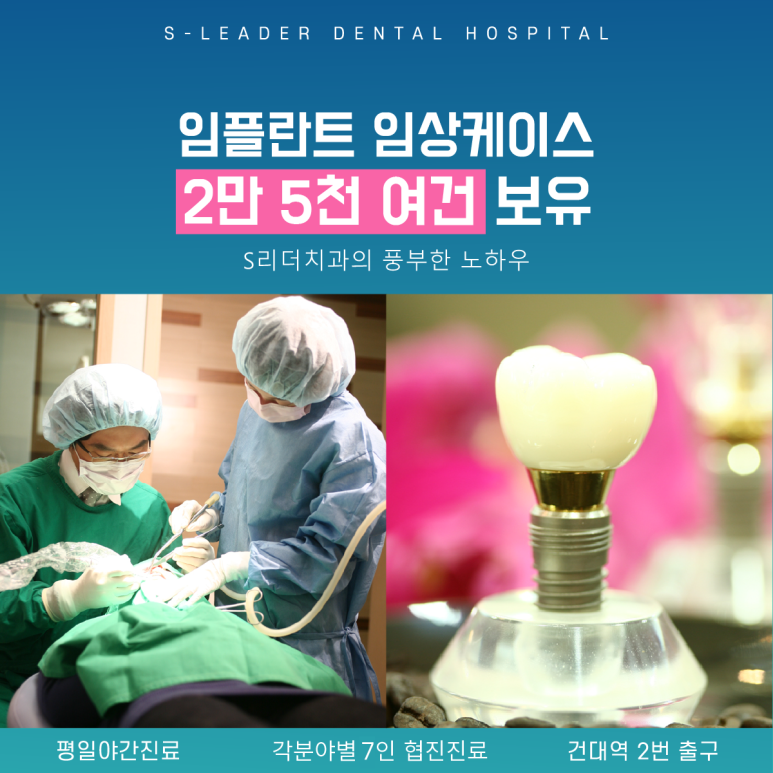
For long-term use of Gwangjin-gu dental implants,
check your care routine with S Leader Dental Hospital.
Implants are a treatment option that helps restore the function of lost teeth and allows them to be used for a long time, but care after treatment is also important.
Just as consistent oral care and regular checkups are needed to keep natural teeth healthy, it is also advisable to continue monitoring the condition of the gums surrounding the implant and the prosthesis.
In particular, developing a habit of thoroughly caring for the area around the implant, receiving regular dental checkups, and avoiding excessively strong force in daily life may help you use the implant healthily for a long time.
Even if you have no particular discomfort, if you have been using the implant for a long time or notice changes from usual, such as gum bleeding, an odor, or discomfort when chewing, it is advisable to have the condition checked.
At S Leader Dental Hospital, a Gwangjin-gu dental implant clinic, we continue to examine the condition of the implant, surrounding gums, and prosthesis after treatment and help provide ongoing follow-up care.
Since implant care does not end with a single treatment and must continue afterward, we hope you will use your implants healthily for a long time through regular checkups and proper care habits.

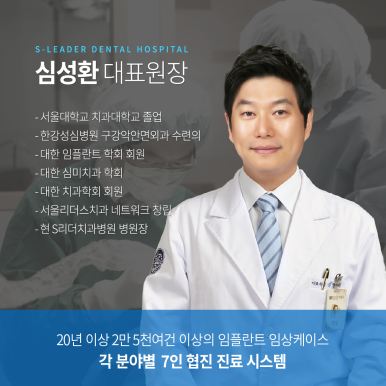


Gwangjin-gu Dental Implants :: S Leader Dental Hospital