
Hello. We are Mary Plastic Surgery Clinic, which pursues natural and beautiful changes.
Each facial feature has its own function.
Beyond that, shape and proportions can influence the overall impression and refine the aesthetic feel.
Among them, the nose is one of the areas that creates facial dimension.
For that reason, many people consider the front and side angles of the face as they adjust the angle and line of the nose.
In particular, plastic surgery has traditionally been attempted more often by women, but nowadays men are also investing in improving their appearance.
Because the nose not only contributes to facial dimension, but changes in its shape, angle, and proportions can create a more distinct and defined image, it is highly preferred regardless of gender.
In the case of men, you need to undergo surgery while considering the male nose surgery ratios, which differ from those for women.
The focus should be on improving natural lines while maintaining a masculine look.
Also, compared with women, men tend to have thicker skin and larger cartilage and bone structure, so crooked noses, hooked noses, and bulbous noses are more likely to stand out.
Therefore, when undergoing nose surgery, it is important not simply to raise the height of the nose, but to proceed with customized nose surgery that also takes male nose surgery ratios into account.
What Are the Male Nose Surgery Ratios?

The surgical method for a male nose is not fundamentally different from the method used for women.
It is the same in that nose surgery must also consider functional aspects, but the planning for the appearance should be set with a different focus.
In particular, male nose surgery ratios are applied differently from the lines and angles preferred by women.
For women, the ideal proportions are often said to be an angle of 135–140° where the bridge starts between the eyebrows, and a nasolabial angle—the angle between the tip of the nose and the philtrum and lips—of 95–105°.
They also tend to prefer a thin nasal bridge with a soft curve and a nose tip that gives a raised, refined impression.
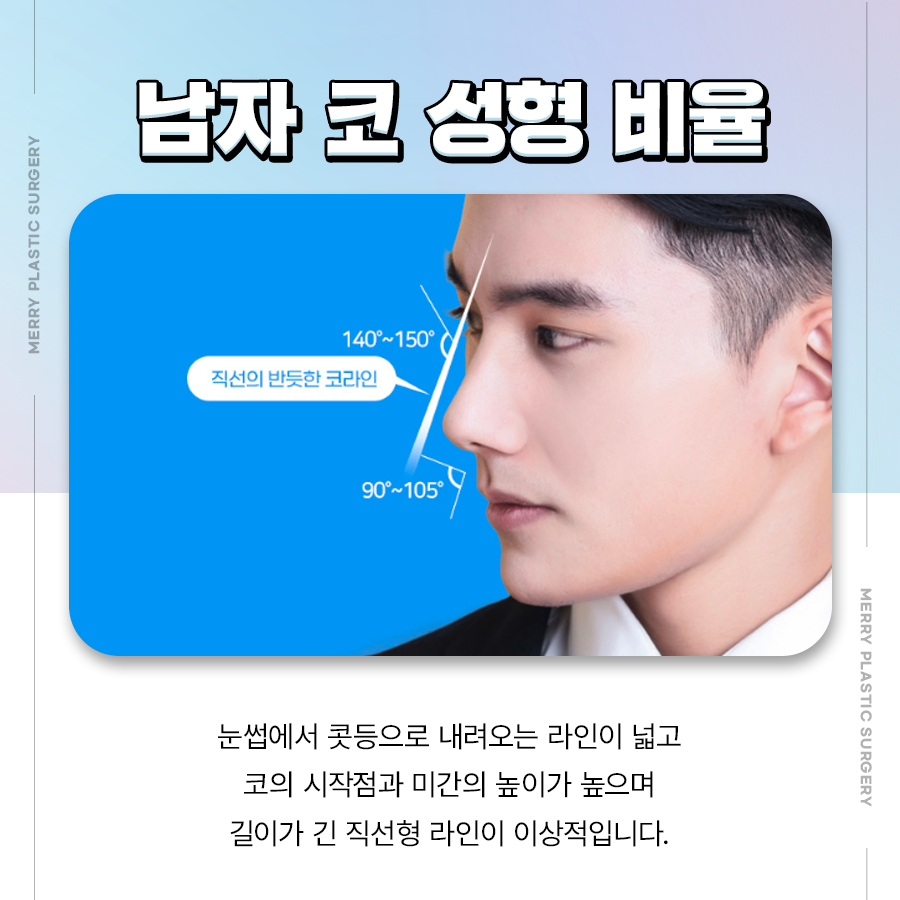
Then what are the male nose surgery ratios?
If a man’s nose has too much curvature, the impression may feel awkward and appear more feminine.
For that reason, people tend to prefer a moderate thickness and a straight, neat nasal line that brings out a sophisticated yet masculine feel.
Also, an angle of 140–150° at the starting point of the nose and a nasolabial angle of 90–105° can create an ideal line.
Looking for a Good Place for Male Nose Surgery?
There are points you should not miss when undergoing nose surgery, including male nose surgery ratios.

First, when performing nose surgery, the internal functional aspects of the nose must also be examined.
Many people focus on the appearance of the nose.
However, if the original function is not kept in mind when changing the shape and structure of the nose, breathing can become uncomfortable and other problems may arise.
Likewise, if there are existing functional defects due to structural issues, it is good to consider whether they can be improved at the same time through nose surgery.
In particular, men are more likely to have a bent nasal cartilage, a hooked nose with a bend, or a deviated septum, so correcting these together can provide both functional and aesthetic benefits.
At our clinic, we conduct detailed and precise analysis using devices such as 3D CT so that we can understand the internal structure of the nose and focus on creating a beautiful nose that is comfortable to breathe through.
Second, nose surgery should be done with a medical team that has extensive experience.
Not only for women’s nose surgery, but also for places with a lot of experience in male nose surgery, you can expect stable results.
Based on the medical team’s various experiences in reconstructing men’s noses and their anatomical knowledge, they are working to achieve results that preserve masculinity.
To produce results that are not simply a pretty nose from the front, but one that also considers the side profile, the face, and the proportions of the facial features from many angles, we recommend checking the medical team’s skill level.












Previous image
Next image