
Hello. We are Mary Plastic Surgery Clinic, pursuing natural and beautiful changes.
As we live our lives, there are things we tend to take for granted and forget how precious they are.
Among them, many people overlook the importance of the organs that allow us to sense the five senses.
Only when discomfort appears over time do we realize how precious they are.
A representative example is the nose, an organ located at the center of the face. It plays an important aesthetic role, but as an organ that breathes and supplies oxygen to the body, its importance is by no means secondary.
However, various problems can accompany the nose due to its shape or internal defects.
If breathing becomes difficult because of a defect, it can cause not only a feeling of stuffiness, but in severe cases, it can also lead to reduced concentration and headaches.
However, these functional defects of the nose can be improved by a method that also enhances nasal aesthetics.
Today, we will discuss the types of problems that can be treated with functional rhinoplasty, along with nasal turbinate reduction for rhinitis.
What is functional rhinoplasty?

Functional rhinoplasty is, as the name suggests, a surgery that improves functional nasal problems by changing the structure.
When breathing is difficult because of the structure of the nose, there are cases where both the inside and the outside can be improved at the same time.
Typical examples include hypertrophic rhinitis, nasal valve stenosis, and deviated septum.
A deviated septum refers to difficulty breathing when the septal cartilage and nasal bone that form the bridge of the nose are bent.
Since the nose is often visibly bent as well, it can be improved at the same time through correction of the bridge of the nose.
In the case of nasal valve stenosis, it refers to the empty space in the passage through which air moves inside the nose.
When this space narrows, breathing becomes difficult.
Likewise, rhinitis is characterized by the nasal mucosa swelling unusually due to various causes and remaining chronically swollen.
In mild cases of rhinitis, symptoms can be relieved through medication, but in severe cases, they can be improved with nasal turbinate reduction for rhinitis.
What is nasal turbinate reduction for rhinitis?
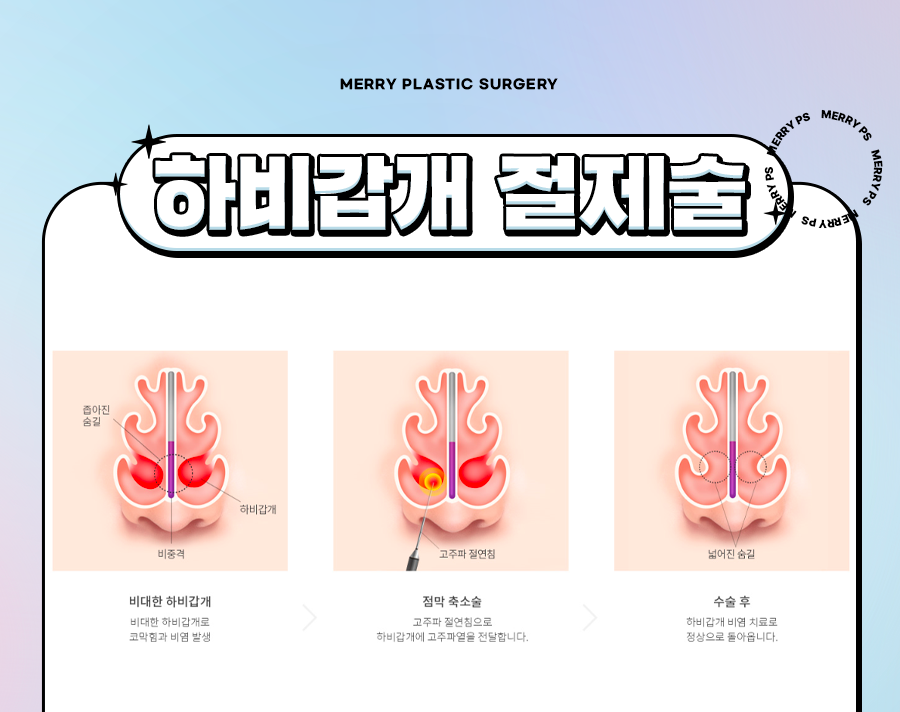
So how is nasal turbinate reduction for rhinitis performed?
It is a method that can improve cases where rhinitis or nasal congestion occurs because the inferior turbinate mucosa has thickened due to repetitive inflammation or structural problems such as a deviated septum.
By osteotomizing the inferior turbinate outward to widen the airway and condensing the mucosa with radiofrequency to reduce the inferior turbinate, it can help smooth the flow of air while breathing.
At this time, the radiofrequency device used to condense the mucosa after nasal turbinate reduction for rhinitis is used to remove the mucosa or tissue and apply radiofrequency to reduce its size.
Unlike simple lasers or cautery devices, it has the advantage of treating while protecting normal mucosa as much as possible without burning even healthy tissue.
Nevertheless, because the nose is a very small and delicate area that requires surgery, it is important to visit a clinic with extensive experience in nasal turbinate reduction for rhinitis.
Where is a good place for nasal turbinate reduction for rhinitis?

At Mary Plastic Surgery Clinic, which introduced nasal turbinate reduction for rhinitis today, we have extensive experience in various functional rhinoplasty procedures and can expect stable results based on anatomical knowledge.
Through 3D CT and nasal endoscopy, we determine whether a disease is present and strive to create a nose that is both aesthetically pleasing and comfortable to breathe through by improving nasal conditions and shape at the same time.
By improving nasal deviation and nasal congestion at the same time, stable results can be expected.
Such rhinoplasty should be performed differently depending on each person's nasal condition.
At our clinic, we conduct thorough consultations for customized one-on-one surgery, so if you want to know exactly what problems your nose has, we recommend visiting for an examination.
Thank you.














Previous image
Next image