
Hello, we are Mary Plastic Surgery Clinic, pursuing natural and beautiful changes.
The nose, located at the center of the face, not only determines the balance of the facial features but also plays a role in adding dimension to the face.
For that reason, people considering plastic surgery for a more aesthetic nose have been increasing at a pace comparable to eyelid surgery.
In particular, a straight, lifted nose is something desired by both men and women, so the proportion of male patients seeking plastic surgery was also quite high.
What Is the Ideal Nose?

In the past, when people hoped to have nose surgery, they often focused only on a high, straight nose shape.
Today, many people recognize the importance of a nose that preserves individuality while also harmonizing aesthetically with the face.
Therefore, to achieve the ideal nose shape, it is necessary not only to consider the nose’s length, width, height, and angle, but also to adjust the balance with the face and the desired image in order to expect a stable result.
For that reason, it was especially important to undergo rhinoplasty with medical staff who have diverse experience.
The nose is also an area with many blood vessels and nerves, so caution is necessary, but if it is considered only for cosmetic purposes, it is one of the surgeries that can lead to side effects.
In addition, rhinoplasty may use implants depending on the need.
If capsular contracture occurs because the implant is recognized as a foreign body, reconstructive surgery is needed to improve the condition.
What Is Capsular Contracture?

Capsular contracture refers to a side effect in which, after inflammation caused by an implant, the skin becomes hard and contracts, causing the nose to become elevated.
When a foreign body enters the body, our body surrounds it with a capsule to isolate it.
If an implant is recognized as a foreign body, inflammation can occur along with capsule formation.
At this time, if the surrounding tissues contract, capsular contracture can occur, causing the nose to lift and become shorter.
When this side effect occurs, the shortened nose can be reconstructed through lengthening of the contracted nose.
Who Is a Candidate for Revision Surgery for a Contracted Nose?
✅ When inflammation occurs after nose surgery
✅ When the nasal tip is severely lifted and deformed
✅ When the nostrils are twisted or pinched
✅ When the nasal tip becomes hard and gradually deforms
✅ When an implant protrudes from the nasal tip after nose surgery
How Is Contracted Nose Lengthening Performed?
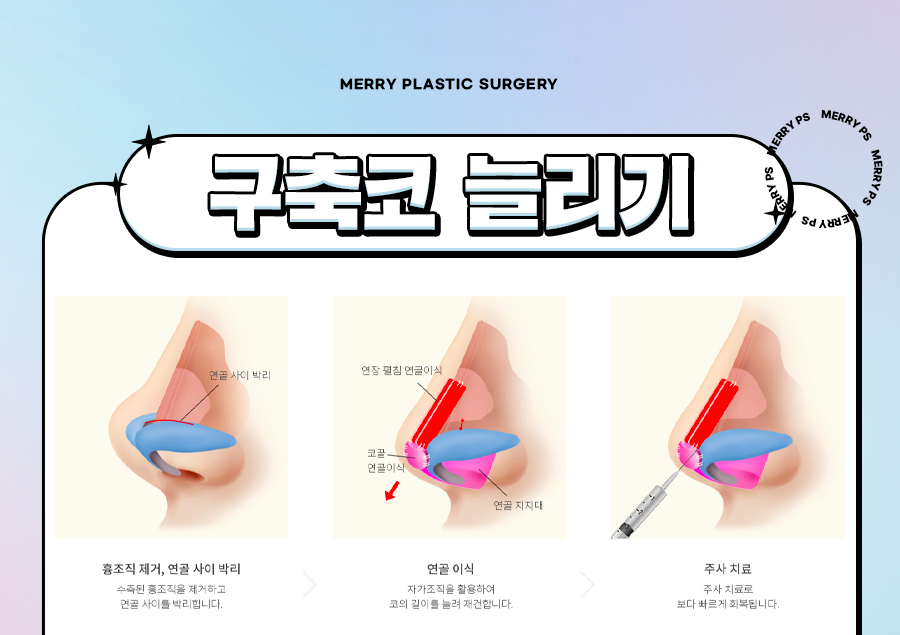
In general, contracted noses can be treated by removing the contracted scar tissue and using autologous tissue to perform lengthening of the contracted nose.
Stable care through injection treatment can help sufficiently stretch the internal cartilage structure and tissue of the nose.
Contracted Nose Lengthening: When Should It Be Done?
In general, capsular contracture is one of the symptoms that can occur when inflammation becomes chronic.
In such cases, it is important to first control the inflammation before lengthening the contracted nose.
After removing all causative foreign bodies, attention should be focused on relieving the inflammation.
Surgery should be performed when inflammation and contraction have been eased and there is room for the skin to extend.
Because surgery should be performed in a nose condition that is smoother and less likely to develop the same problem again, stem cell treatment may be used to loosen and stretch hardened skin.
What Is Mary’s Reconstructive Surgery for a Contracted Nose?

At our clinic, we explain that revision nose surgery should be performed after analyzing the cause of the first surgery’s failure and after sufficient recovery.
To prevent recurrence of the same problem, the source must be addressed and the nose’s condition must be restored as much as possible before reconstruction.
At Mary Plastic Surgery Clinic, we strive to make this the final surgery that does not lead to contracture by using autologous tissue and meticulous correction.
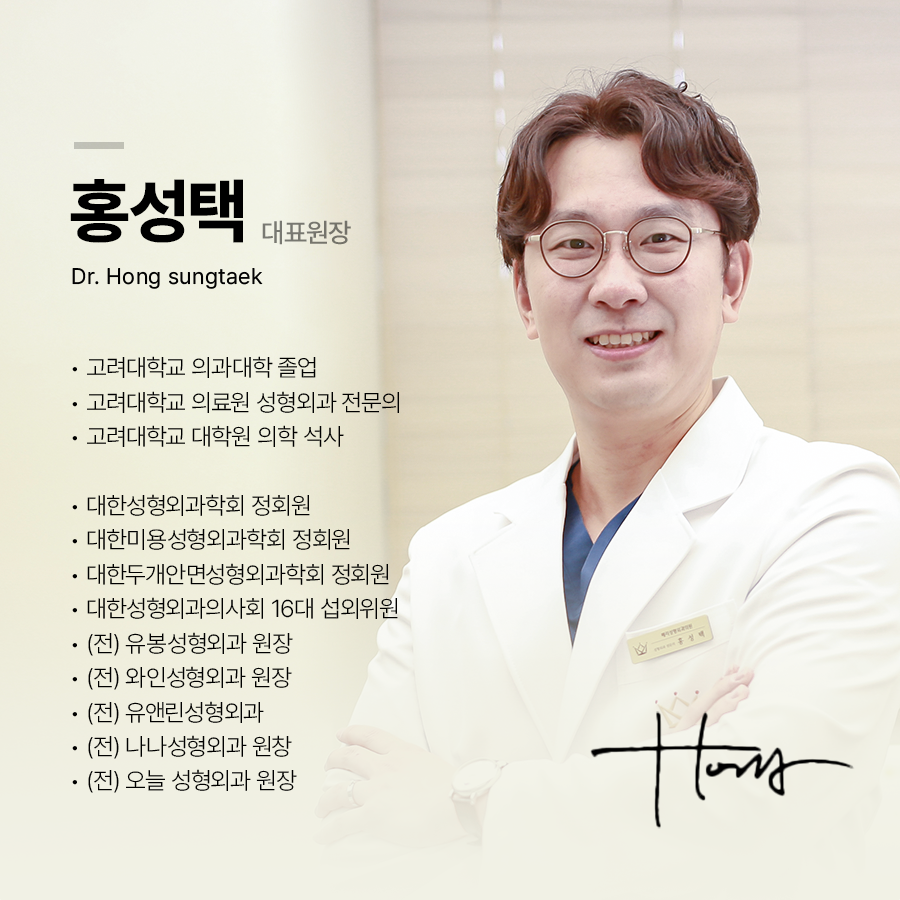
Dr. Hong Seong-taek, the chief director and a board-certified plastic surgeon, has extensive surgical experience and anatomical knowledge, and based on this, stable results can be expected.














Previous image
Next image