
When undergoing rhinoplasty, artificial implants are commonly used to create the desired height and shape of the nose. However, for people who have difficulty using implants or who are concerned about the foreign-body sensation from implants, there is also a method of achieving a natural-looking rhinoplasty using autologous tissue. This kind of autologous tissue can also be used in nose revision surgery to help reconstruct a deformed or damaged nose shape.
Among these, rib cartilage is one of the autologous materials most often used in rhinoplasty and revision surgery because it allows a larger amount of cartilage to be obtained compared with other autologous tissues. At Mary Plastic Surgery Clinic, we design a firm yet elegant nose line using rib cartilage so that self-rib cartilage revision surgery here can be your last.
What Is Rib Cartilage?

Rib cartilage refers to the autologous tissue used in self-rib cartilage nose revision surgery and rhinoplasty, meaning the cartilage from the ribs. The human body has 12 ribs on each side, for a total of 24 ribs.
If you gently touch the area near the upper abdomen with your finger, you will feel a pointed bone. Rib cartilage is located where this rib meets the sternum.
When other autologous tissue materials are difficult to use, surgery may be performed using rib cartilage. In general, cartilage from ribs 5 through 10 is harvested and used in surgery.
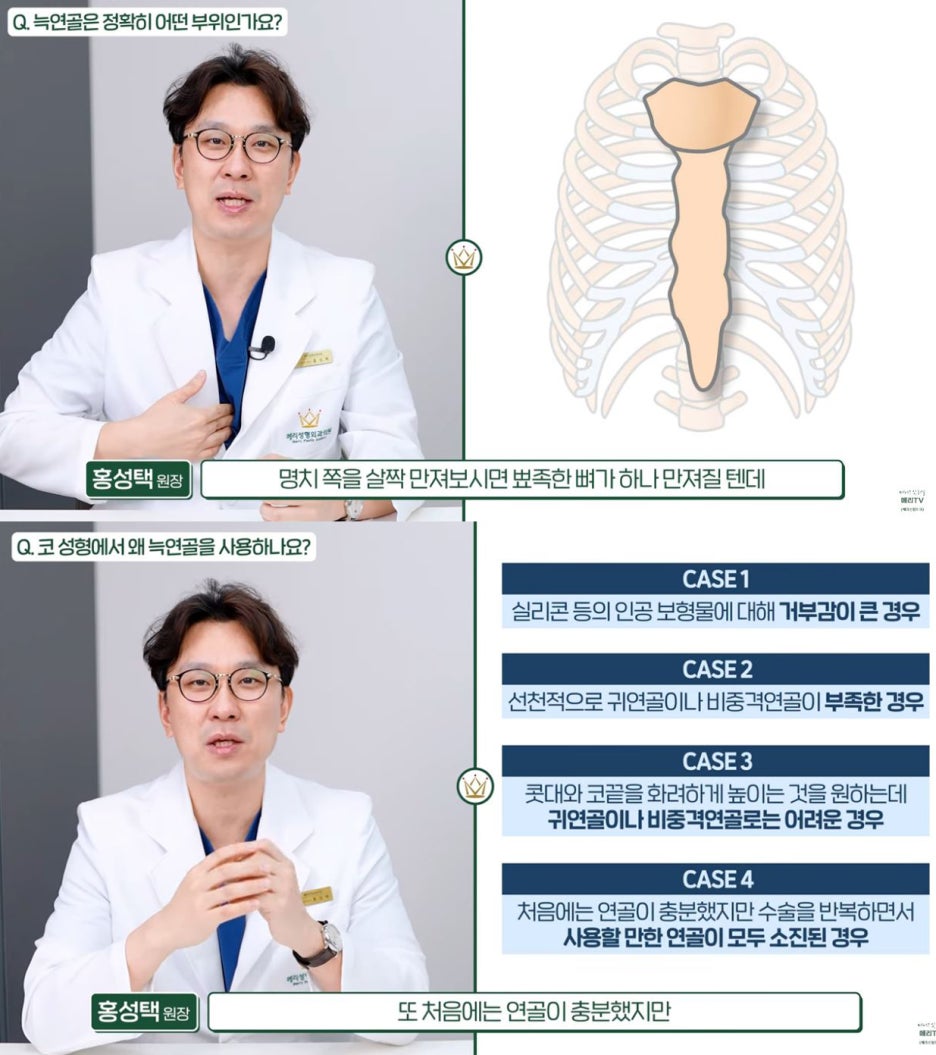
The amount harvested can vary depending on the patient’s condition, so the quantity collected may differ from person to person. The following people may want to consider rhinoplasty or revision surgery using rib cartilage:
✅ When there is reluctance about using artificial implants such as silicone
✅ When there is a congenital shortage of ear cartilage or septal cartilage
✅ When a high bridge and tip are desired but ear cartilage or septal cartilage alone is not enough
✅ When all usable cartilage has already been used, but repeated revision surgeries have exhausted the available cartilage
Mary Plastic Surgery Clinic’s
Self-Rib Cartilage Nose Revision Surgery
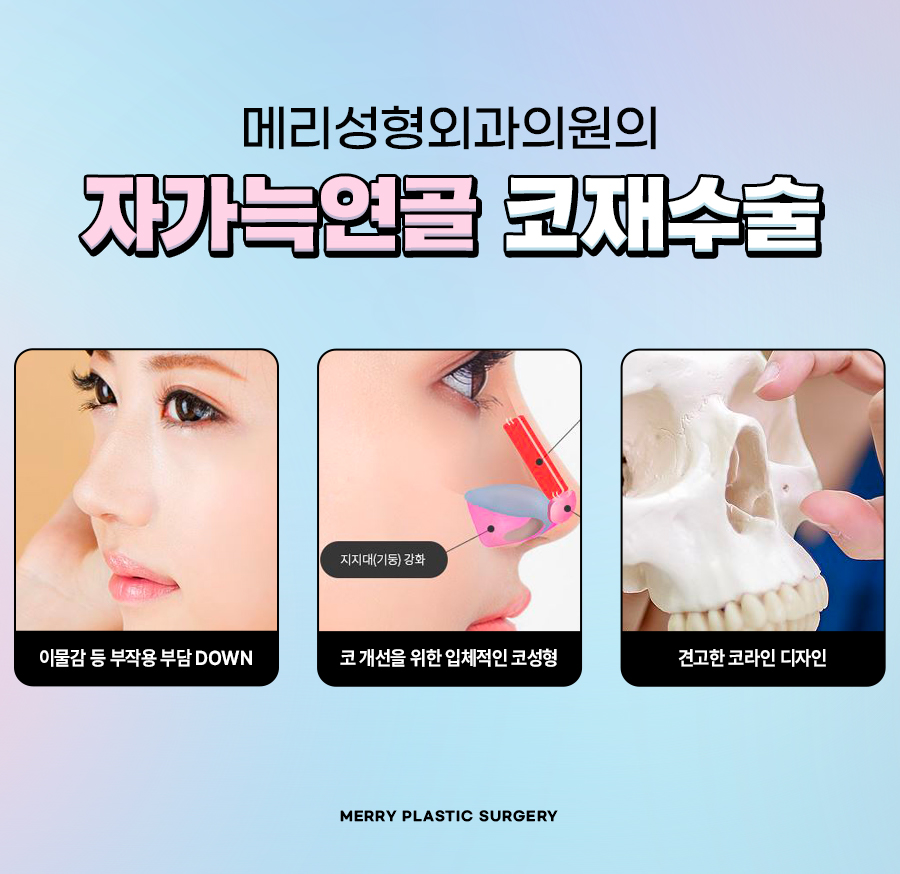
At Mary Plastic Surgery Clinic, self-rib cartilage nose revision surgery helps patients who are concerned about secondary nasal deformities caused by trauma or surgery improve the natural look of their nose line. When using rib cartilage, a separate surgical process is required in addition to rhinoplasty, so it is preferable to have the knowledge and technique of highly experienced medical staff supporting the procedure.
At our clinic, Board-Certified Plastic Surgeon Hong Seong-taek provides 1:1 customized nose revision surgery plans based on anatomical knowledge and extensive surgical experience, helping reduce the risk of side effects such as foreign-body sensation and allergic reactions while supporting rhinoplasty with a shape and feel that look natural to each patient.
✔ Lower burden of side effects such as foreign-body sensation and allergic reactions
✔ Three-dimensional rhinoplasty to improve a damaged nose bridge, tip, and more
✔ Firm nose line design with strong support
Mary Plastic Surgery Clinic’s
Diagonal Cutting of Self-Rib Cartilage
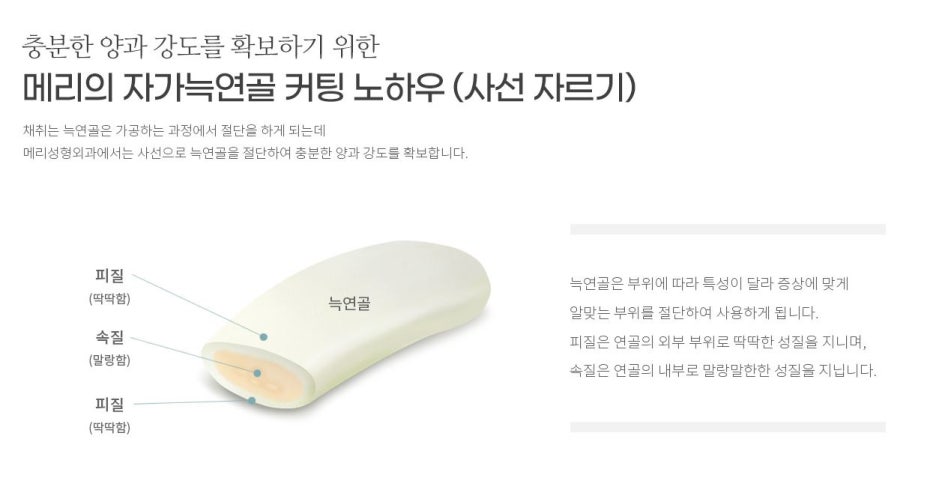
In our clinic’s self-rib cartilage nose revision surgery, we secure enough quantity and strength for each patient through a diagonal cutting method during the process of safely harvesting and processing rib cartilage.
The characteristics of rib cartilage differ by area, so the key is to cut and use the appropriate sections according to the symptoms. At our clinic, we help create a sufficient amount of strong rib cartilage pieces through diagonal cutting, supporting natural self-rib cartilage nose revision surgery.
Because the structure has the cortex surrounding the medulla, it is important to harvest and use each part appropriately according to its characteristics.
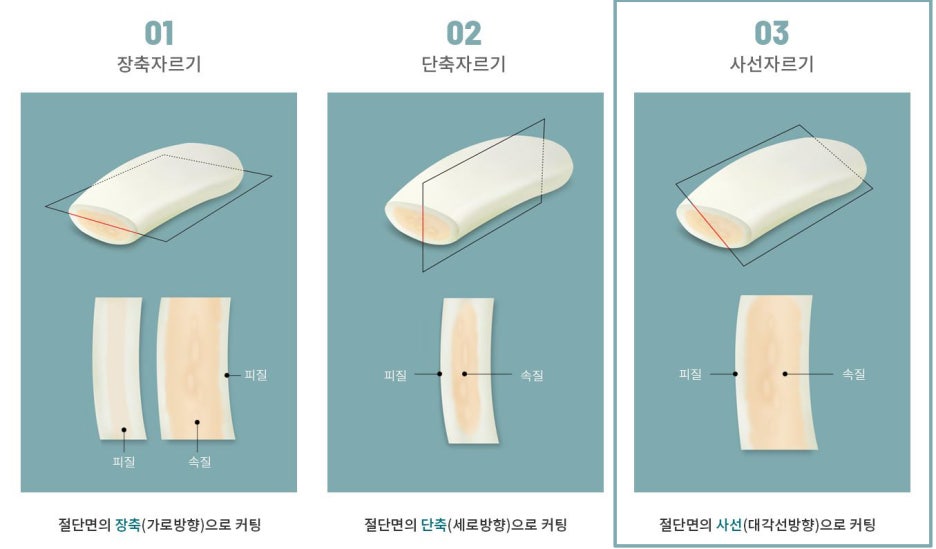
- Long-axis cutting
Cut in the horizontal direction of the cut surface. It can create deep and wide cartilage, but because the cortex and medulla differ, warping occurs easily.
- Short-axis cutting
Cut in the vertical direction of the cut surface. Because it can be harvested uniformly as cortex-medulla-cortex, it offers good strength and less warping, but the width is narrow, so its use is less flexible.
- Diagonal cutting
Cut in a diagonal direction across the cut surface. This method complements the two cutting methods above and can create rib cartilage pieces that are both strong and wide enough.
With a Systematic Care System

At our clinic, we carefully check patients’ conditions even after rhinoplasty and revision surgery, working to reduce the risk of side effects and achieve stable surgical results.
In addition to the detailed consultation and customized surgical planning by our board-certified plastic surgeon, meticulous nose revision surgery is performed based on extensive surgical experience.
Putting patient safety first, we also carefully monitor patients with a systematic care system according to each stage so they can recover from swelling, scarring, and more after surgery. We hope you will experience rhinoplasty that is created through constant communication with patients from consultation, design, surgery, and aftercare at Mary Plastic Surgery Clinic.












 Previous image
Next image
Previous image
Next image




 Previous image
Next image
Previous image
Next image