Hello, this is Merry Plastic Surgery Clinic, delighted to meet you.
Today, I’d like to talk about the recovery after lower blepharoplasty and possible side effects.
We’ll look at why these side effects can happen after surgery,
how to prevent them,
and what to do if they do occur.

Recovery After Lower Blepharoplasty
The expected natural recovery after surgery is similar to the recovery after under-eye fat repositioning surgery.
First, swelling and bruising usually peak on days 2 to 3 and then gradually improve.
So, it helps to apply cold compresses for about 3 days, and after that, switching to warm compresses for the next 3 days can be very helpful in reducing swelling.

Possible Side Effects After Surgery
Stitches are usually removed about a week after surgery, and recovery speeds up after that.
However, because the skin and muscle are incised during the procedure, side effects can still occur.
The first is scarring.
Fortunately, the skin under the eyes is the thinnest area and the least likely to develop noticeable scars.
Also, because the incision is generally made just below the eyelashes, the scar is not very visible,
so there is probably no need to worry too much.
And
there is something even more important than a scar on the skin: side effects caused by muscle incision.
In particular, the orbicularis oculi muscle, located around the eyes, plays a role in closing, opening, and blinking the eyes,
draining tears into the tear duct, participating in facial expressions around the eyes when smiling, and maintaining tension in the tarsal plate,
so it is a muscle that does a great deal around the eyes.

Therefore, if this muscle is damaged or while it is recovering, discomfort may occur.
Even if symptoms appear from this kind of damage,
as time passes and muscle function gradually recovers, things improve, so please do not worry too much,
and consistent warm compresses and massage can help recovery happen more quickly.
Among the side effects that do not resolve on their own, the one that requires a hospital visit is ectropion.
After lower blepharoplasty, this is a condition in which the tarsal plate is turned outward.
It can occur when too much skin is removed and pulls downward,
when the tarsal plate has lost elasticity due to aging,
or when the orbicularis oculi muscle is damaged.
If ectropion occurs, it is not only aesthetically undesirable,
but the eye may not close completely, causing eye irritation, dry eye, and other discomforts.
During the preoperative consultation, the degree of elasticity should be carefully checked through tests that assess tarsal plate elasticity (Distraction test, Snap back test),
and during surgery, care should be taken not to remove too much skin,
while minimizing damage to the orbicularis oculi muscle so that ectropion does not occur.
Even if ectropion does occur, please do not worry too much.
In most cases, it often recovers naturally after about 3 months,
and warm compresses and under-eye massage can shorten the recovery time.
However, if it does not recover naturally over time,
ectropion can be corrected through tarsal strip surgery and lateral canthopexy.
That said, the recovery period can be quite uncomfortable, so it is better to prevent ectropion in advance if possible, right?
Next, double vision may occur.
There is a muscle called the inferior oblique muscle that moves the eyes outward and upward.
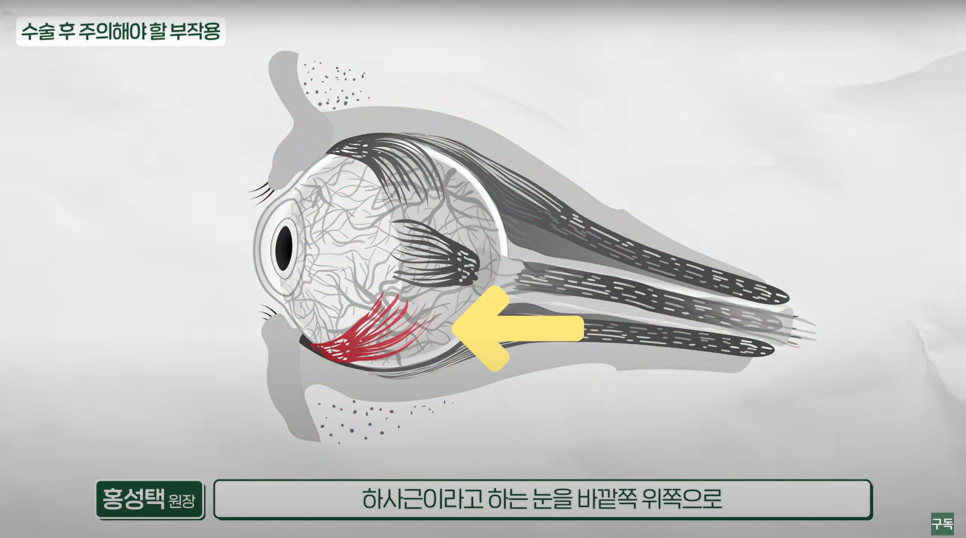
When fat repositioning is performed, this muscle cannot help but be affected to some extent.
It may feel more severe in people with hypothyroidism or those who are naturally born with weak muscles.
In most cases, the double vision improves over time,
but if the symptoms become more severe or persist, surgical treatment to release the muscles around the area may be needed, so you should contact the hospital.
Lastly, the most important emergency situation is orbital hematoma caused by bleeding.
This is a very, very important issue, so I hope those preparing for under-eye surgery will remember it.
A hematoma caused by bleeding in the eye is a very serious side effect that can even lead to blindness if treatment is delayed.
If the bleeding comes out externally, it is not a problem,
but if it gradually accumulates inside the eye, it compresses the optic nerve in the center of the eyeball.
If optic nerve compression continues, the optic nerve loses function and blindness can occur.
Therefore,
if one eye suddenly becomes abnormally and severely swollen, or if the eye pain is very severe and vision in one eye is poor,
!!! you must contact the hospital immediately. !!!

If, after evaluation by medical staff, it has progressed to an orbital hematoma,
rapidly removing the pooled blood and lowering the pressure inside the eye can allow normal recovery without any problems,
so if any abnormal symptoms are noticed, please be sure to contact the hospital promptly.
And like other surgeries, infection and inflammation can also occur.
Although they do not progress acutely, they still require treatment,
so you should definitely be examined by your attending physician and receive appropriate care.
Since I wanted to explain in detail what would be good to know before surgery, this post became quite long.^^;;
I’ll continue in the next post.
So far, this has been Merry Plastic Surgery Clinic.