Hello, this is Merry Plastic Surgery Clinic, always a pleasure to meet you.
There are many reasons why people start thinking about plastic surgery,
but I think the influence of people around them is especially significant.
When a friend who looked a lot like me comes back after vacation with a very pretty nose!!
From that day on, thoughts start taking over: Should I try plastic surgery too? Could my nose become that pretty too? Which hospital did she go to?
If a celebrity were to do it, who should I ask them to copy?
So many thoughts begin to dominate me.

Conditions of a nose that responds well to plastic surgery
Ah!! But before that, shouldn’t we first find out whether my nose is actually one that will do well with surgery, or one that won’t?
In my previous post, I talked about various ratios, conditions, ideal shapes, and more to consider when getting rhinoplasty,
but today, like a top instructor, I’ll cut straight to the point and tell you only the essentials.
I’ll start right away with the conditions of a nose that people are curious about—the kind that responds well to plastic surgery!
Condition 1: Skin
The first is skin.

More important than all the other conditions I’ll mention later, the very first thing is skin.
Why is skin so important?
If there is no cartilage, another type of cartilage can be used, and if the bridge is low, implants such as silicone can be used,
but as of now, there is no substitute for skin.
When consulting with patients, I half-jokingly and half-seriously say that we can raise the nose as high as Pinocchio’s~
But even if we raise it that much, the problem is that there is no skin to cover the elevated nose.
It’s not only the amount of skin that matters, but also its thickness.
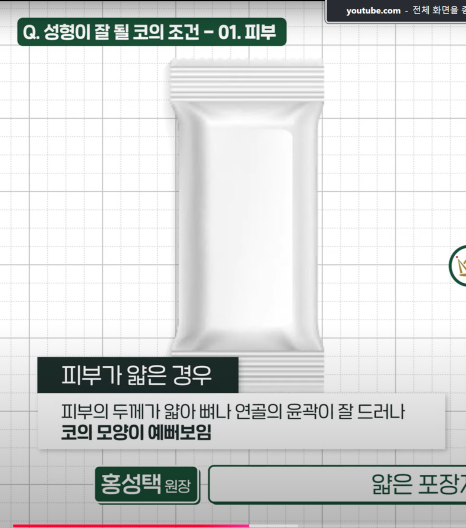
If you imagine wrapping an object,
you can think of the object as bone or cartilage, and the wrapping paper as skin.
If you wrap the object with thin wrapping paper, the shape of what’s inside will show through clearly,
but on the other hand, with thick wrapping paper, you can’t tell what’s inside at all, right?
So,
soft, stretchy skin
makes the carefully built framework made of cartilage or silicone show more clearly.
On the other hand, skin with blackheads, enlarged pores, and a firm, thick texture
makes the skin itself stand out, so it is difficult for the shape to come through well.

That said, thin skin is not automatically better either.
If the skin is too thin, implants or cartilage may become visible, so there can still be limitations.
Still, if you have to choose between the two, thin skin is somewhat better than thick skin.
That’s because you can insert dermis over the implant or cartilage to prevent it from showing through.
Condition 2: Cartilage
The second is cartilage.
People with well-developed cartilage that determines the shape of the nose tip have a higher chance of a big success with rhinoplasty.
The bridge area can usually be covered to some extent with artificial implants such as silicone,
but the shape of the nose tip depends on the shape of the alar cartilage located beneath the nasal bones.
Even if you use cartilage grafts with costal cartilage or ear cartilage,
there are limits compared with shaping it using your own alar cartilage.
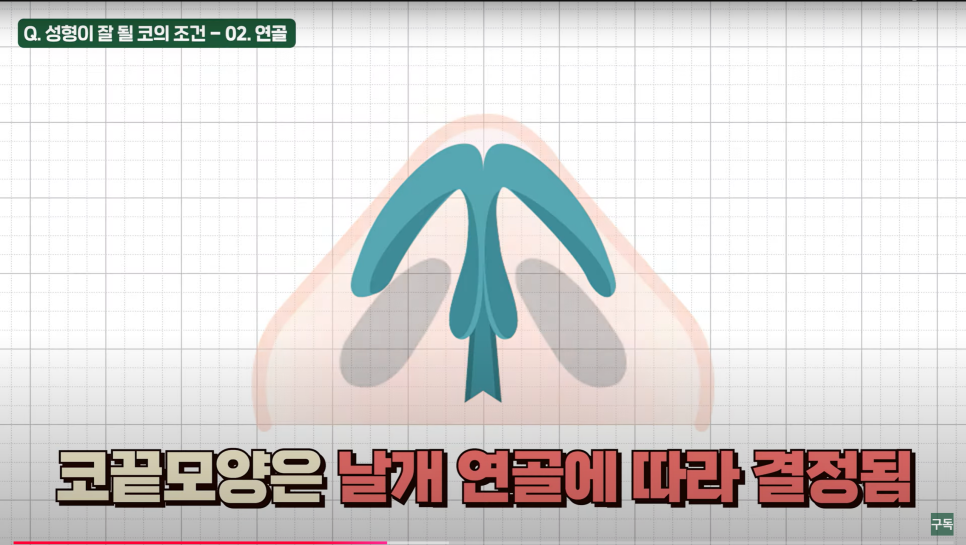
Even if the nose tip is low and wide, if the cartilage is well developed, you too can hit the jackpot with rhinoplasty!!
Condition 3: Nostrils
The third is the nostrils.
This may also be connected to cartilage,
but whether there is enough cartilage or not, the shape of the nostrils can affect rhinoplasty.
For example, people with heart-shaped nostrils like singer Henry,
or people with unusual nostril shapes such as a dragon nose, where the nostril flare is visible,
may still have limits to how much the shape can change even after surgeries like lowering the nose bridge.
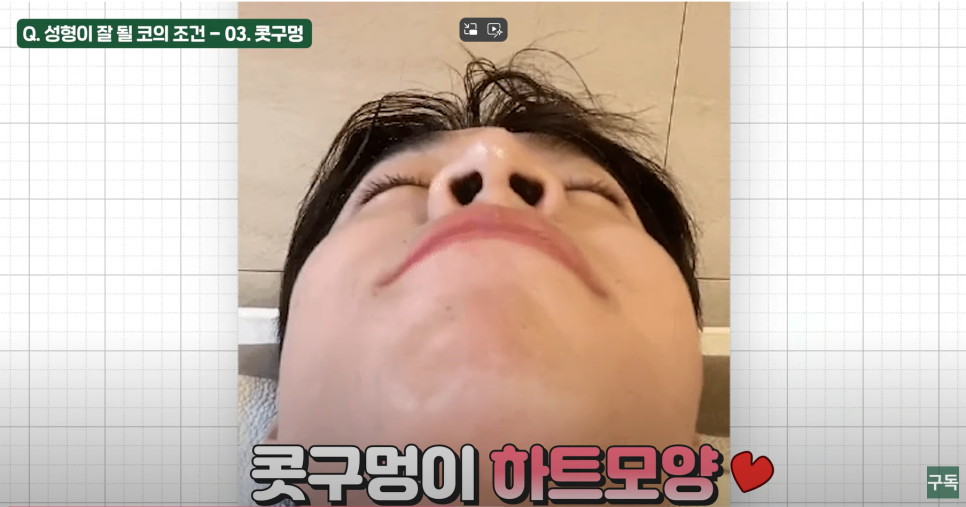
If you have symmetrical, round nostrils, then once again, you have a good chance of a big success with rhinoplasty.
Condition 4: The shape of the nose
Now, lastly, the shape of the nose.
You may think this is obvious, but once you hear the explanation, you’ll say, Ah, I see!!
Among various nose shapes, people with a hooked nose are actually one of the types that respond well to rhinoplasty.
Surprised?
If you simply adjust a nose tip that droops downward a little, the bridge already provides support, so the result can be much better.
If the hook is severe, just reshaping the bone and placing an implant on top can noticeably change the appearance.
And in the case of a small nose, you need to keep adding material,
but with a large nose, you can refine and remove unnecessary parts, and if needed, add more material.
Because the range of choices is so wide, the results are often good.

Therefore, if you feel that your nose is large compared to your face, it is quite possible that it will actually improve well after surgery.
In addition, some people may have a bent nasal bone, or may have been injured in the past and are worried because it became bumpy.
Compared with skin or cartilage, the nasal bone has many areas that can be corrected, so you may actually see a clear before-and-after difference.
So this is actually a big opportunity!!

Noses that are difficult to improve through surgery
So then, what kinds of noses are difficult to improve even after plastic surgery?
If you think about it simply, the opposite of a nose that responds well to surgery is a nose that does not.
Let me explain in a little more detail~
If your skin is thick and firm, and it does not stretch well!
Honestly, if you have this kind of skin quality and nose shape,
you may want to clear your mind a little before surgery and lower your expectations somewhat.
Also, when the bridge is wide, osteotomy is needed,
but because the width must be reduced while securing space for breathing, there are some limits to how much the nasal bone can be narrowed.
So there are many cases where the width cannot be reduced as much as hoped.
That doesn’t mean there is absolutely no method, so it’s also good not to be too disappointed in advance~
Still, for people with noses like this, it is extremely difficult to get a dramatic effect from the first surgery.
You’ve probably heard things like, “Revision rhinoplasty is essential,” or “Some kind of additional surgery is essential,” right?
Of course, that could be because of concerns about complications,
but if the first surgery goes well without problems, the skin and tissue will have stretched in line with the newly created nose shape.
This is called tissue expansion.
When a large wound is created by injury, one method in reconstructive surgery is to stretch the normal skin to cover the wound area and make up for the missing skin.

The same concept can also be applied to revision rhinoplasty.
If the first surgery creates some space and the tissue inside the nose tip heals well,
then the stretched skin becomes able to stretch a bit more again.
At that point, another surgery can be done to achieve a more desired shape.
Usually, people who say the second surgery was better than the first
are talking about how tissue expansion allowed the skin to stretch well and created more skin room~
That said, this does not mean you must always have revision surgery, so please do not misunderstand.
Very, very important
Whether to undergo a second surgery must absolutely be decided after consulting with a specialist.
Today, we looked at the conditions of noses that do or do not respond well to rhinoplasty,
but honestly, I also think it is a little difficult to judge these things for yourself at home.
And even if a nose is one that does not respond well to rhinoplasty, that does not mean there is no solution at all,
so please do not get scared in advance, and on the other hand, do not feel too at ease either~
It is best to make your decision based on the judgment given directly by a professional.
Also, opinions may differ depending on the surgeon, so I recommend visiting several places and getting advice from multiple angles.
This has been Merry Plastic Surgery Clinic.
If you want to see it in video form, meet us on Doctor Hong’s Merry TV~
If you need a consultation after reading the post and watching the video, come to Merry Plastic Surgery Clinic.